Levels of consciousness
意识层次理论
Levels of consciousness, or the topographic model, is Freud’s early map of the mind. It sorts mental contents into three systems (conscious, preconscious and unconscious) by whether, and how easily, they can enter awareness.[1][2]
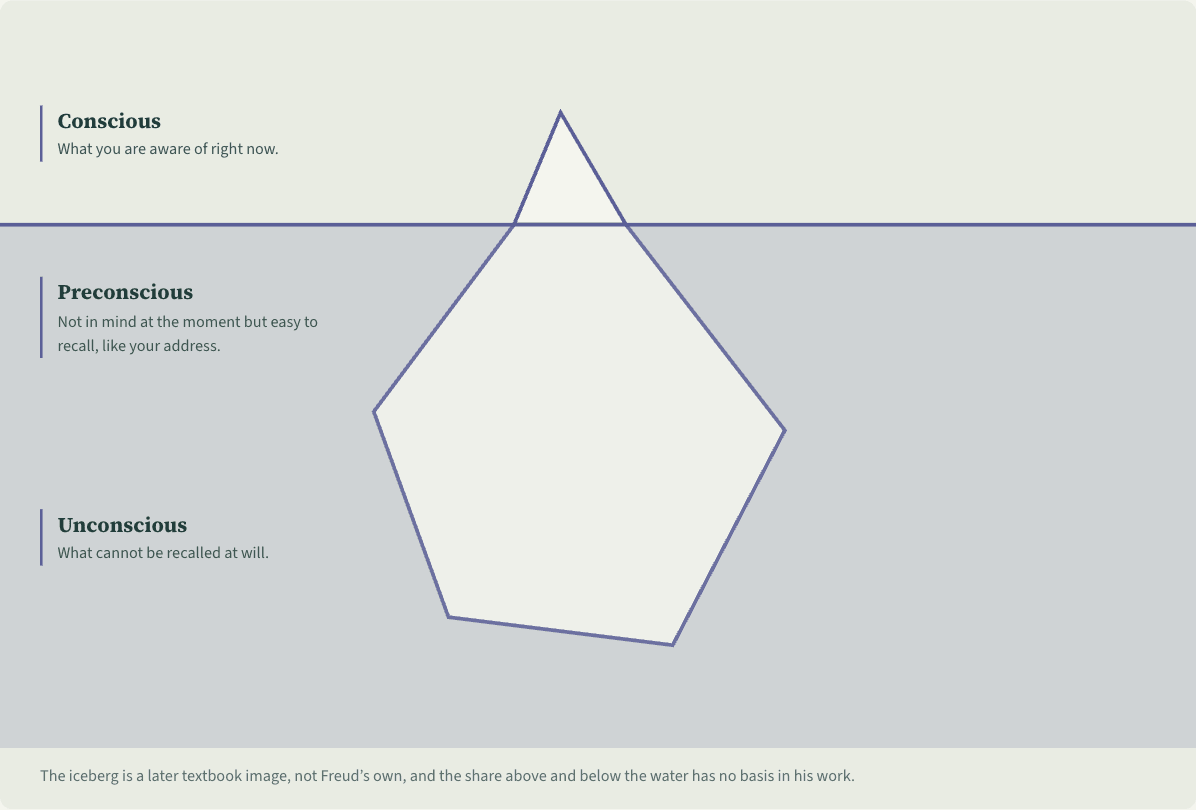
- Conscious What you are aware of right now.
- Preconscious Not in mind at the moment but easy to recall, like your address.
- Unconscious What cannot be recalled at will.
The iceberg is a later textbook image, not Freud’s own, and the share above and below the water has no basis in his work.
A slowly turning 3D iceberg in translucent water. Labels at the left: conscious above the water, preconscious at the waterline, unconscious below. A note says the iceberg is a later textbook image and its proportions have no basis.
 Save as image (PNG)
Key points
- The conscious is what you are aware of now; the preconscious is what you can easily recall, like your address; the unconscious is what you cannot recall at will.[2]
- Freud laid out the scheme in chapter 7 of The Interpretation of Dreams (1900) and used it as his main framework until 1923.[1]
- In The Ego and the Id (1923) he switched to the structural model of Id, ego and superego; the unconscious stopped being a separate system and was partly replaced by the id.[1]
- Experiments on implicit memory and subliminal emotion support the broad idea that much mental activity happens outside awareness, which is not the same as confirming Freud’s specific claims.[4]
An example
Asked for the name of her primary-school homeroom teacher, Ms. Wang pauses for a few seconds, then remembers it. The name was not on her mind, but she could retrieve it once prompted. In Freud’s scheme it sat in the preconscious.
Misreadings and limits
The popular iceberg picture, with consciousness as the visible tip and the unconscious below the waterline, is not Freud’s own image. He never mentioned an iceberg in his published writings; introductory psychology books later adopted it to explain his theory.[3]
Sources
- 1 Avzaradel, J. R., Furlong, A., Gammelgaard, J., & Papiasvili, E. D. (n.d.). The unconscious (tri-regional entry). IPA Inter-Regional Encyclopedic Dictionary of Psychoanalysis. International Psychoanalytical Association. View source
- 2 Britannica Editors (n.d.). Unconscious. Encyclopaedia Britannica. View source
- 3 Green, C. D. (2019). Where did Freud's iceberg metaphor of mind come from?. History of Psychology, 22(4), 369–372. View source
- 4 Westen, D. (1998). The scientific legacy of Sigmund Freud: Toward a psychodynamically informed psychological science. Psychological Bulletin, 124(3), 333–371. View source
Last checked against sources: October 26, 2026