Id, ego and superego
本我、自我与超我
Id, ego and superego are the three agencies in Freud’s structural model, set out in The Ego and the Id (1923): the id houses the drives, the ego represents external reality, and the superego carries internalized moral prohibitions and ideals.[1]
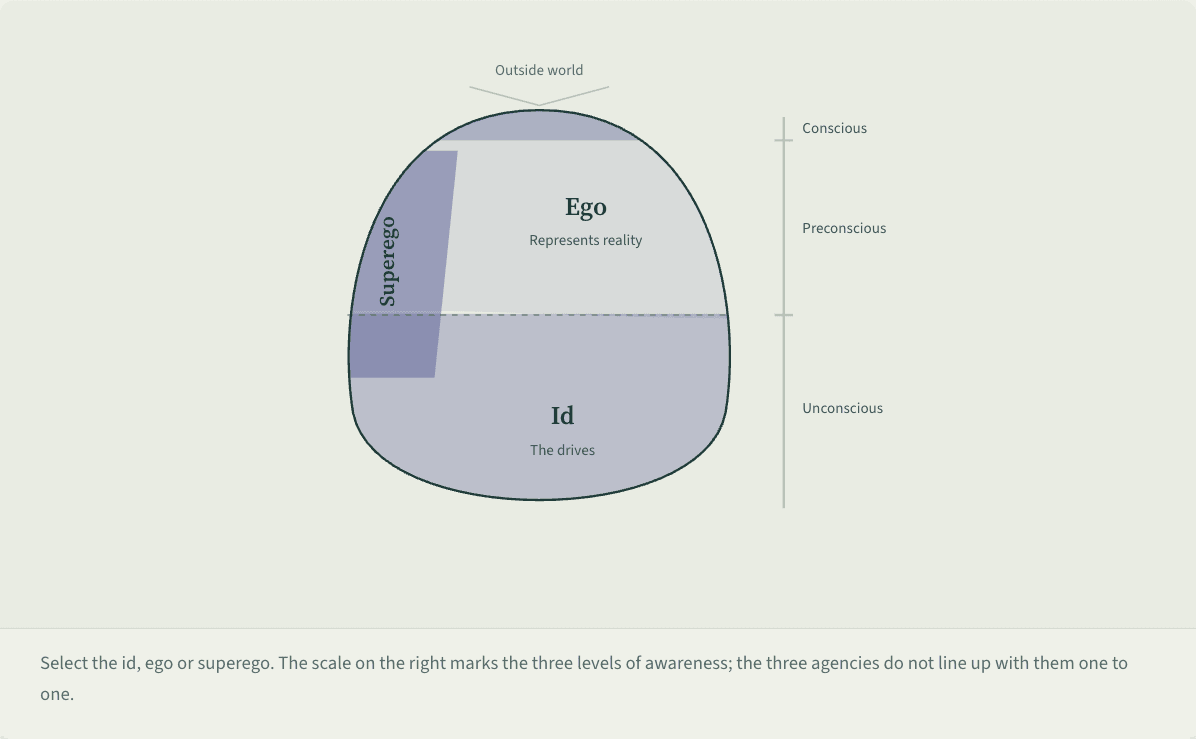
An egg-shaped outline. A thin strip at the top faces the outside world: the ego’s conscious surface. The upper half is the ego, with a slanted region on its left for the superego; the lower half is the id. A scale on the right reads conscious, preconscious and unconscious from top to bottom, and a dashed line shows the preconscious–unconscious boundary passing through the ego.
 Save as image (PNG)
Key points
- It replaced Freud’s earlier Levels of consciousness scheme: the unconscious was no longer treated as a separate system and was partly replaced by the id.[1]
- The three parts do not line up with layers of awareness. Freud held that the ego is mostly preconscious with a large unconscious part; only its perceptual surface is conscious.[1]
- Freud described the superego as a special grade of the ego and heir to the Oedipus complex, representing society’s internalized prohibitions and ideals.[1]
An example
Late at night Jay wants to order more takeout (the id’s urge), remembers his promise to save money this month (the superego’s demand), and settles on cooking noodles at home, a choice that takes reality into account, which Freud assigned to the ego as the representative of reality.
Misreadings and limits
The model is not current psychodynamic science. Westen notes that contemporary psychoanalysts rarely write about ids and egos and that many aspects of Freud’s theory are out of date; the ideas with research support are broader ones, such as unconscious processes and conflicting motives.[2]
Sources
- 1 Avzaradel, J. R., Furlong, A., Gammelgaard, J., & Papiasvili, E. D. (n.d.). The unconscious (tri-regional entry). IPA Inter-Regional Encyclopedic Dictionary of Psychoanalysis. International Psychoanalytical Association. View source
- 2 Westen, D. (1998). The scientific legacy of Sigmund Freud: Toward a psychodynamically informed psychological science. Psychological Bulletin, 124(3), 333–371. View source
Last checked against sources: October 26, 2026