Amnesia
遗忘症
Amnesia is a partial or total inability to recall past experiences. Retrograde amnesia affects events before the causative event; anterograde amnesia is the inability to store new memories after it.[1]
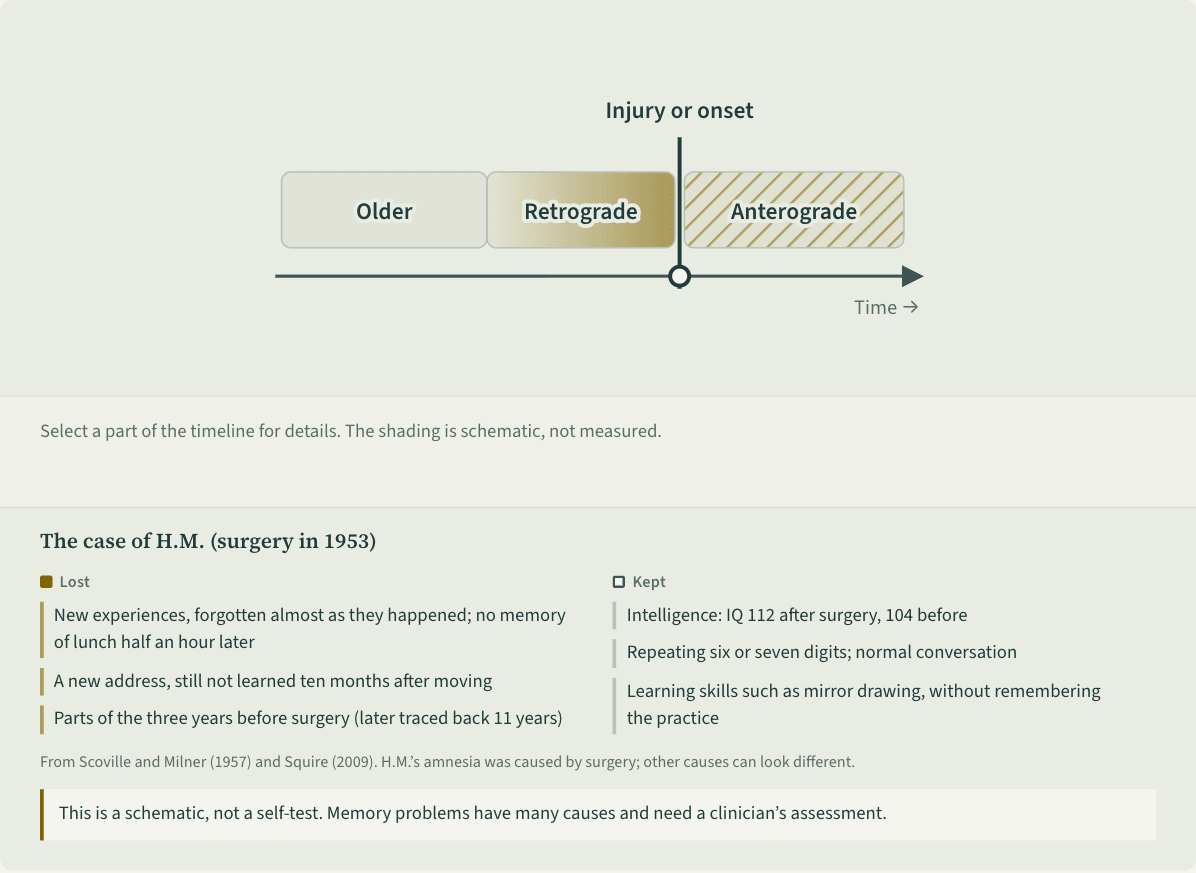
The case of H.M. (surgery in 1953)
Lost
- New experiences, forgotten almost as they happened; no memory of lunch half an hour later
- A new address, still not learned ten months after moving
- Parts of the three years before surgery (later traced back 11 years)
Kept
- Intelligence: IQ 112 after surgery, 104 before
- Repeating six or seven digits; normal conversation
- Learning skills such as mirror drawing, without remembering the practice
From Scoville and Milner (1957) and Squire (2009). H.M.’s amnesia was caused by surgery; other causes can look different.
This is a schematic, not a self-test. Memory problems have many causes and need a clinician’s assessment.
A timeline running left to right, with a vertical line right of center labeled “injury or onset.” The stretch just left of it is labeled “retrograde,” shaded more deeply near the line to show that memories closest to the event are most easily lost; further left, “older memories” is shaded lightest. The stretch right of the line is labeled “anterograde” and hatched, showing that new experiences after the event are not stored in long-term memory. Shading is schematic. Below, two columns for H.M. (surgery in 1953). Lost: new experiences forgotten almost as they happened, not remembering lunch half an hour later; still not knowing a new address ten months after moving; patchy loss of the three years before surgery, later traced back 11 years. Kept: intelligence (IQ 112 after surgery, 104 before); repeating six or seven digits and normal conversation; learning skills such as mirror drawing without remembering the practice.
 Save as image (PNG)
Key points
- Amnesia is a sign, not a single disease: brain injury, degenerative or metabolic disorders, seizures and psychological causes can all produce it, and diagnosis rests on clinical assessment.[1]
- In 1953 H.M. had parts of both medial temporal lobes removed to treat epilepsy; afterward he forgot daily events almost as they happened, though intelligence and digit span stayed normal.[2][3]
- His retrograde amnesia was milder: the first report described patchy loss for about three years before surgery with early memories intact; later testing put it at up to 11 years.[2][3]
- H.M. learned mirror drawing and kept the skill over three days, yet had no recollection of practicing: an early hint that the brain has more than one memory system.[3]
An example
Jay watches a film whose hero, after a blow to the head, forgets who he is yet soon builds a new life. Real cases can look almost the reverse: H.M.’s understanding and reasoning were intact, but half an hour after lunch he could not say what he had eaten, or that he had eaten at all.[2]
Misreadings and limits
Films often show amnesia as lost identity after a head injury, with new learning intact and a second blow as the cure. Baxendale finds most such portrayals unrealistic: in organic amnesia, identity and personality are usually unaffected and the main difficulty is taking in new information; true dissociative amnesia or fugue is rare.[4]
Sources
- 1 Huang, J. (2025). Amnesias. MSD Manual Professional Version (full review September 2025). View source
- 2 Scoville, W. B., & Milner, B. (1957). Loss of recent memory after bilateral hippocampal lesions. Journal of Neurology, Neurosurgery & Psychiatry, 20(1), 11–21. doi:10.1136/jnnp.20.1.11
- 3 Squire, L. R. (2009). The legacy of patient H.M. for neuroscience. Neuron, 61(1), 6–9. doi:10.1016/j.neuron.2008.12.023
- 4 Baxendale, S. (2004). Memories aren’t made of this: Amnesia at the movies. BMJ, 329(7480), 1480–1483. doi:10.1136/bmj.329.7480.1480
Last checked against sources: October 26, 2026