Myers-Briggs Type Indicator (MBTI)
MBTI 人格类型量表
The MBTI is a personality questionnaire developed by Katharine Cook Briggs and Isabel Briggs Myers from Carl Jung’s theory of psychological types. It assigns each person to one of 16 types based on four pairs of preferences.[1][2]
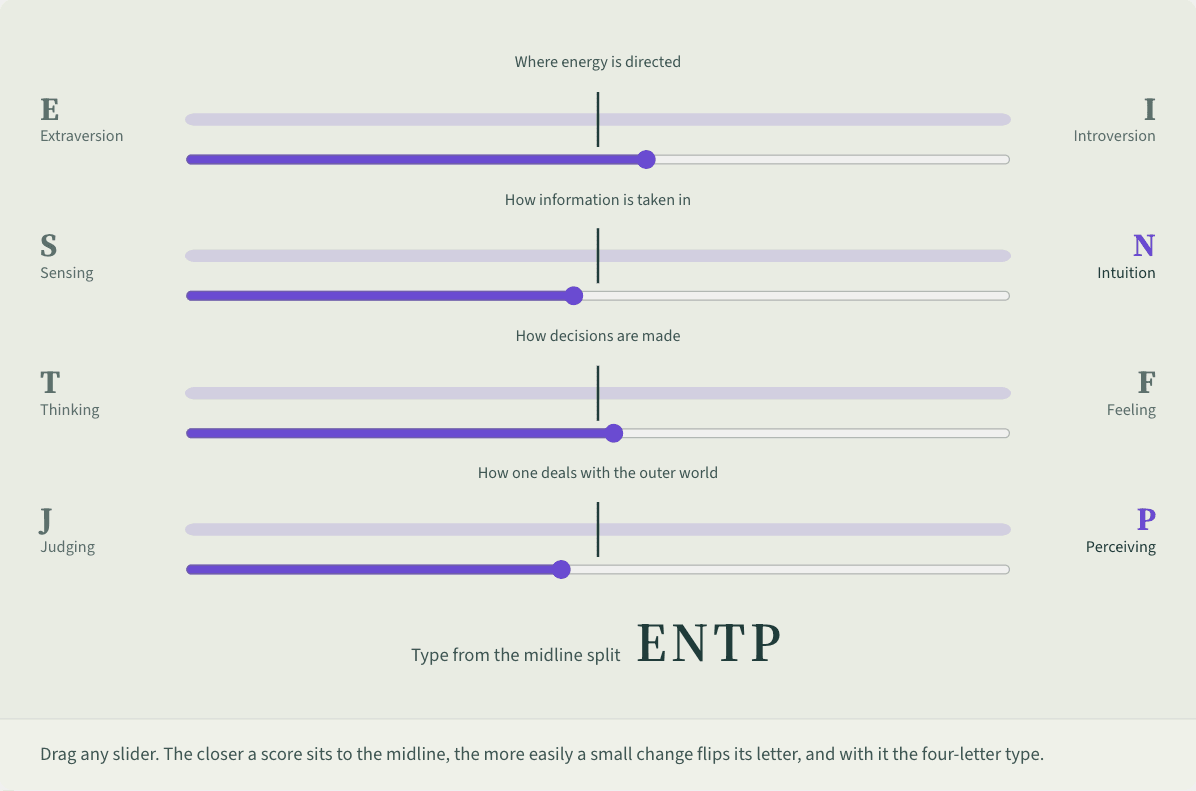
Type from the midline split
Four horizontal scales, E–I, S–N, T–F and J–P, each split by a vertical midline. Each has a draggable slider, and the four-letter type shown below changes when a slider crosses its midline.
 Save as image (PNG)
Key points
- The pairs cover where energy is directed (E/I), how information is taken in (S/N), how decisions are made (T/F), and how one deals with the outer world (J/P).[1]
- The first version was developed in 1943, and neither author was a psychologist. The Myers-Briggs Company publishes it today.[2]
- The publisher states that results describe preferences rather than ability and that the MBTI is not intended for selecting job candidates.[2]
- A 1989 study of 468 adults found the four scales correspond to four of the five Big Five personality traits dimensions and yield continuous scores rather than distinct types.[3]
An example
Ms. Wang’s team takes the MBTI at a workshop, and her result is INTJ. The facilitator asks everyone to talk about how they prefer to run meetings and share information, but no one’s role is assigned from the results.
Misreadings and limits
A common misreading treats the four letters as a fixed identity. By the publisher’s own figure, only about half of people get the same four-letter type on retest, and research does not support truly either-or categories.[2][3]
Sources
- 1 The Myers & Briggs Foundation (n.d.). The MBTI preferences. The Myers & Briggs Foundation. View source
- 2 The Myers-Briggs Company (n.d.). MBTI facts. The Myers-Briggs Company. View source
- 3 McCrae, R. R., & Costa, P. T., Jr. (1989). Reinterpreting the Myers-Briggs Type Indicator from the perspective of the five-factor model of personality. Journal of Personality, 57(1), 17–40. doi:10.1111/j.1467-6494.1989.tb00759.x
- 4 苗丹民, 皇甫恩, 等 (2000). MBTI人格类型量表的效度分析. 心理学报, 32(3), 324–331. View source Source for the Chinese name used on this page.
Last checked against sources: October 26, 2026