Big Five personality traits
大五人格
The Big Five is a trait model that organizes personality into five broad dimensions: openness, conscientiousness, extraversion, agreeableness, and neuroticism. Each broad dimension can be broken down into narrower traits.[1]
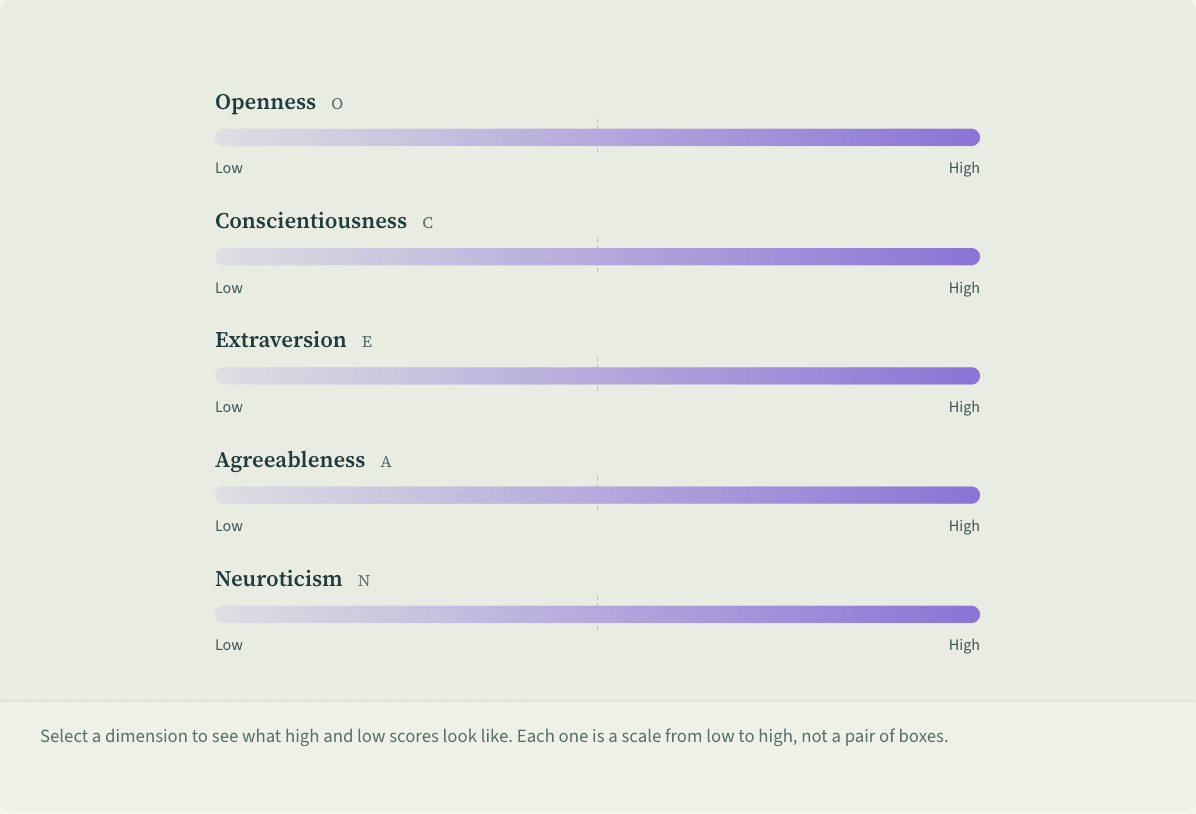
Five horizontal bars shading from light to dark, labeled Openness O, Conscientiousness C, Extraversion E, Agreeableness A and Neuroticism N, with low scores at the left, high scores at the right and a dashed midpoint line.
 Save as image (PNG)
Key points
- The five initials spell OCEAN: openness (O), conscientiousness (C), extraversion (E), agreeableness (A), and neuroticism (N).[1]
- Each dimension is a continuous score from low to high, so a result describes degree, not membership in a type.[1]
- A meta-analysis of behavior genetic studies covering more than 100,000 people attributed about 40% of individual differences in personality to genes.[2]
- A large replication project retested 78 links between traits and life outcomes; 87% were significant in the expected direction, though effects were typically about 77% as strong as first reported.[3]
An example
Lin completes a Big Five questionnaire and scores a little below average on extraversion and high on conscientiousness. She reads this as her position relative to other people, not as being “an introvert type,” and uses it to think about why she likes to plan ahead.
Misreadings and limits
Neuroticism, also called negative emotionality, runs from worrying, pessimistic and temperamental at the high end to calm and stable at the low end. Emotional stability is the low pole, so labeling neuroticism “emotional stability” reverses the scale.[3]
Sources
- 1 McCrae, R. R., & John, O. P. (1992). An introduction to the five-factor model and its applications. Journal of Personality, 60(2), 175–215. doi:10.1111/j.1467-6494.1992.tb00970.x
- 2 Vukasović, T., & Bratko, D. (2015). Heritability of personality: A meta-analysis of behavior genetic studies. Psychological Bulletin. doi:10.1037/bul0000017
- 3 Soto, C. J. (2019). How replicable are links between personality traits and consequential life outcomes? The Life Outcomes of Personality Replication Project. Psychological Science. doi:10.1177/0956797619831612
Last checked against sources: October 26, 2026