Erikson’s psychosocial stages
埃里克森心理社会发展阶段
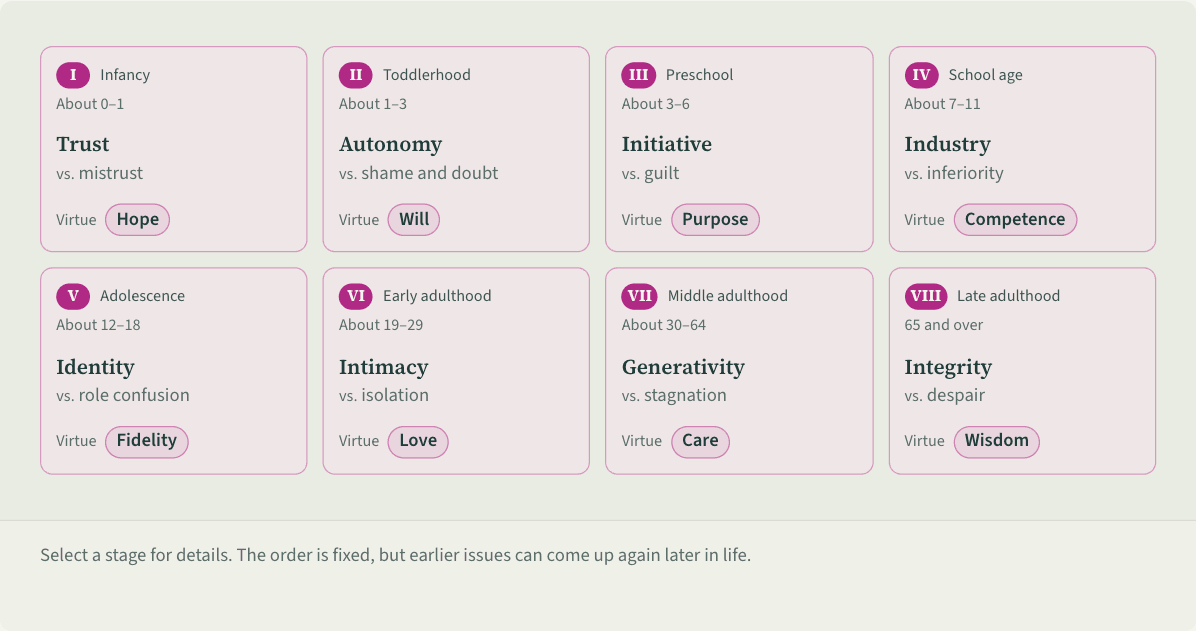
A theory of personality development across the whole life span, proposed by Erik Erikson in 1950. It divides life into eight stages, each posing a psychosocial crisis between two opposite tendencies; handling a crisis well yields a basic strength, or virtue.[1][3]
 Save as image (PNG)
Key points
- Erikson built on Freud’s psychosexual stages, added social influences, and extended development into old age.[3] He drew mainly on clinical cases and observations of Sioux and Yurok child rearing.[1]
- Each crisis pairs a positive and a negative tendency. The healthy outcome is not wiping out the negative pole but letting the positive one predominate while staying aware of its opposite.[3]
- The order of stages is fixed, but no issue is settled for good. People move on even when a crisis is unresolved, and later life events can reopen earlier issues.[3]
- Textbooks attach age bands, such as 12–18 for adolescence.[2] Erikson, however, described periods of life rather than fixed ages, so the bands are only approximate.[3]
An example
Ms. Wang, 48, has a child who just left for college. She now mentors new coworkers and spends weekends teaching older neighbors to use their phones, glad her experience is useful. In Erikson’s terms she is working on the middle-adulthood crisis of generativity versus stagnation: turning her energy toward the next generation and others.
Misreadings and limits
The eight stages are a descriptive framework drawn from clinical observation; the ages are rough, and earlier issues can resurface.[1][3] Using it to pinpoint where a problem began gives an interpretation, not a test result. A meta-analysis of 50 samples (over 20,000 people) also found that scores on the eight stages covary enough to form one general factor.[4]
Sources
- 1 Erikson, E. H. (1950). Childhood and society. W. W. Norton. View source
- 2 Spielman, R. M., Jenkins, W. J., & Lovett, M. D. (2020). Lifespan theories. Psychology 2e (section 9.2). OpenStax. View source
- 3 Orenstein, G. A., & Kaur, J. (2026). Erikson’s stages of psychosocial development. StatPearls. StatPearls Publishing (NCBI Bookshelf NBK556096). View source
- 4 Dunkel, C. S., & Harbke, C. (2017). A review of measures of Erikson’s stages of psychosocial development: Evidence for a general factor. Journal of Adult Development, 24, 58–76. doi:10.1007/s10804-016-9247-4
Last checked against sources: October 26, 2026