Sleep stages
睡眠阶段
Sleep is divided into three stages of non-rapid eye movement (NREM) sleep, N1 to N3, and rapid eye movement (REM) sleep. Each has its own brain-wave pattern, and the stages repeat in cycles through the night.[1][2]
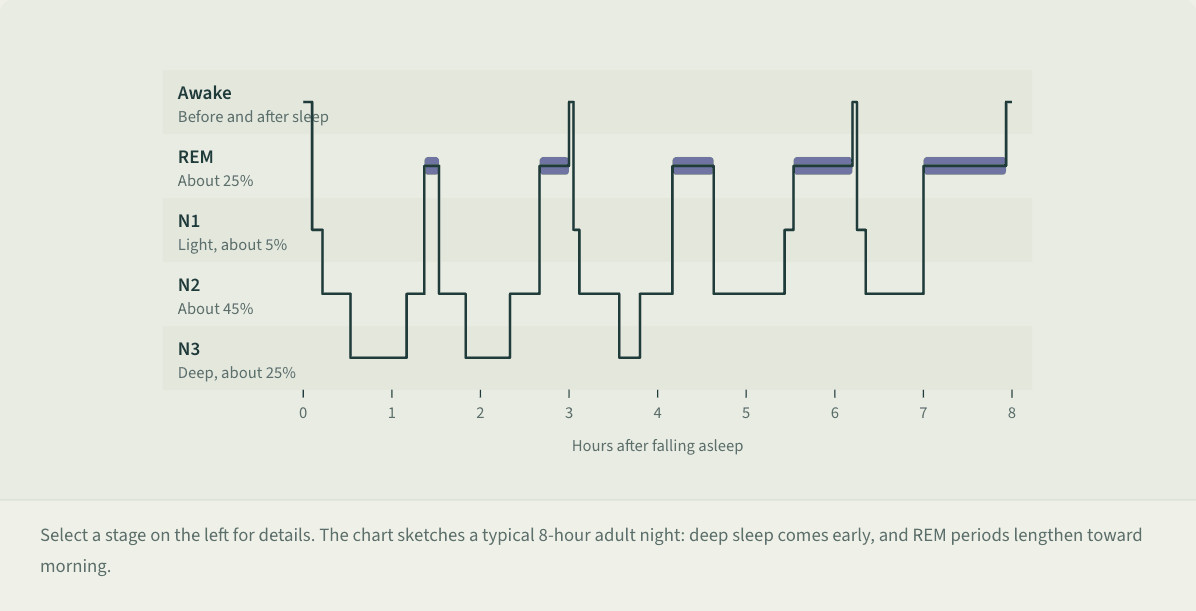
A stepped line over 0 to 8 hours after sleep onset, with rows from top to bottom for awake, REM, N1, N2 and N3. The line completes a cycle about every 90 minutes; the first two cycles reach N3 for long stretches, later ones do not reach it; REM segments are colored and grow from about 10 to about 60 minutes.
 Save as image (PNG)
Key points
- N1 is light sleep (about 5% of adult sleep); N2 brings sleep spindles and K-complexes (about 45%); N3, deep sleep, is dominated by slow, high-amplitude delta waves (about 25%).[1]
- REM (about 25%) brings rapid eye movements, wake-like brain waves and slack skeletal muscles except the eyes and diaphragm. People woken from REM usually report dreams.[1][3]
- Eugene Aserinsky and Nathaniel Kleitman first described REM periods in 1953; 20 of 27 awakenings during eye movements produced detailed dream reports.[3]
- A cycle averages about 90 minutes and repeats 4 to 6 times a night. Deep sleep dominates early; later, REM periods lengthen until morning sleep is mostly N1, N2 and REM.[1][2]
An example
Ms. Wang’s alarm goes off at 2 a.m. and she wakes groggy, with no dream to recall. At 6 a.m. she wakes on her own in the middle of a vivid dream. The first waking most likely came from deeper NREM sleep, the second from REM.
Misreadings and limits
REM sleep is often mistaken for deep sleep. The deepest stage is N3, with slow, high-amplitude delta waves. During REM the brain is nearly as active as when awake, and it is not considered a restful stage for the body.[1]
Sources
- 1 Patel, A. K., Reddy, V., Shumway, K. R., & Araujo, J. F. (2024). Physiology, sleep stages. StatPearls. StatPearls Publishing (NCBI Bookshelf NBK526132). View source
- 2 Eunice Kennedy Shriver National Institute of Child Health and Human Development (2019). What happens during sleep?. NICHD, National Institutes of Health. View source
- 3 Aserinsky, E., & Kleitman, N. (1953). Regularly occurring periods of eye motility, and concomitant phenomena, during sleep. Science, 118, 273–274. View source
Last checked against sources: October 26, 2026