Parenting styles
父母教养方式
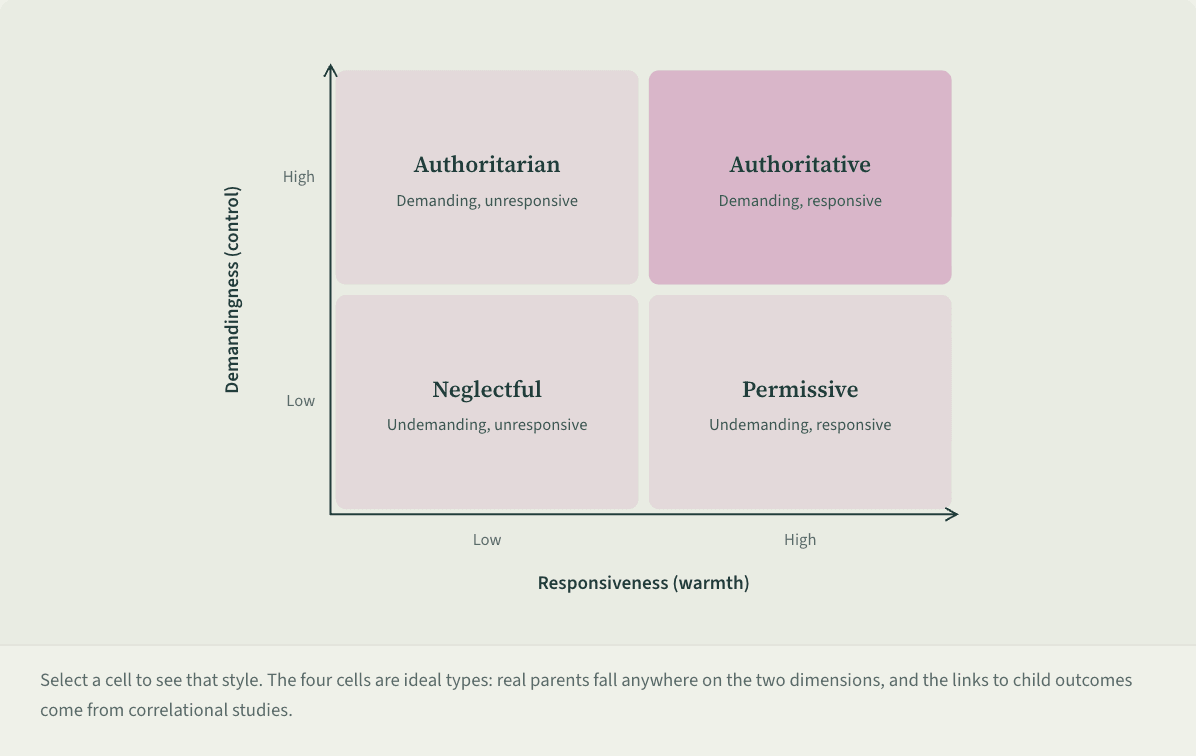
Parenting style is the overall way parents raise a child. Baumrind described authoritative, authoritarian and permissive styles in the 1960s; Maccoby and Martin (1983) crossed two dimensions, demandingness and responsiveness, into four styles, adding a neglectful one.[1]
A two-by-two grid. The horizontal axis runs from low to high responsiveness, the vertical from low (bottom) to high (top) demandingness. Top left authoritarian (demanding, unresponsive), top right authoritative (demanding, responsive; shaded darker), bottom left neglectful (undemanding, unresponsive), bottom right permissive (undemanding, responsive).
 Save as image (PNG)
Key points
- Authoritative is not the strict one: it pairs clear demands with warmth and responsiveness. The style that demands obedience with little responsiveness is authoritarian.[1]
- In studies, children of authoritative parents show the best psychosocial competence and grades, those of neglectful parents the worst; authoritarian parenting tracks aggression and anxiety, permissive findings are mixed.[1]
- A meta-analysis of 428 studies found more similarities than differences across regions: everywhere, authoritative parenting went with at least one good outcome and authoritarian with at least one poor one.[2]
- Chao argued that “authoritarian” misses the Chinese idea of “training”; yet China Family Panel Studies data still show the best grades and mental health among children of authoritative parents.[3][4]
An example
Lin’s daughter wants her tablet right after school. Lin says homework comes first, listens to why she is so tired today, and they agree on 15 minutes of play first: close to authoritative. “Because I said so” would lean authoritarian; letting her play until bedtime, permissive; never asking at all, neglectful.
Misreadings and limits
Most of this evidence is correlational, so it does not show that a style causes a child’s outcomes. Influence runs both ways: parents may punish less because their children have fewer problems. The four boxes are ideal types; real parents fall anywhere along the two dimensions.[1]
Sources
- 1 Kuppens, S., & Ceulemans, E. (2019). Parenting styles: A closer look at a well-known concept. Journal of Child and Family Studies, 28(1), 168–181. doi:10.1007/s10826-018-1242-x
- 2 Pinquart, M., & Kauser, R. (2018). Do the associations of parenting styles with behavior problems and academic achievement vary by culture? Results from a meta-analysis. Cultural Diversity and Ethnic Minority Psychology, 24(1), 75–100. doi:10.1037/cdp0000149
- 3 Chao, R. K. (1994). Beyond parental control and authoritarian parenting style: Understanding Chinese parenting through the cultural notion of training. Child Development, 65(4), 1111–1119. doi:10.1111/j.1467-8624.1994.tb00806.x
- 4 张皓辰, & 秦雪征 (2019). 父母的教养方式对青少年人力资本形成的影响. 财经研究, 45(2), 46–58. doi:10.16538/j.cnki.jfe.2019.02.004
Last checked against sources: October 26, 2026