Attachment theory
依恋理论
Attachment theory was proposed by John Bowlby and developed jointly with Mary Ainsworth. It holds that infants have an evolved system of attachment behavior that keeps them close to a caregiver, and that its function is protection.[1][3]
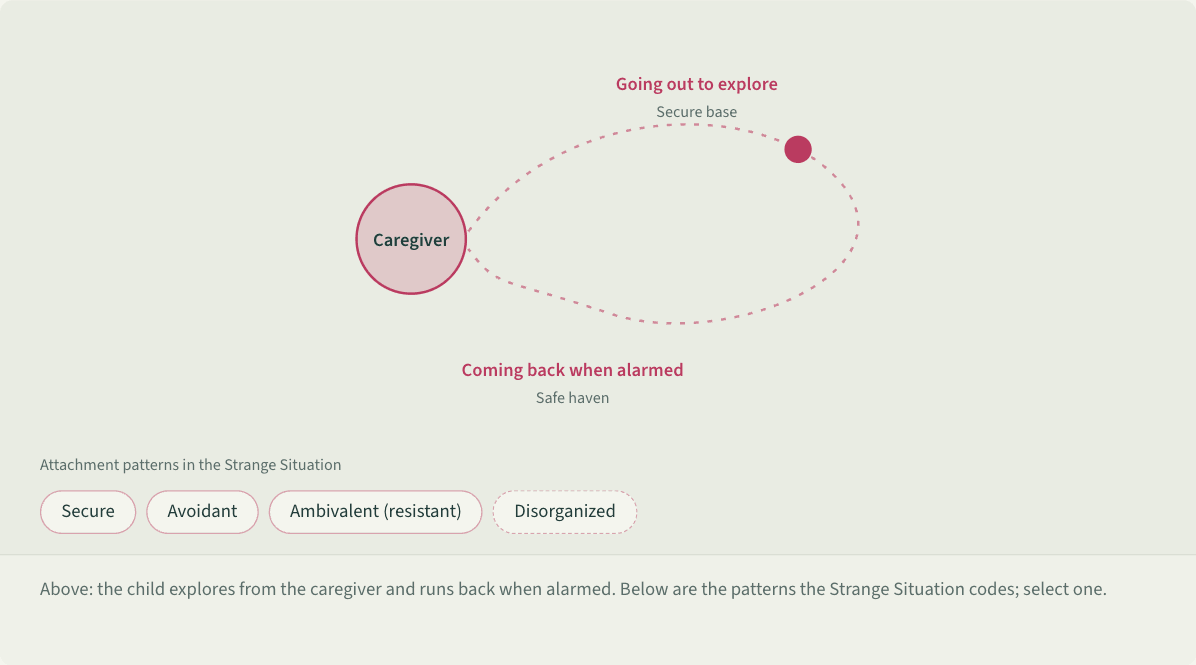
Attachment patterns in the Strange Situation
A large circle for the caregiver; a small circle for the child loops out along a dashed path, pauses, then hurries back. The outbound arc is labeled exploring (secure base), the return labeled coming back when alarmed (safe haven). Below are four buttons: secure, avoidant, ambivalent (resistant) and disorganized.
 Save as image (PNG)
Key points
- A caregiver serves both as a secure base for exploring and as a safe haven the child returns to for comfort when frightened.[3]
- Ainsworth’s Strange Situation, a 20-minute procedure in eight episodes, observes how infants respond when a caregiver leaves and comes back.[2][3]
- It originally sorted infants into secure, avoidant and ambivalent (resistant) patterns; Main and Solomon later added a disorganized category.[4]
- Bowlby held that attachment behavior continues across life and is not a childish regression; early experience shapes “internal working models” of self and of attachment figures.[1][3]
An example
Ms. Wang’s 18-month-old son is stacking blocks at a relative’s home, glancing back at her now and then. When a dog barks loudly outside, he runs to her lap, calms down, and goes back to his blocks. His mother is both his starting point for exploring and his refuge when scared.
Misreadings and limits
Researchers stress that disorganized attachment describes a child’s relationship with one particular caregiver, not a fixed trait of the child. It is not a clinical diagnosis, cannot be used to screen for maltreatment, and only modestly predicts later problems.[4]
Sources
- 1 Bowlby, J. (1969). Attachment and loss: Vol. 1. Attachment. Basic Books. View source
- 2 Ainsworth, M. D. S., Blehar, M. C., Waters, E., & Wall, S. (1978). Patterns of attachment: A psychological study of the strange situation. Lawrence Erlbaum (reissued 2015, Psychology Press Classic Editions). View source
- 3 Bretherton, I. (1992). The origins of attachment theory: John Bowlby and Mary Ainsworth. Developmental Psychology, 28(5), 759–775. View source
- 4 Granqvist, P., Sroufe, L. A., Dozier, M., Hesse, E., Steele, M., van IJzendoorn, M., Solomon, J., et al. (2017). Disorganized attachment in infancy: A review of the phenomenon and its implications for clinicians and policy-makers. Attachment & Human Development, 19(6), 534–558. doi:10.1080/14616734.2017.1354040
Last checked against sources: October 26, 2026