Sensitive periods
敏感期
A sensitive period is a limited time in development when experience has an unusually strong effect on a neural circuit. When that experience is essential for normal development and its effects cannot be reversed, the period is called a critical period, a special case of sensitive period.[1]
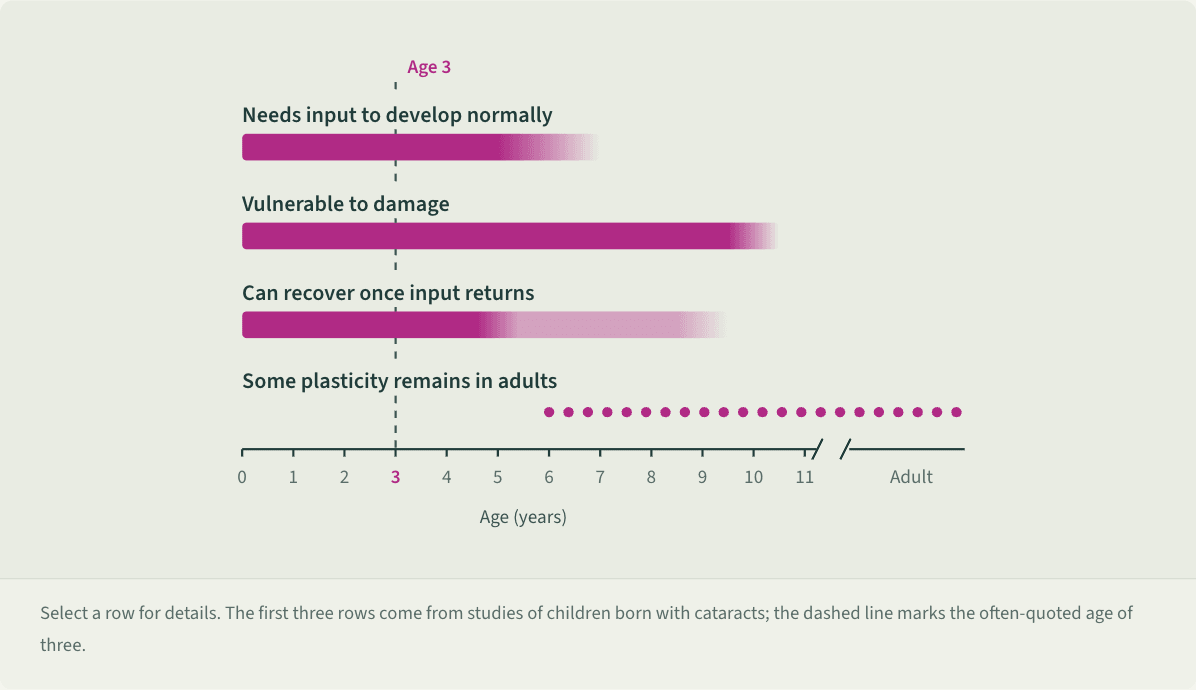
A horizontal age axis from birth to 11 years, with a separate segment at the right for adulthood. Three bars show sensitive periods for human visual acuity: needing visual input to develop normally, from birth to about 5–7 years; vulnerable to damage, to about 10; able to recover once input returns, dark to about 5 (fine detail) and pale to about 9 (coarse patterns). A fourth row is a dotted line from about 6 years into adulthood, marking residual plasticity (schematic). A vertical dashed line at age 3 is crossed by all three bars.
 Save as image (PNG)
Key points
- Different circuits have their sensitive periods at different ages: those for basic sensory analysis end early, those for language or reading facial expressions much later.[2]
- Human visual acuity alone has at least three: normal development runs to about 5–7 years, vulnerability to damage to about 10, and the capacity to recover to about 5–9.[3]
- “The critical period for language” is too simple: circuits for phonetic analysis pass through sensitive periods, while those for word meaning stay plastic throughout life.[1]
- In animals, maturing inhibitory neurons open critical periods and “brakes” such as perineuronal nets and myelin close them; lifting the brakes restores some plasticity in adults.[4]
An example
Jay started Japanese at 30. Years later his vocabulary and grammar are solid, yet colleagues in Japan can tell at once that he is not a native speaker. His six-year-old daughter, after a year at a Tokyo school, already sounds like her classmates. This fits findings that speech-sound circuits have sensitive periods while word learning stays plastic.
Misreadings and limits
The most common misreading is that once a window closes, learning becomes impossible. The National Scientific Council on the Developing Child calls claims that it closes at age three unfounded; for most functions it stays open well beyond. Many circuits remain substantially plastic after their sensitive period, though change is harder.[1][2]
Sources
- 1 Knudsen, E. I. (2004). Sensitive periods in the development of the brain and behavior. Journal of Cognitive Neuroscience, 16(8), 1412–1425. doi:10.1162/0898929042304796
- 2 National Scientific Council on the Developing Child (2007). The timing and quality of early experiences combine to shape brain architecture (Working Paper No. 5). Center on the Developing Child, Harvard University. View source
- 3 Maurer, D., & Lewis, T. L. (2013). Sensitive periods in visual development. In P. D. Zelazo (Ed.), The Oxford handbook of developmental psychology, Vol. 1: Body and mind. Oxford University Press. doi:10.1093/oxfordhb/9780199958450.013.0008
- 4 Hensch, T. K., & Bilimoria, P. M. (2012). Re-opening windows: Manipulating critical periods for brain development. Cerebrum: The Dana Forum on Brain Science, 2012, 11. View source
Last checked against sources: October 26, 2026