Piaget’s theory of cognitive development
皮亚杰认知发展理论
Jean Piaget’s theory of how thinking develops. Children adapt to their surroundings by adjusting mental schemas through assimilation and accommodation, and their thinking passes through four stages that differ in fundamental ways: sensorimotor, preoperational, concrete operational, and formal operational.[1][4]
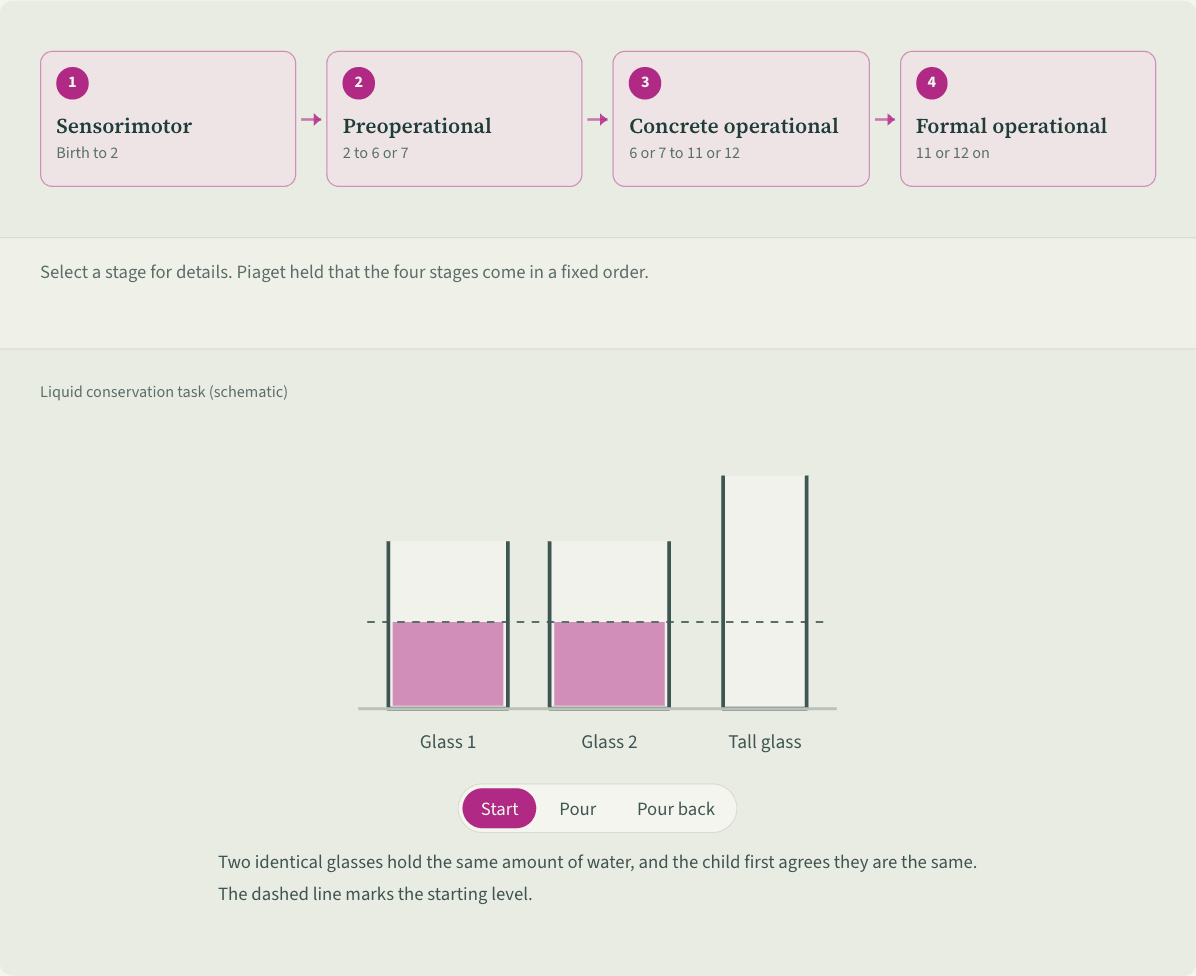
Liquid conservation task (schematic)
Two identical glasses hold the same amount of water, and the child first agrees they are the same. The dashed line marks the starting level. Glass 2 is poured into the tall glass and the level rises. A preoperational child often says, “This one has more because it’s higher.” A concrete operational child says they are the same: “It’s taller but thinner,” or “Pour it back and it’s the same.” Poured back into its own glass, the water matches glass 1 again. A child who grasps reversibility can predict this without seeing it done.
At the top, four stage buttons in order: 1 sensorimotor (birth to 2), 2 preoperational (2 to 6 or 7), 3 concrete operational (6 or 7 to 11 or 12), 4 formal operational (11 or 12 on). Below, a conservation task: two identical short glasses with water at the same height, an empty tall thin glass beside them, and a dashed line at the starting level. Three buttons step through it: both glasses equal; glass 2 poured into the tall glass, where the water rises well above the line; poured back, where it returns to the line.
 Save as image (PNG)
Key points
- Schemas are mental structures for organizing experience. A toddler calling a sheep a “dog” is assimilating; building a new “sheep” schema after correction is accommodating. Piaget saw adaptation as balancing both.[1][3]
- Sensorimotor infants know the world through perception and action; preoperational children use symbols but fix on one dimension; concrete operational children reason about concrete things; formal operational thinkers reason abstractly.[3][4]
- In conservation tasks, children under 7 usually say water poured into a taller, thinner glass is now more. Piaget held that their perception was not yet corrected by “taller but thinner.”[2][4]
- Piaget’s method paired hands-on tasks with open conversation, following up on each child’s own answers to probe the mechanisms behind their thinking.[2]
An example
Jay splits a carton of juice between two identical cups, and his 4-year-old daughter and 8-year-old son agree they hold the same. When he pours her cup into a tall, thin glass, she says she now has more. Her brother shrugs: “It’s the same. Pour it back and you’ll see.”
Misreadings and limits
Later research found that many abilities appear earlier than Piaget thought: 3- to 4-month-olds look longer when an object seems to vanish, and development looks more continuous than neat stages.[3][4] Experience and culture matter too. Children of Mexican potters grasp earlier that reshaped clay keeps its amount, and formal operations may be largely absent where schooling in scientific reasoning is lacking.[4]
Sources
- 1 Piaget, J. (1952). The origins of intelligence in children (M. Cook, Trans.). International Universities Press. doi:10.1037/11494-000
- 2 Piaget, J. (1952). The child’s conception of number (C. Gattegno & F. M. Hodgson, Trans.). Routledge & Kegan Paul (original work published 1941). doi:10.4324/9781315006222
- 3 Spielman, R. M., Jenkins, W. J., & Lovett, M. D. (2020). Lifespan theories. Psychology 2e (section 9.2). OpenStax. View source
- 4 Siegler, R. (2026). Cognitive development in childhood. In R. Biswas-Diener & E. Diener (Eds.), Noba textbook series: Psychology. DEF Publishers. View source
Last checked against sources: October 26, 2026