Gateway hypothesis
门户理论
What is the gateway hypothesis?
The gateway hypothesis holds that people typically use “gateway” substances such as alcohol, tobacco or cannabis before other illicit drugs such as heroin or cocaine, and that the earlier ones raise the risk of the later ones.[2][3] It grew out of Denise Kandel’s 1975 surveys of teenage drug use.[1]
The observed order
- Beer or wine
- Cigarettes or hard liquor
- Cannabis
- Other illicit drugs
Three explanations
Evidence
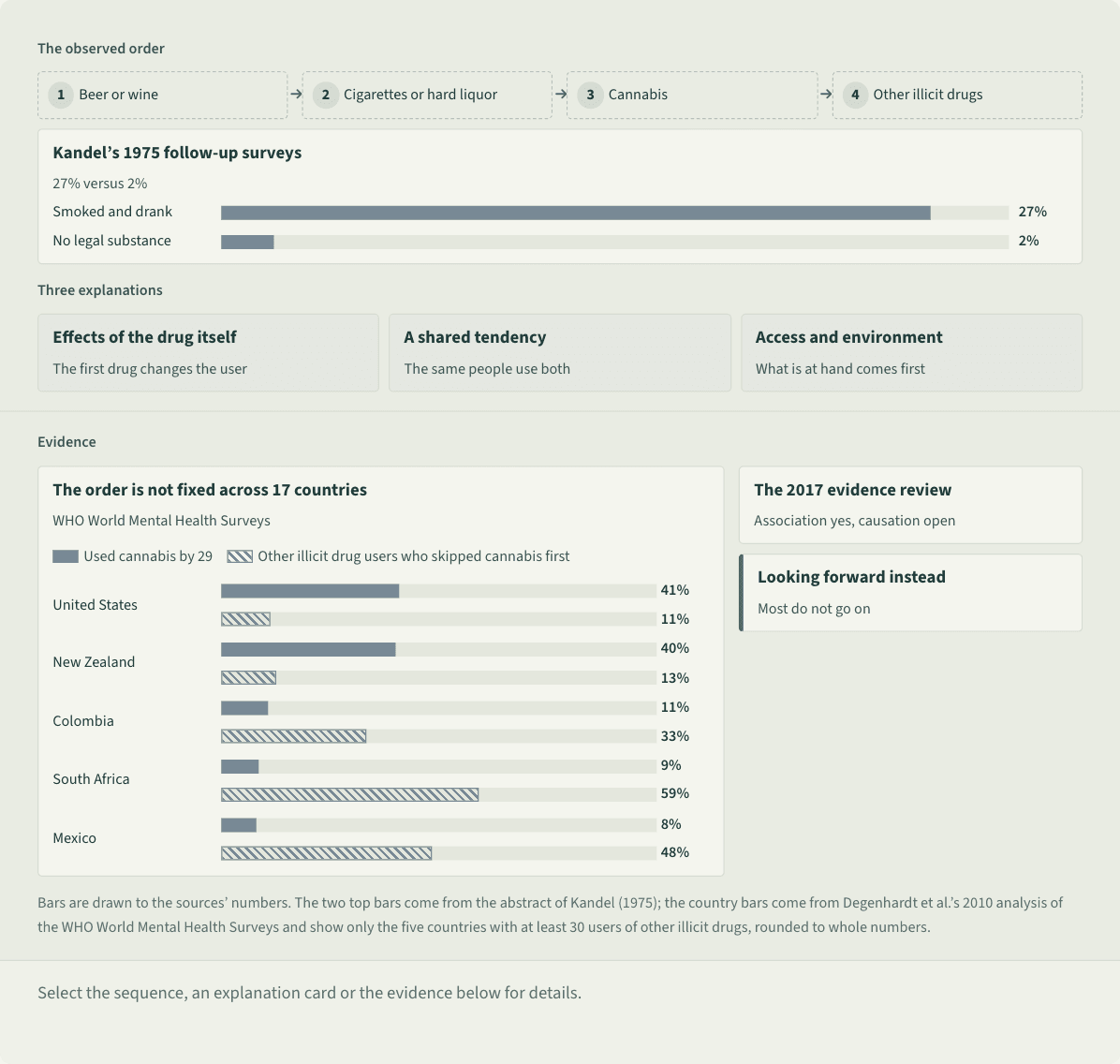
Bars are drawn to the sources’ numbers. The two top bars come from the abstract of Kandel (1975); the country bars come from Degenhardt et al.’s 2010 analysis of the WHO World Mental Health Surveys and show only the five countries with at least 30 users of other illicit drugs, rounded to whole numbers.
Top: four boxes joined by arrows in sequence: beer or wine, cigarettes or hard liquor, cannabis, other illicit drugs. Below them, two bars compare the share who started cannabis within about half a year: 27% of high school students who smoked and drank versus 2% of those who used no legal substance. Middle: three cards for three explanations: effects of the drug itself, a shared tendency, and access and environment. Bottom left: paired bars for five countries, the left bar the share who had used cannabis by age 29 and the right bar the share of other illicit drug users who had not used cannabis first: United States 41% and 11%, New Zealand 40% and 13%, Colombia 11% and 33%, Mexico 8% and 48%, South Africa 9% and 59%. Bottom right: two cards, the 2017 National Academies evidence review (moderate evidence of association, causation unsettled) and the point that most people who have used cannabis do not go on to other substances.
 Save as image (PNG)
This figure image is licensed CC BY 4.0: reuse it with credit and a link back to this page. How to reuse
Key points
- From two follow-up surveys of New York State high school students, Kandel described four stages: beer or wine, cigarettes or hard liquor, cannabis, then other illicit drugs.[1]
- A 2017 National Academies report found moderate evidence that cannabis use is associated with later dependence on alcohol, tobacco or other illicit drugs; whether this is causal remains to be studied.[2]
- In 17-country WHO surveys the order varied with local use: in Mexico, where cannabis is rarer, 48% of other illicit drug users had not used it first; in the US, 11%.[3]
- Other explanations fit too: cannabis is easier to get, and its risk factors resemble those for other drugs.[2][4] Cannabis may also cause brain changes that raise the risk of other addictions.[4]
An example
Ms. Wang reads online that “almost every drug user started with cannabis” and fears her college-age son will slide toward heroin if he ever tries it. That claim looks backward; looking forward, most people who have used cannabis do not go on to other substances,[4] and cannabis may come first simply because it is easier to get.[2]
Misreadings and limits
A common misreading is that most cannabis users move on to other drugs. In the US, nearly nine in ten users of other illicit drugs had used cannabis first,[3] but most people who have used cannabis do not go on to use other substances.[4] The sequence and association are robust; how much of it is causal is unresolved.[2][3]
Sources
- 1 Kandel, D. (1975). Stages in adolescent involvement in drug use. Science, 190(4217), 912–914. doi:10.1126/science.1188374
- 2 National Academies of Sciences, Engineering, and Medicine (2017). Cannabis use and the abuse of other substances. In The health effects of cannabis and cannabinoids: The current state of evidence and recommendations for research (pp. 357–376). The National Academies Press. doi:10.17226/24625
- 3 Degenhardt, L., Dierker, L., Chiu, W. T., Medina-Mora, M. E., Neumark, Y., Sampson, N., Alonso, J., Angermeyer, M., Anthony, J. C., Bruffaerts, R., de Girolamo, G., de Graaf, R., Gureje, O., Karam, A. N., Kostyuchenko, S., Lee, S., Lépine, J.-P., Levinson, D., Nakamura, Y., … Kessler, R. C. (2010). Evaluating the drug use “gateway” theory using cross-national data: Consistency and associations of the order of initiation of drug use among participants in the WHO World Mental Health Surveys. Drug and Alcohol Dependence, 108(1–2), 84–97. doi:10.1016/j.drugalcdep.2009.12.001
- 4 National Institute on Drug Abuse (2024). Cannabis (marijuana). National Institutes of Health. View source
Last checked against sources: October 28, 2026