Substance use disorders and addiction
物质使用障碍与成瘾
What are substance use disorders and addiction?
Substance use disorders involve repeated use of alcohol, drugs or other psychoactive substances that impairs control, takes priority over other things and continues despite harm, or that has clearly damaged health.[1][2] ICD-11 lists similar problems with gambling and video gaming as disorders due to addictive behaviors.[1]
ICD-11 (alcohol as the example; not fixed stages)
DSM-5: criteria met (out of 11)
Addictive behaviors in ICD-11
Schematic, not a self-test.
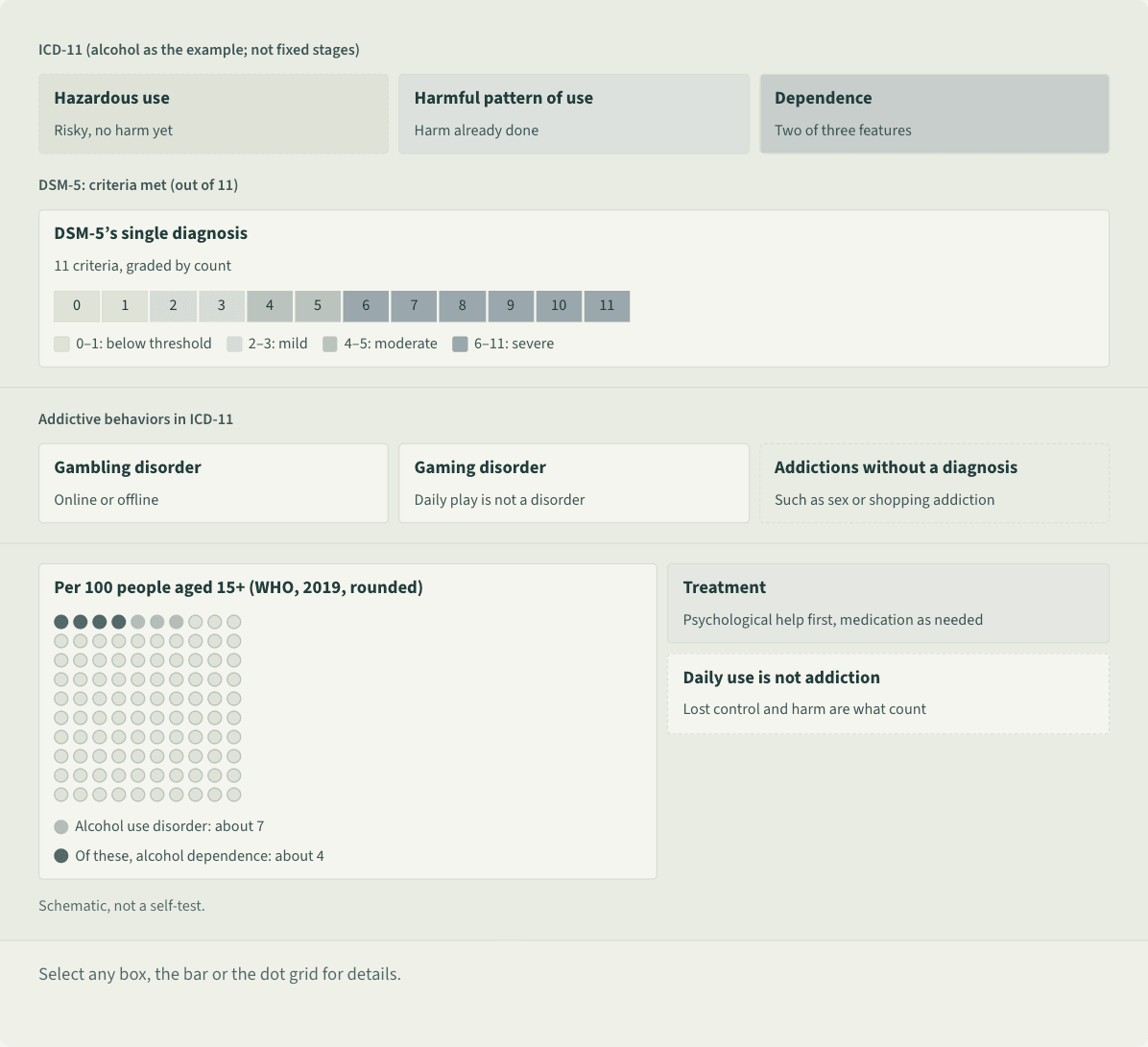
Schematic. Across the top, three columns: hazardous use (risk but no harm yet, not a mental disorder), harmful pattern of use (has damaged health or harmed others) and dependence (at least two of impaired control, rising priority and physiological adaptation). Below them, a bar in four segments shows the 11 DSM-5 substance use disorder criteria: 0 to 1 is below the threshold, 2 to 3 mild, 4 to 5 moderate, 6 or more severe. In the middle, three boxes: gambling disorder, gaming disorder, and addictions with no diagnosis of their own (such as sex addiction, which falls under compulsive sexual behavior disorder). Below, a grid of 100 dots has 7 colored for people with an alcohol use disorder, 4 of them darker for alcohol dependence. Beside it, two boxes: treatment, and daily use is not the same as addiction. A note says the figure is schematic and not a self-test.
 Save as image (PNG)
This figure image is licensed CC BY 4.0: reuse it with credit and a link back to this page. How to reuse
Key points
- ICD-11 separates a harmful pattern of use from dependence.[1] DSM-5 has a single substance use disorder, diagnosed when two of 11 criteria are met within a year.[2]
- ICD-11 recognizes two behavioral addictions: gambling and gaming disorder. “Sex addiction” falls under compulsive sexual behavior disorder, an impulse control disorder; shopping and the like have no separate diagnosis.[1]
- WHO estimates that 7% of people aged 15 or over, 400 million, have an alcohol use disorder; where data exist, under 1% to at most 14% are in contact with treatment.[3]
- NICE’s alcohol guideline starts with motivational interviewing, then therapy such as CBT; moderate to severe dependence may add medication after withdrawal, and harm reduction suits severe cases unwilling to stop.[4]
An example
Jay drinks most nights after work, often meaning to stop at two beers but going on past midnight, and he skips weekend games with friends. At a checkup his doctor flags abnormal liver tests. He has tried cutting back without success. Whether this is an alcohol use disorder is for a doctor to judge, looking at control, priority and harm.[1]
Misreadings and limits
Drinking or gaming every day is not in itself addiction, and tolerance or withdrawal from prescribed pain medication is not dependence; what matters is lost control and harm.[1][2] This page is not for self-diagnosis. If cutting down keeps failing, a doctor can help; heavy daily drinkers can have serious withdrawal on stopping and should be assessed first.[4]
If you need help now
If you’re struggling to cope or having thoughts of harming yourself:
- US and Canada: call or text 988 (24/7)
- UK and Ireland: Samaritans, 116 123 (free, 24/7)
- Australia: Lifeline, 13 11 14 (24/7)
- Elsewhere: findahelpline.com
If you’re in immediate danger, call your local emergency number.
Psyfield is not a crisis service. Numbers checked October 2026.
Sources
- 1 World Health Organization (2025). Disorders due to substance use or addictive behaviours: 6C40 Disorders due to use of alcohol; 6C50 Gambling disorder; 6C51 Gaming disorder; 6C72 Compulsive sexual behaviour disorder. ICD-11 for mortality and morbidity statistics (2025-01 release). View source
- 2 Hasin, D. S., O’Brien, C. P., Auriacombe, M., Borges, G., Bucholz, K., Budney, A., Compton, W. M., Crowley, T., Ling, W., Petry, N. M., Schuckit, M., & Grant, B. F. (2013). DSM-5 criteria for substance use disorders: Recommendations and rationale. American Journal of Psychiatry, 170(8), 834–851. doi:10.1176/appi.ajp.2013.12060782
- 3 World Health Organization (2024). Alcohol. WHO fact sheet (June 28, 2024). View source
- 4 National Institute for Health and Care Excellence (2011). Alcohol-use disorders: Diagnosis, assessment and management of harmful drinking (high-risk drinking) and alcohol dependence (CG115). NICE clinical guideline (last updated October 2014). View source
Last checked against sources: October 28, 2026