Concurrent disorders
精神障碍与物质使用障碍共病
A term used by Canadian health organizations for having both a mental health problem and a substance use problem. It covers any combination of the two, such as an anxiety disorder with problematic alcohol use.[1][2]
Names for the same idea
- Canada (CAMH, CCSA)
- concurrent disorders
- United States (SAMHSA)
- co-occurring disorders
- Research reviews
- dual diagnosis, comorbidity
This is not a self-test. Whether someone has concurrent disorders is for a professional to assess, often through several evaluations over time.
How big is the overlap? US adults (NESARC-III survey)
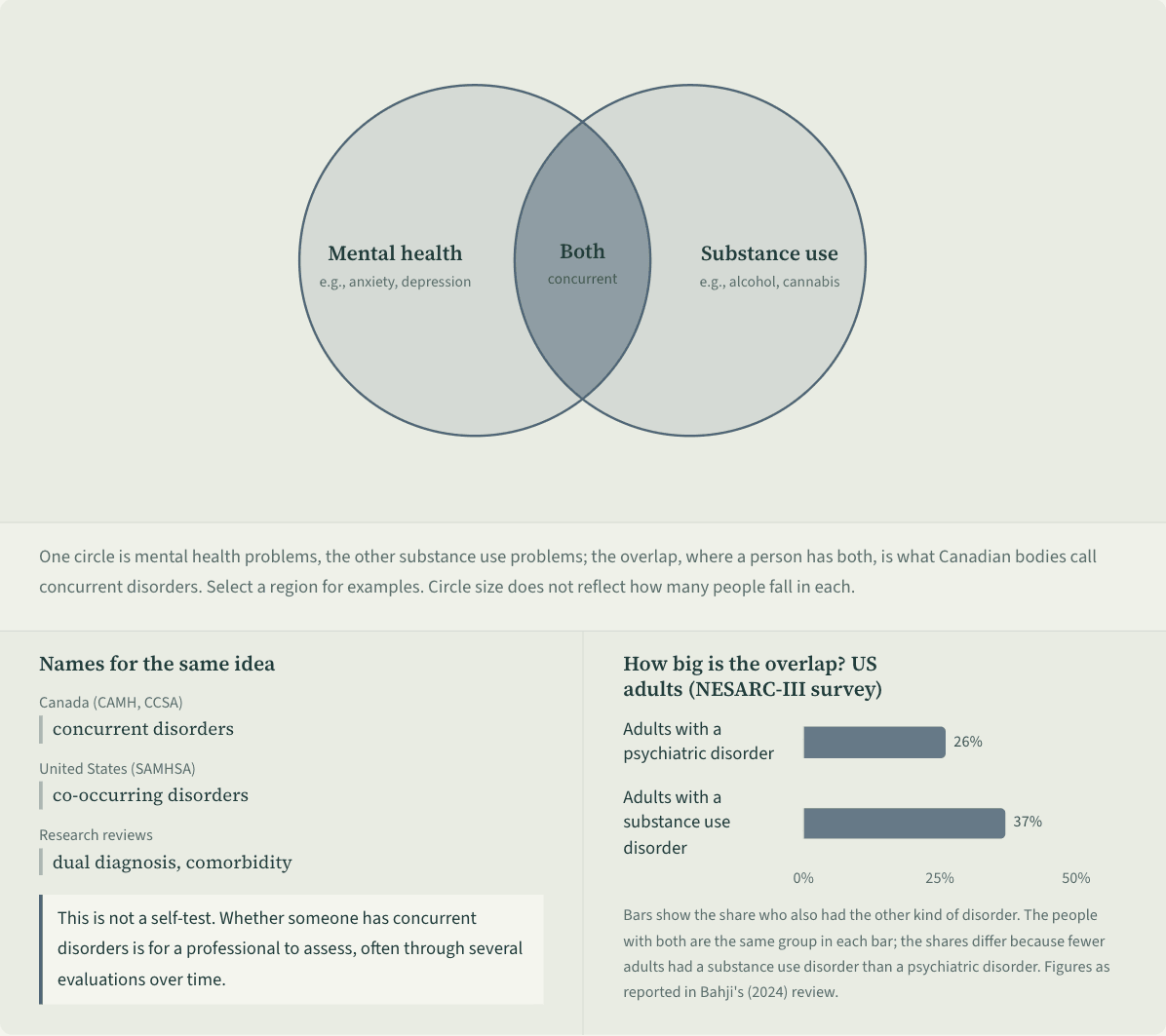
Bars show the share who also had the other kind of disorder. The people with both are the same group in each bar; the shares differ because fewer adults had a substance use disorder than a psychiatric disorder. Figures as reported in Bahji's (2024) review.
Top: two overlapping circles. The left circle is mental health problems, such as anxiety or depression; the right circle is substance use problems, such as alcohol or cannabis use. The overlap, where a person has both, is labeled concurrent disorders. Bottom left, names for the overlap: concurrent disorders in Canada (CAMH, CCSA), co-occurring disorders in the United States (SAMHSA), and dual diagnosis or comorbidity in research reviews, with a note that this is not a self-test. Bottom right, two bars from the US NESARC-III survey: 26% of adults with a psychiatric disorder also had a substance use disorder, and 37% of adults with a substance use disorder also had a psychiatric disorder.
 Save as image (PNG)
Key points
- Canadian bodies such as CAMH and CCSA say concurrent disorders; the US agency SAMHSA says co-occurring disorders; reviews also use dual diagnosis and comorbidity.[1][2][3][4]
- It is not one diagnosis. Schizophrenia with cannabis use disorder and depression with addiction to sleeping pills both count, and no symptom is common to all combinations.[1][3]
- More than half of people seeking help for addiction also have a mental illness, CCSA reported in 2010.[2] SAMHSA estimates that 21.2 million US adults had both in 2024.[3]
- The link runs both ways: a mental health problem raises the risk of addiction, and substance use can worsen mental health. CAMH says integrated treatment, addressing both at once, works best.[1]
An example
Lin drinks more on nights when worry keeps him awake, and an online article makes him wonder whether he has concurrent disorders. That is for a professional to assess, sometimes over several visits. He can tell his doctor about both the drinking and the worry so the two are assessed together.
Misreadings and limits
Having both does not mean one caused the other; the two can exist independently.[4] Substance use can itself bring on mood or anxiety symptoms, for example during alcohol withdrawal, so an accurate diagnosis often takes several assessments over time.[4]
Sources
- 1 Centre for Addiction and Mental Health (2026). Concurrent disorders. CAMH (revised 2026). View source
- 2 Canadian Centre on Substance Abuse (2010). Substance abuse in Canada: Concurrent disorders. Highlights. Canadian Centre on Substance Abuse (now the Canadian Centre on Substance Use and Addiction), April 2010. View source
- 3 Substance Abuse and Mental Health Services Administration (2025). Co-occurring disorders and other health conditions. SAMHSA (last updated December 22, 2025). View source
- 4 Bahji, A. (2024). Navigating the complex intersection of substance use and psychiatric disorders: A comprehensive review. Journal of Clinical Medicine, 13(4), 999. doi:10.3390/jcm13040999
Last checked against sources: October 26, 2026