Borderline personality disorder
边缘型人格障碍
What is borderline personality disorder (BPD)?
Borderline personality disorder is a long-standing personality disorder marked by pervasive instability in relationships, self-image and emotions, along with marked impulsivity.[1][2] Common features include frantic efforts to avoid abandonment, chronic emptiness, intense anger and repeated self-harm.[1][2]
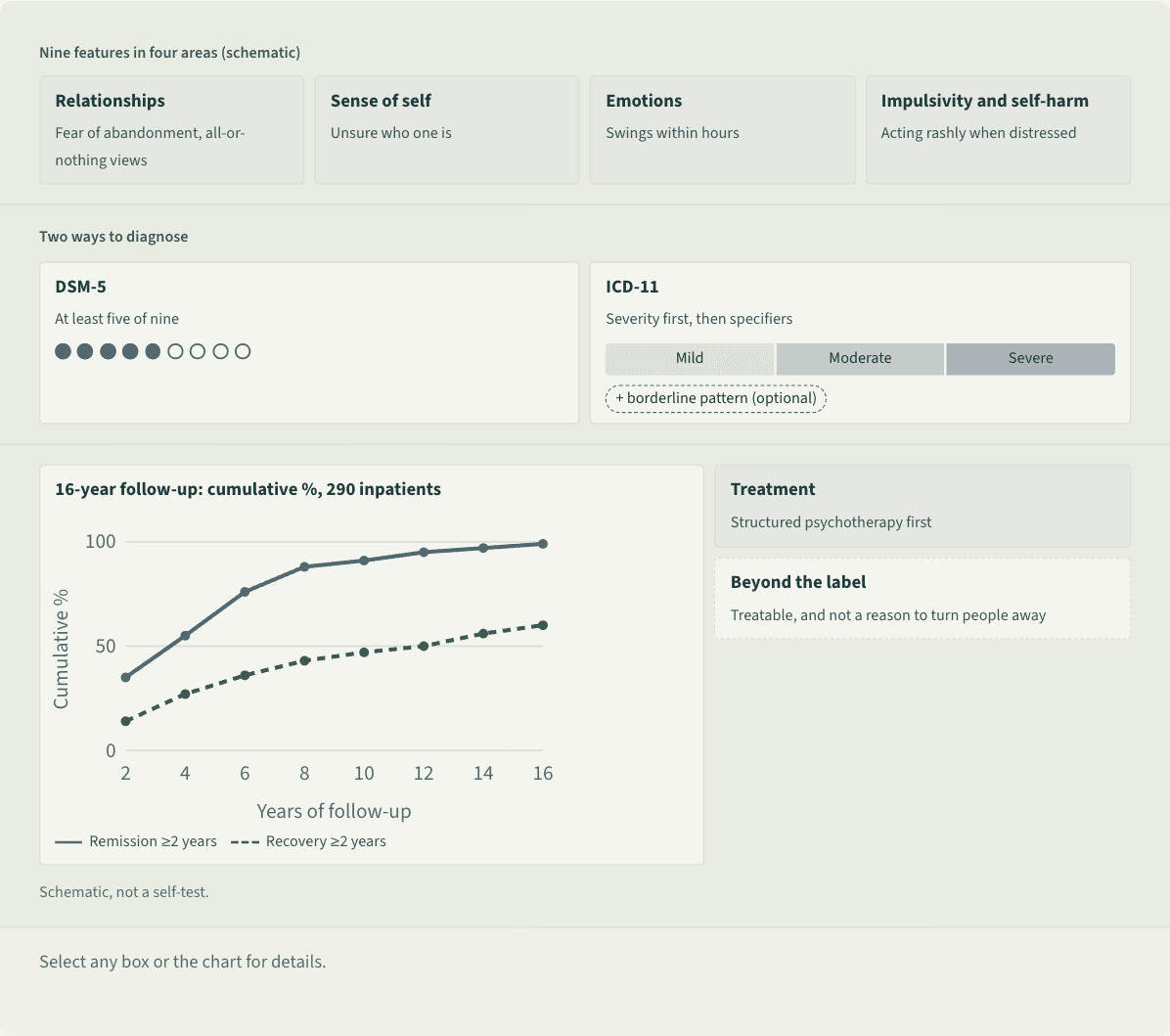
Nine features in four areas (schematic)
Two ways to diagnose
Schematic, not a self-test.
Schematic. At the top, four boxes: relationships (fear of abandonment, swinging between idealizing and devaluing), self-image (unstable, chronic emptiness), emotions (sharp swings within hours, intense anger, brief paranoia or dissociation under stress), and impulsivity and self-harm. In the middle, two boxes: DSM-5 requires at least five of nine features; ICD-11 first rates personality disorder as mild, moderate or severe with trait domains, then may add a borderline pattern specifier. Below, a line chart with follow-up years 2 to 16 on the horizontal axis and cumulative percentage on the vertical: remission lasting at least two years rises from 35% at year 2 to 99% at year 16; recovery, meaning remission plus good social and work functioning for at least two years, rises from 14% to 60%. Beside it, two boxes: treatment centers on structured psychotherapy; no one should be refused care because of the diagnosis. A note says the figure is schematic and not a self-test.
 Save as image (PNG)
This figure image is licensed CC BY 4.0: reuse it with credit and a link back to this page. How to reuse
Key points
- ICD-11 replaced personality disorder types with a severity rating and trait domains; an optional borderline pattern, the only type-like label kept, helps identify people suited to certain psychotherapies.[1][2]
- Reported lifetime prevalence in adults is 0.7–2.7%, about 12% among psychiatric outpatients and 22% among inpatients. Depression, anxiety and substance use disorders often co-occur.[2]
- In a 16-year study of 290 people first seen as inpatients, 99% had a symptom remission lasting at least two years, but only 60% also regained good social and work functioning.[3]
- NICE advises against drugs aimed at BPD itself or its individual symptoms.[4] Structured psychotherapies such as DBT and mentalization-based treatment come first, with no approach clearly superior.[2]
An example
Lin’s mood often swings within hours. When a friend is slow to reply, she fears being left, sends a dozen messages, then says she never wants to hear from them again. She often can’t say who she is or what she wants. Whether this is a lasting pattern across situations that causes real distress is for a professional to assess.[1]
Misreadings and limits
This page is not for self-diagnosis. Moodiness and risk-taking are more common in adolescence, and behavior confined to one relationship is not enough for a diagnosis.[1] BPD is treatable, and NICE says no one should be refused services because of the diagnosis or self-harm.[4] Repeated self-harm or thoughts of suicide call for prompt help from a doctor or mental health professional.[4]
If you need help now
If you’re struggling to cope or having thoughts of harming yourself:
- US and Canada: call or text 988 (24/7)
- UK and Ireland: Samaritans, 116 123 (free, 24/7)
- Australia: Lifeline, 13 11 14 (24/7)
- Elsewhere: findahelpline.com
If you’re in immediate danger, call your local emergency number.
Psyfield is not a crisis service. Numbers checked October 2026.
Sources
- 1 World Health Organization (2025). 6D10 Personality disorder; 6D11.5 Borderline pattern. ICD-11 for mortality and morbidity statistics (2025-01 release). View source
- 2 Leichsenring, F., Fonagy, P., Heim, N., Kernberg, O. F., Leweke, F., Luyten, P., Salzer, S., Spitzer, C., & Steinert, C. (2024). Borderline personality disorder: A comprehensive review of diagnosis and clinical presentation, etiology, treatment, and current controversies. World Psychiatry, 23(1), 4–25. doi:10.1002/wps.21156
- 3 Zanarini, M. C., Frankenburg, F. R., Reich, D. B., & Fitzmaurice, G. (2012). Attainment and stability of sustained symptomatic remission and recovery among patients with borderline personality disorder and axis II comparison subjects: A 16-year prospective follow-up study. American Journal of Psychiatry, 169(5), 476–483. doi:10.1176/appi.ajp.2011.11101550
- 4 National Institute for Health and Care Excellence (2009). Borderline personality disorder: Recognition and management (CG78). NICE clinical guideline (presentational update July 2024). View source
Last checked against sources: October 28, 2026