Eisenhower matrix
艾森豪威尔矩阵
The Eisenhower matrix is a time-management tool that sorts tasks on two axes, urgent or not and important or not, into four groups. It is named after a remark Eisenhower quoted in a 1954 speech; Stephen Covey’s time matrix in The 7 Habits of Highly Effective People uses the same axes.[1][2]
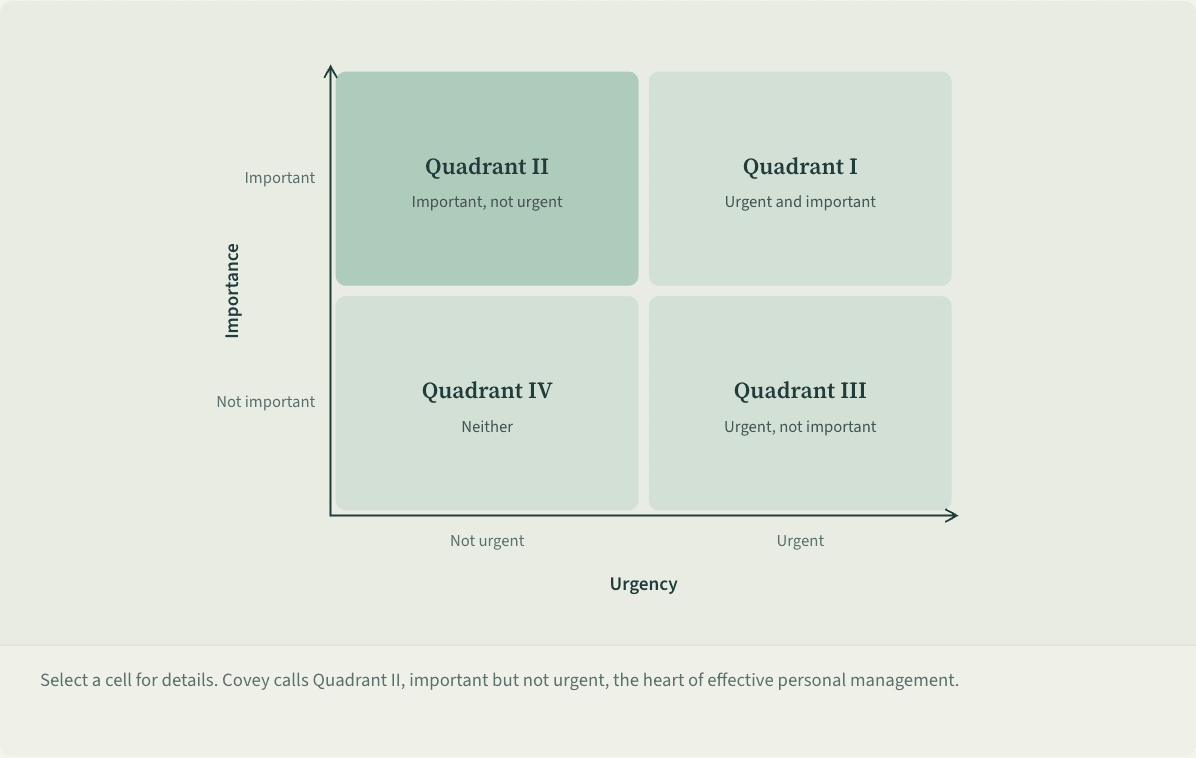
A two-by-two grid. The horizontal axis runs from not urgent to urgent, the vertical from not important to important. Top left Quadrant II (important, not urgent; highlighted), top right Quadrant I (urgent and important), bottom left Quadrant IV (neither), bottom right Quadrant III (urgent, not important).
 Save as image (PNG)
Key points
- In a 1954 speech in Evanston, Illinois, Eisenhower quoted “a former college president”: problems are urgent or important, and “the urgent are not important, and the important are never urgent.”[1]
- In Covey’s version, urgency is about how soon something must be done, and importance is about whether it serves your mission, values, and high-priority goals.[2]
- Covey argues for spending more time on what is important but not urgent, such as planning, creative thinking, learning, and renewal, and calls this Quadrant II the heart of effective personal management.[2][4]
- Five experiments on the “mere urgency effect” found more people chose a lower-paying task over a better-paying one when it merely seemed about to expire, especially people who felt busy.[3]
An example
Ms. Wang’s Monday list has two items: replying to a coworker’s group message (urgent, not important) and drafting next week’s project plan (important, not urgent). After sorting them into the grid, she spends 10 minutes on the message and keeps the whole morning for the plan.
Misreadings and limits
The matrix is often presented as Eisenhower’s own method. The 1954 speech contains only the remark, and Eisenhower credited even that to an unnamed former college president.[1]
Sources
- 1 Eisenhower, D. D. (1954). Address at the Second Assembly of the World Council of Churches, Evanston, Illinois (August 19, 1954). The American Presidency Project (G. Peters & J. T. Woolley, Eds.). View source
- 2 FranklinCovey (n.d.). Habit 3: Put first things first. FranklinCovey. View source
- 3 Zhu, M., Yang, Y., & Hsee, C. K. (2018). The mere urgency effect. Journal of Consumer Research, 45(3), 673–690. doi:10.1093/jcr/ucy008
- 4 FranklinPlanner (2025). Intro to Habit 3 & the time matrix (pg. 168–177). FranklinPlanner blog. View source
Last checked against sources: October 26, 2026