Plutchik’s wheel of emotions
普拉切克情绪轮
Plutchik’s wheel of emotions comes from American psychologist Robert Plutchik’s psychoevolutionary theory of emotion. It proposes a small number of basic emotions, each tied to an adaptive function, and treats all other emotions as mixtures or derivatives of them.[1]
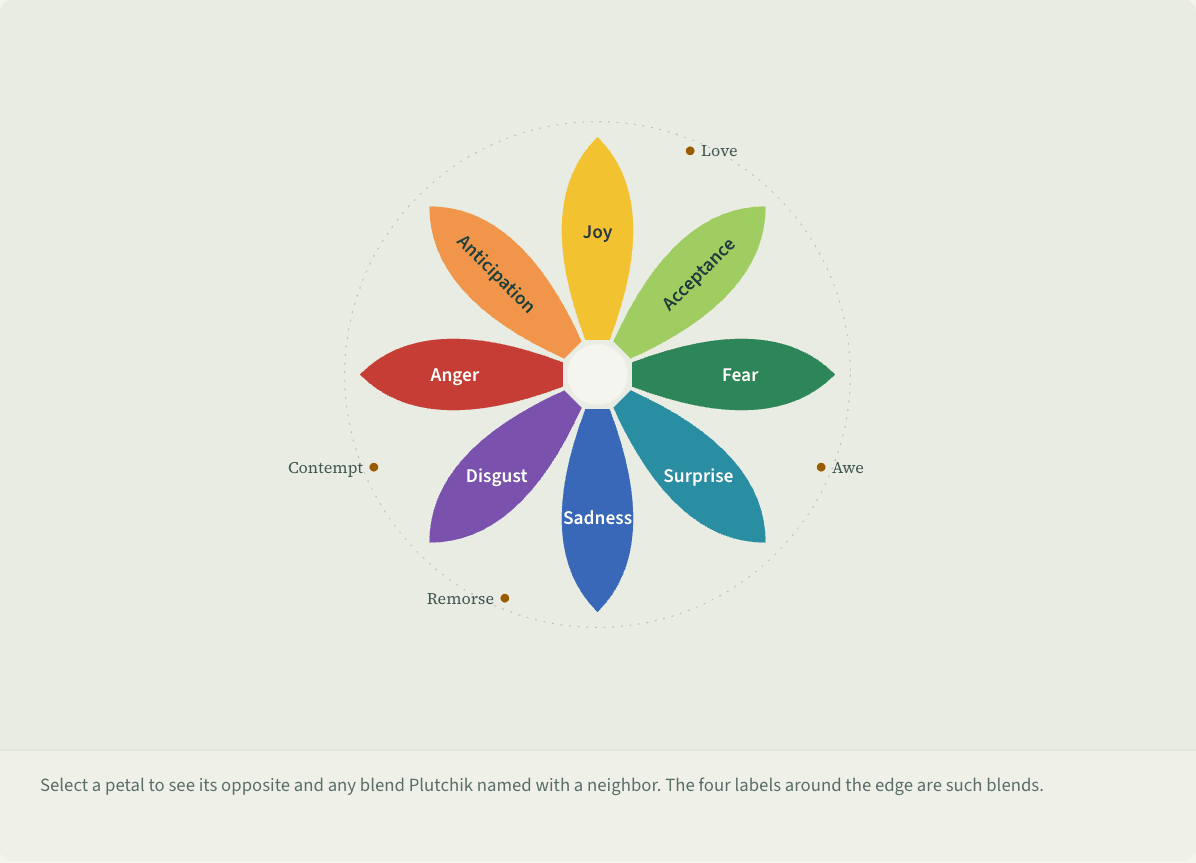
Eight petals in a ring, clockwise from the top: joy, acceptance (trust), fear, surprise, sadness, disgust, anger, anticipation. Opposite petals are opposite emotions. Around the edge, between neighboring petals, are four blends: love, awe, remorse and contempt. Petal colors only tell them apart and are not part of the theory.
 Save as image (PNG)
Key points
- Eight basic emotions form four opposing pairs: joy and sadness, acceptance (trust) and disgust, fear and anger, surprise and anticipation.[1]
- Similar emotions sit next to each other on the circle. Plutchik drew the whole model as a cone whose vertical axis is intensity, so each emotion ranges from mild to strong.[2]
- Neighboring emotions blend into what Plutchik called primary dyads: joy plus acceptance gives love, and disgust plus anger gives contempt.[2]
- Each basic emotion sits in an adaptive chain of stimulus, cognition, feeling, behavior and effect, such as threat → “danger” → fear → running away → protection.[1]
An example
Lin’s coworker cuts her off in a meeting, and afterward she just feels “annoyed.” Using the wheel, she picks out anger mixed with some disgust, the blend Plutchik called contempt. Seeing that, she decides to raise it with the coworker privately rather than snap back in the group chat.
Misreadings and limits
The wheel is often taken as a proven, complete map of emotions. Plutchik himself called the number of primary emotions “a theoretical decision,”[2] and whether emotion categories have fixed natural boundaries is still debated.[3]
Sources
- 1 Plutchik, R. (1980). A general psychoevolutionary theory of emotion. In R. Plutchik & H. Kellerman (Eds.), Emotion: Theory, research, and experience: Vol. 1. Theories of emotion (pp. 3–33). Academic Press. View source
- 2 Plutchik, R. (2001). Integration, differentiation, and derivatives of emotion. Evolution and Cognition, 7(2), 114–125. View source
- 3 Barrett, L. F. (2006). Are emotions natural kinds?. Perspectives on Psychological Science, 1(1), 28–58. doi:10.1111/j.1745-6916.2006.00003.x
Last checked against sources: October 26, 2026