Procrastination
拖延
In a 2007 meta-analysis, Piers Steel defined procrastination as voluntarily delaying an intended course of action despite expecting to be worse off for the delay. He described it as a typical form of self-regulatory failure.[1]
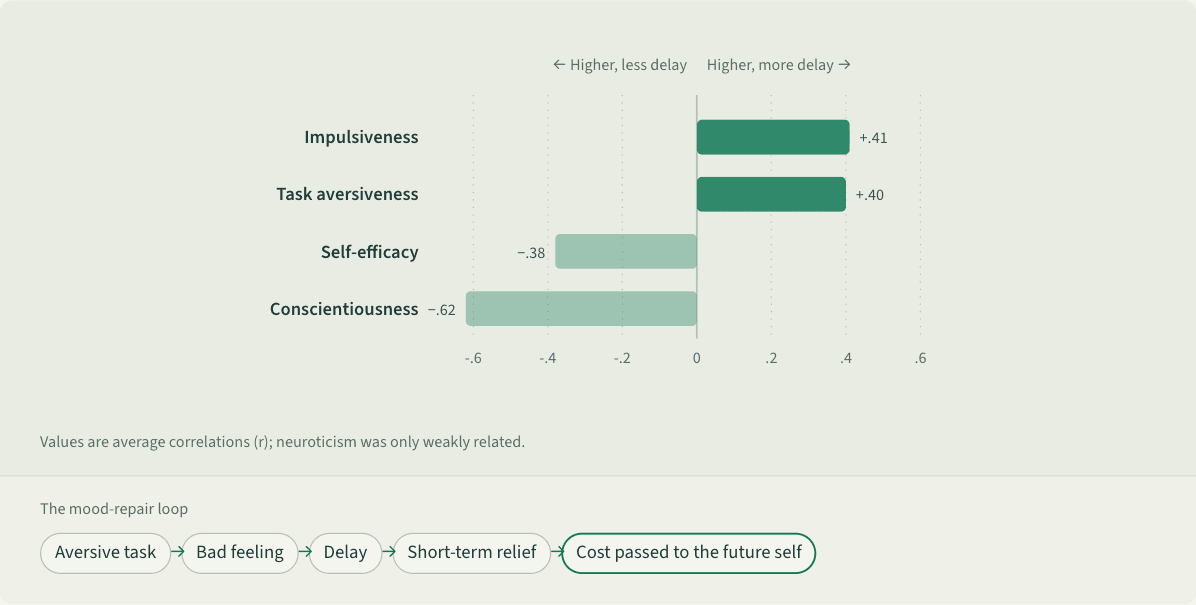
Values are average correlations (r); neuroticism was only weakly related.
The mood-repair loop
- Aversive task
- Bad feeling
- Delay
- Short-term relief
- Cost passed to the future self
A horizontal bar chart centered on zero: impulsiveness +.41 and task aversiveness +.40 extend right; self-efficacy −.38 and conscientiousness −.62 extend left. Below, a row of labels: aversive task, bad feeling, delay, short-term relief, cost passed to the future self.
 Save as image (PNG)
Key points
- It is common. Estimates cited by Steel put it at 80% to 95% of college students, about half of them persistently and problematically, and 15% to 20% of adults chronically.[1]
- Pooling 691 correlations, Steel found the strongest predictors were task aversiveness, low self-efficacy, impulsiveness, and low conscientiousness; neuroticism was only weakly related.[1]
- An emotion-regulation account holds that procrastination is largely about repairing mood in the short term, while the costs fall on the future self.[2]
- In a 7-day study of Chinese students who procrastinated heavily, those using positive reappraisal found tasks less aversive, felt more willing to act, and procrastinated less.[3]
An example
Jay has a report due Friday. He plans to start on Monday, but each time he opens the file he feels irritated and picks up his phone instead, knowing the delay will cost him. He finally writes it in one late night on Thursday.
Misreadings and limits
Procrastination is often equated with laziness or poor time management. Research links it more to aversive tasks and short-term mood repair.[1][2] Not every delay counts, either: deliberate, strategic postponement is not procrastination in Steel’s sense.[1]
Sources
- 1 Steel, P. (2007). The nature of procrastination: A meta-analytic and theoretical review of quintessential self-regulatory failure. Psychological Bulletin, 133(1), 65–94. doi:10.1037/0033-2909.133.1.65
- 2 Sirois, F., & Pychyl, T. (2013). Procrastination and the priority of short-term mood regulation: Consequences for future self. Social and Personality Psychology Compass, 7(2), 115–127. doi:10.1111/spc3.12011
- 3 童廷婷, 白幼玲, & 冯廷勇 (2024). 情绪调节改善拖延行为的认知机制:任务厌恶中介作用. 心理学报, 56(4), 458–468. doi:10.3724/SP.J.1041.2024.00458
Last checked against sources: October 26, 2026