Change talk
改变语句
In Motivational interviewing, change talk is any client speech that favors movement toward a particular change goal. Its counterpart, sustain talk, is speech that favors the status quo.[1][2]
Preparatory change talk DARN
Motivation, without stating intent
Mobilizing change talk CAT
Expresses or implies action
Sustain talk
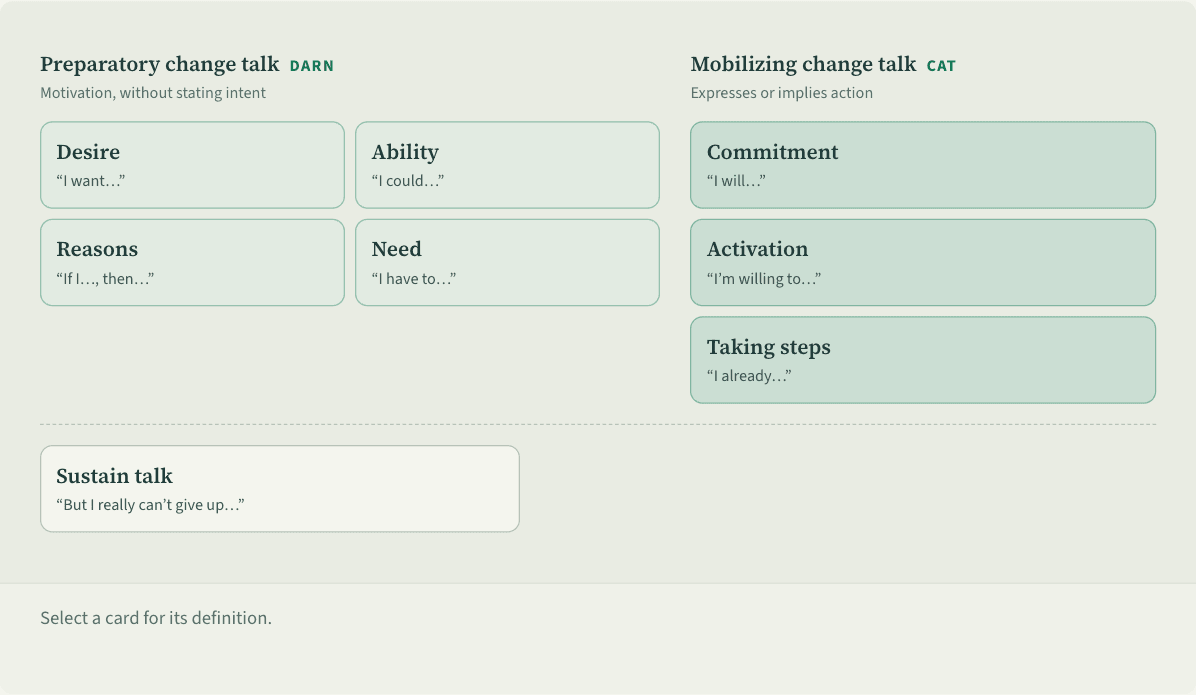
Two groups of cards. The left group, preparatory change talk, has desire, ability, reasons and need; the right group, mobilizing change talk, has commitment, activation and taking steps. Each card carries a typical phrase.
 Save as image (PNG)
Key points
- Preparatory change talk (DARN) expresses motivation without stating intent: desire (I want), ability (I could), reasons (if I did, then…), and need (I have to).[1][2]
- Mobilizing change talk (CAT) expresses or implies action: commitment (I will), activation (I’m willing, short of a promise), and taking steps (I already did something).[1][2]
- MI theory proposes two active parts: a relational one (empathy and collaborative spirit) and a technical one, the counselor’s selective evoking and reinforcing of change talk.[3]
- In one study, commitment language predicted later drug-use outcomes, and a rising pattern of commitment across the session was linked to abstinence.[3]
An example
Talking about drinking, Jay says, “I’d like to cut back” (desire), “I could probably skip weekends” (ability), and “I’ve already gone two days without a drink this week” (taking steps). The listener reflects these statements back and invites him to say more.
Misreadings and limits
It is often treated as a script for getting people to say the right thing, or as a case of “more is better.” The evidence is not that simple: early studies found the amount of change talk did not predict outcomes, and a later study found that change talk and sustain talk each predicted drinking outcomes independently.[3]
Sources
- 1 Miller, W. R., & Rollnick, S. (2013). Motivational interviewing: Helping people change (3rd ed.). Guilford Press. View source
- 2 Motivational Interviewing Network of Trainers (2024). Glossary of motivational interviewing terms (English/Spanish/Portuguese). Motivational Interviewing Network of Trainers (MINT). View source
- 3 Miller, W. R., & Rose, G. S. (2009). Toward a theory of motivational interviewing. American Psychologist, 64(6), 527–537. doi:10.1037/a0016830
- 4 Miller, W. R., & Rollnick, S. (n.d.). 动机式访谈法:帮助人们改变(郭道寰、王韶宇、江嘉伟 译). 华东理工大学出版社,ISBN 978-7-5628-3755-8. Chinese edition of [1]; the Chinese terms on this page follow its glossary.
Last checked against sources: October 26, 2026