Emotional intelligence
情绪智力
Emotional intelligence is a set of abilities to perceive and express emotions in oneself and others, regulate emotions, and use feelings to motivate and plan. Psychologists Peter Salovey and John Mayer proposed the concept in 1990.[1]
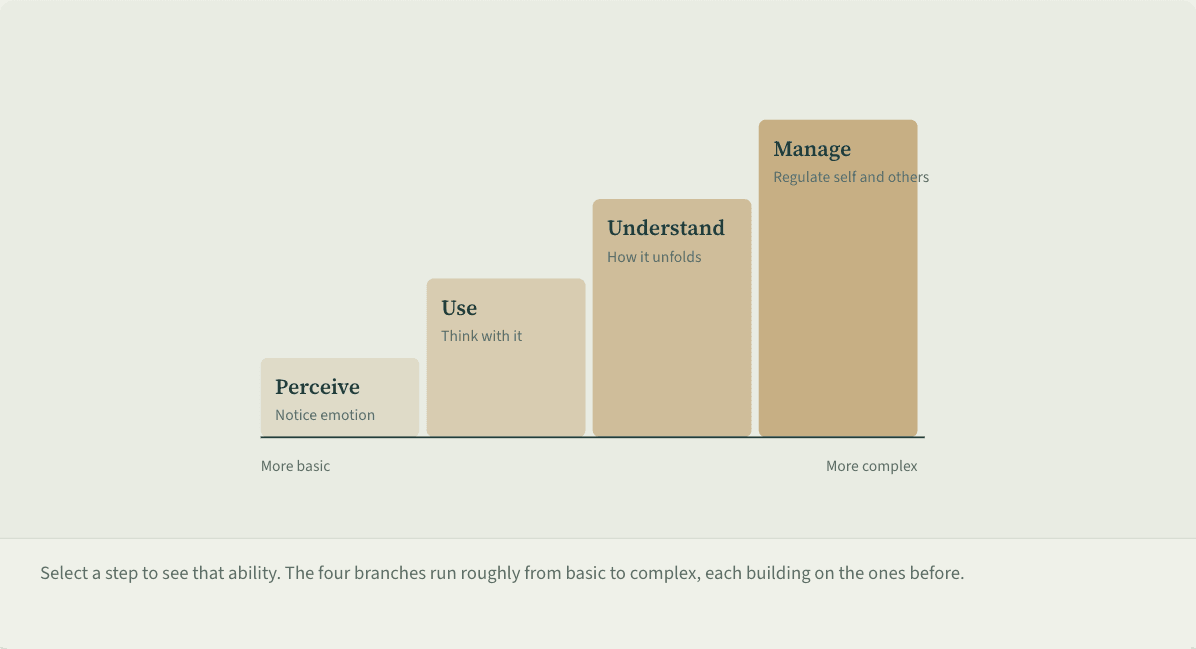
Four steps rising from left to right: perceiving emotions, using emotions to aid thinking, understanding emotions and managing emotions, with more basic at the left and more complex at the right.
 Save as image (PNG)
Key points
- The four-branch ability model covers perceiving emotions, using emotions to aid thinking, understanding emotions and managing emotions, in rough order from basic to complex.[2]
- Daniel Goleman’s 1995 book folded in traits such as persistence, zeal and self-control. Theories that mix abilities with personality traits this way are called mixed models.[2]
- Ability tests such as the MSCEIT measure how well people solve emotional problems. Self-report scales ask people to rate themselves and overlap with the Big Five personality traits.[2]
- Ability EI correlates about .35 with verbal intelligence. Beyond personality and IQ, it adds modest predictive power for outcomes such as supervisors’ ratings of interpersonal behavior.[2]
An example
In a meeting, Jay notices a colleague’s tone getting sharper and her answers shorter. He reads it as worry about the schedule rather than hostility toward him, so he first asks where she is stuck and only then offers his edits. The discussion stays calm.
Misreadings and limits
Popular usage often equates high EQ with being smooth or tactful, or claims it matters more than IQ. Mayer and colleagues found no support for claims such as Goleman’s that EI explains “nearly 90%” of what sets star performers apart,[2] and a 2019 review notes that EI can also have negative effects.[3]
Sources
- 1 Salovey, P., & Mayer, J. D. (1990). Emotional intelligence. Imagination, Cognition and Personality, 9, 185–211. doi:10.2190/DUGG-P24E-52WK-6CDG
- 2 Mayer, J. D., Salovey, P., & Caruso, D. R. (2008). Emotional intelligence: New ability or eclectic traits?. American Psychologist, 63(6), 503–517. doi:10.1037/0003-066X.63.6.503
- 3 Sun, J., Tian, X., & Li, R. (2019). Negative effects and mechanisms of emotional intelligence. Advances in Psychological Science, 27(8), 1451–1459. doi:10.3724/SP.J.1042.2019.01451
Last checked against sources: October 26, 2026