Conformity
从众
Conformity occurs when people change their opinions or behavior because of what they perceive others in a group think or do.[2] Solomon Asch’s line-judgment studies are the classic demonstration.[1]
Wrong answers on critical trials
How often each of the 123 participants went along on the 12 critical trials (one dot per person)
Never: 29 1 to 11 times: 88 All 12 times: 6
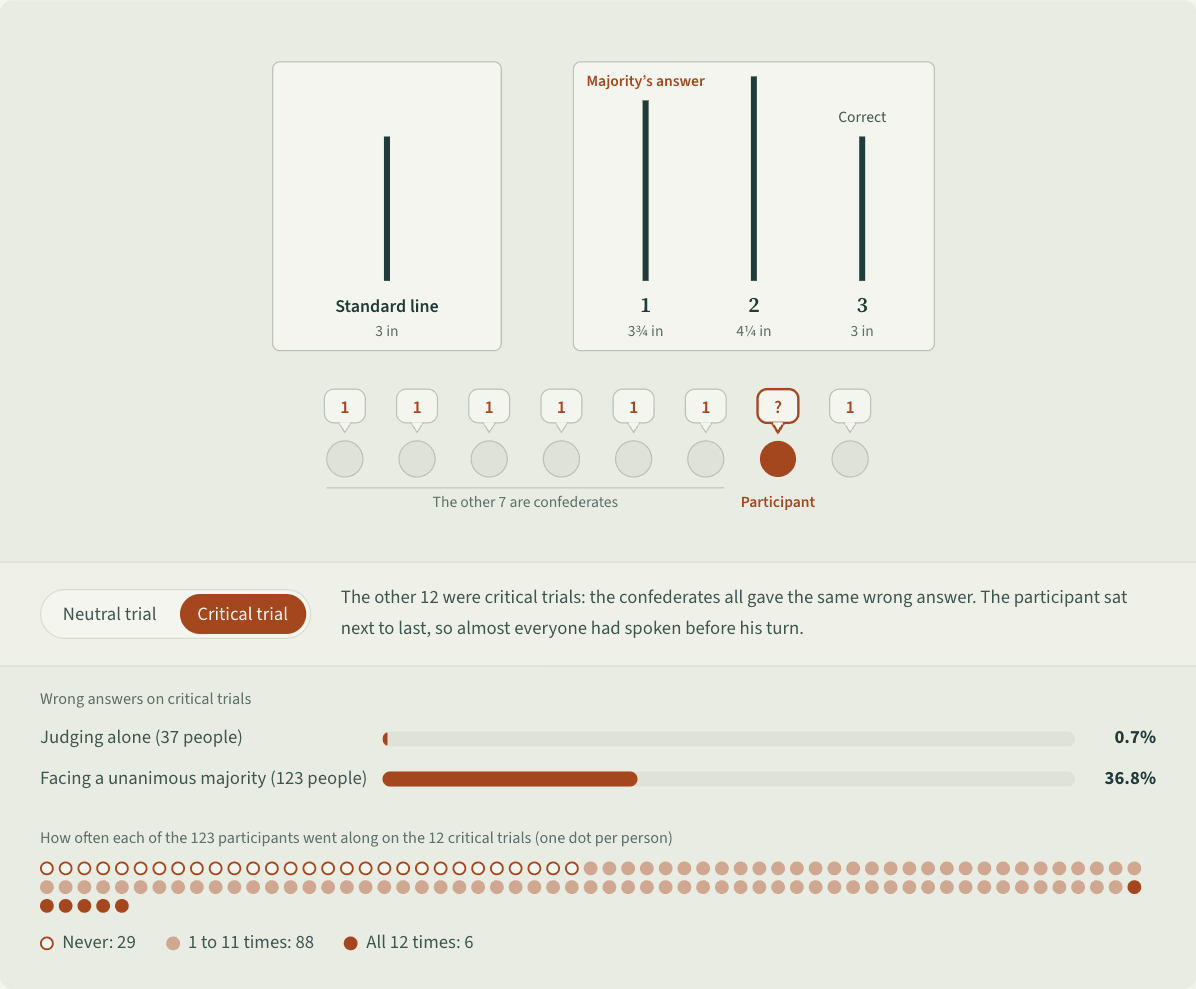
The left card shows a 3-inch standard line; the right card shows three comparison lines numbered 1, 2 and 3, measuring 3¾, 4¼ and 3 inches, so line 3 is correct. Below, a row of eight seats: the seventh is the participant, the other seven are confederates. A toggle switches between a neutral trial, where the confederates all answer 3, and a critical trial, where they all answer 1. Results: people judging alone (37) erred on 0.7% of critical trials; people facing a unanimous majority (123) erred on 36.8%. A grid of 123 dots shows how often each participant went along on the 12 critical trials: 29 never, 88 between 1 and 11 times, 6 on all 12.
 Save as image (PNG)
Key points
- In Asch’s study, when 7–9 confederates unanimously gave a wrong answer, about 37% of participants’ answers followed them. People judging alone erred less than 1% of the time.[1]
- People varied widely: about 24% of the 123 participants never went along with the majority, while about 76% conformed at least once.[1]
- People conform for two broad reasons: to be accurate (informational influence, often real belief change) or to be accepted (normative influence, often public compliance only).[2]
- A meta-analysis of 133 Asch-type studies from 17 countries found higher conformity in collectivist cultures and a decline in US conformity since the 1950s.[3]
An example
In a meeting, the five colleagues who speak first all back plan A. Lin thinks plan B is better but says A when his turn comes. Afterward he admits he was not convinced; he just did not want to stand out.
Misreadings and limits
A common misreading is that Asch showed people blindly follow the crowd. About two-thirds of answers stayed correct, and nearly a quarter of participants never yielded.[1] A 2023 replication found about 33% conforming answers, falling to 25% when correct answers were paid.[4]
Sources
- 1 Asch, S. E. (1956). Studies of independence and conformity: I. A minority of one against a unanimous majority. Psychological Monographs: General and Applied, 70(9, Whole No. 416), 1–70. View source
- 2 Jhangiani, R., & Tarry, H. (2022). The many varieties of conformity. Principles of social psychology (1st international H5P ed.), section 6.1. BCcampus. View source
- 3 Bond, R., & Smith, P. B. (1996). Culture and conformity: A meta-analysis of studies using Asch's (1952b, 1956) line judgment task. Psychological Bulletin, 119(1), 111–137. View source
- 4 Franzen, A., & Mader, S. (2023). The power of social influence: A replication and extension of the Asch experiment. PLoS ONE, 18(11), e0294325. doi:10.1371/journal.pone.0294325
Last checked against sources: October 26, 2026