Positions and interests
立场与利益
Positions and interests are the distinction at the heart of Roger Fisher and William Ury’s Getting to Yes, first published in 1981: a position is something you have decided on, and your interests are what caused you to decide it.[1][2]
Positions: what each has decided on
Lin
“Set it to 20°C”
Can’t sleep when it’s hot
Jay
“Turn it off”
The airflow gives him a sore throat
Turn the vent toward Lin’s side
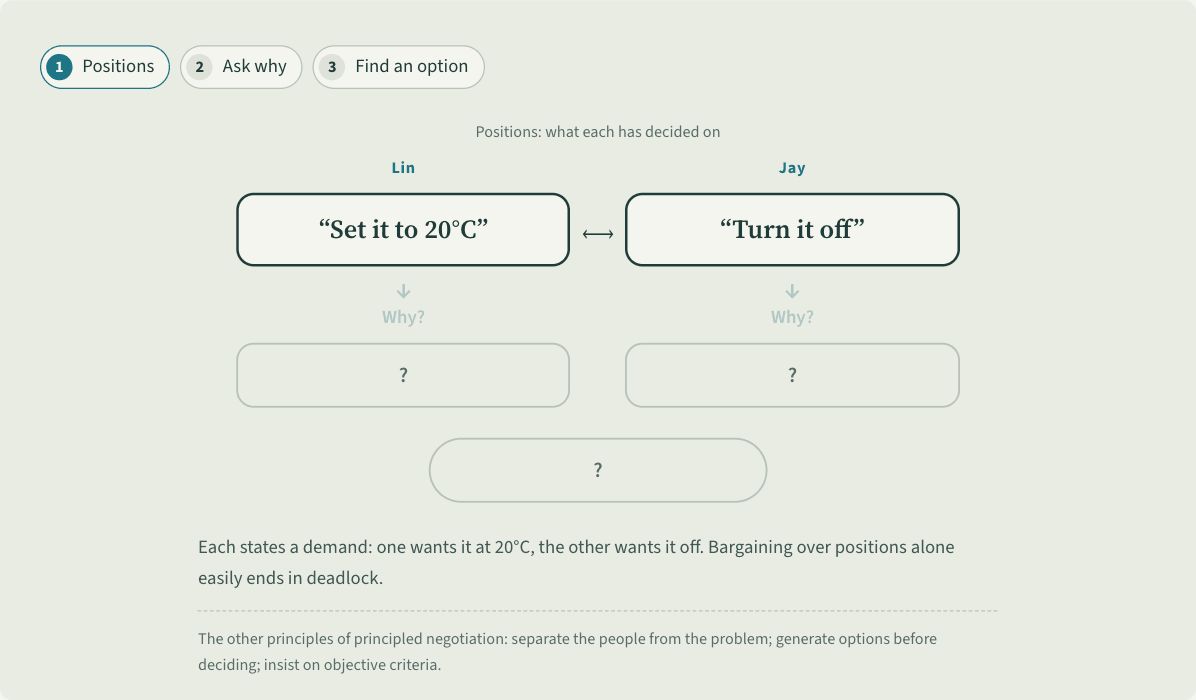
Each states a demand: one wants it at 20°C, the other wants it off. Bargaining over positions alone easily ends in deadlock.Ask why each holds that demand, to understand rather than to challenge. The answers are the interests: Lin can’t sleep when it’s hot, and the airflow gives Jay a sore throat.Starting from interests opens an option neither position offered: turn the vent toward Lin’s side, which serves both.
The other principles of principled negotiation: separate the people from the problem; generate options before deciding; insist on objective criteria.
Two columns, Lin on the left and Jay on the right. Step 1 shows only their positions, “Set it to 20°C” and “Turn it off,” with a double-headed arrow between them. Step 2 adds “Why?” under each position and the interest behind it: Lin can’t sleep when it’s hot; the airflow gives Jay a sore throat. Step 3 adds an option spanning both columns: turn the vent toward Lin’s side. A footnote lists the other principles of principled negotiation: separate the people from the problem, generate options before deciding, insist on objective criteria.
 Save as image (PNG)
Key points
- In positional bargaining, each side states a demand and then concedes step by step. This tends to be inefficient, encourages stubbornness and strains the relationship.[2]
- To find interests, ask why a party holds its position and not some other one. The aim is to understand, not to challenge.[2][3]
- Each side usually has several interests. Common basic needs include security, economic well-being, belonging, recognition and control.[3]
- The wider method of principled negotiation also includes separating the people from the problem, generating options before deciding, and insisting on objective criteria.[2]
An example
Roommates Lin and Jay argue over the air conditioner: one wants it at 20°C, the other wants it off. Those are positions. Asking why reveals the interests: Lin can’t sleep when it’s hot, and the airflow gives Jay a sore throat. They turn the vent toward Lin’s side of the room.
Misreadings and limits
Not every conflict can become a win-win. Critics argue that the approach underplays zero-sum bargaining over fixed resources, and that “objective criteria” can simply give one side’s position an appearance of reasonableness.[3]
Sources
- 1 Fisher, R., Ury, W., & Patton, B. (2011). Getting to yes: Negotiating agreement without giving in (3rd ed.). Penguin. View source
- 2 Glaser, T. (n.d.). Summary of "Getting to yes: Negotiating agreement without giving in". Beyond Intractability, Conflict Information Consortium. View source
- 3 Folberg, J., Golann, D., Stipanowich, T. J., & Kloppenberg, L. A. (2010). Cooperative or interest-based negotiation. Resolving disputes: Theory, practice, and law (2nd ed.), ch. 4. View source
Last checked against sources: October 26, 2026