Fundamental attribution error
基本归因错误
The fundamental attribution error is the tendency to overestimate personal factors such as character or attitudes when explaining someone else’s behavior, and to overlook the situation.[2] Social psychologist Lee Ross named it in 1977.[1]
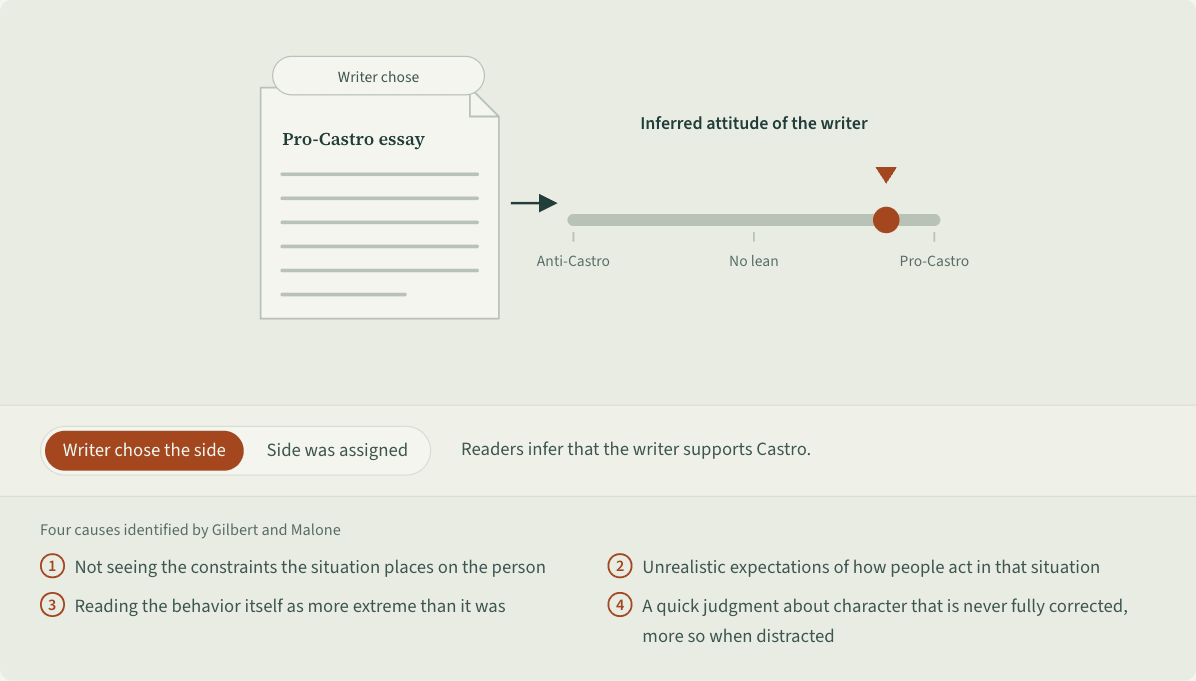
Four causes identified by Gilbert and Malone
- Not seeing the constraints the situation places on the person
- Unrealistic expectations of how people act in that situation
- Reading the behavior itself as more extreme than it was
- A quick judgment about character that is never fully corrected, more so when distracted
On the left, a pro-Castro essay with a tag saying whether the writer chose the side or a coach assigned it. An arrow leads to a scale running from anti-Castro through no lean to pro-Castro, marking the reader’s estimate of the writer’s own view. When the writer chose, the marker sits near the pro end. Switched to “assigned,” it moves toward the middle but still leans clearly pro; a dashed circle at the middle marks what the essay alone would justify. Below, the four causes Gilbert and Malone list: not seeing situational constraints, unrealistic expectations of behavior in that situation, reading the behavior as more extreme than it was, and a quick character judgment that is never fully corrected, more so when distracted.
 Save as image (PNG)
Key points
- In a classic 1967 study, readers of pro- or anti-Castro essays still inferred the writer’s true attitude even when told a debate coach had assigned the position.[1]
- It has several causes: not seeing the constraints on the other person, underestimating how strongly situations push behavior, and failing to correct a quick trait judgment when distracted.[1]
- It varies by culture: covering the same two mass murders, English-language newspapers made more trait attributions about the killers than Chinese-language newspapers, which pointed more to circumstances.[3]
An example
A car cuts in front of Jay at an intersection, and his first thought is that the driver is just rude. A few seconds later he sees the car turn into the hospital’s emergency entrance.
Misreadings and limits
The word “fundamental” suggests a universal law, but cross-cultural research shows that attribution styles vary with culture, so the bias is not equally strong everywhere.[4] It also does not mean personality is irrelevant; it means situations get too little weight.[2]
Sources
- 1 Gilbert, D. T., & Malone, P. S. (1995). The correspondence bias. Psychological Bulletin, 117(1), 21–38. View source
- 2 Jhangiani, R., & Tarry, H. (2022). Biases in attribution. Principles of social psychology (1st international H5P ed.), section 5.3. BCcampus. View source
- 3 Morris, M. W., & Peng, K. (1994). Culture and cause: American and Chinese attributions for social and physical events. Journal of Personality and Social Psychology, 67(6), 949–971. doi:10.1037/0022-3514.67.6.949
- 4 李陈, & 陈午晴 (2006). 基本归因错误的文化局限性. 心理科学进展, 14(6), 938. View source
Last checked against sources: October 26, 2026