Stereotype, prejudice and discrimination
刻板印象、偏见与歧视
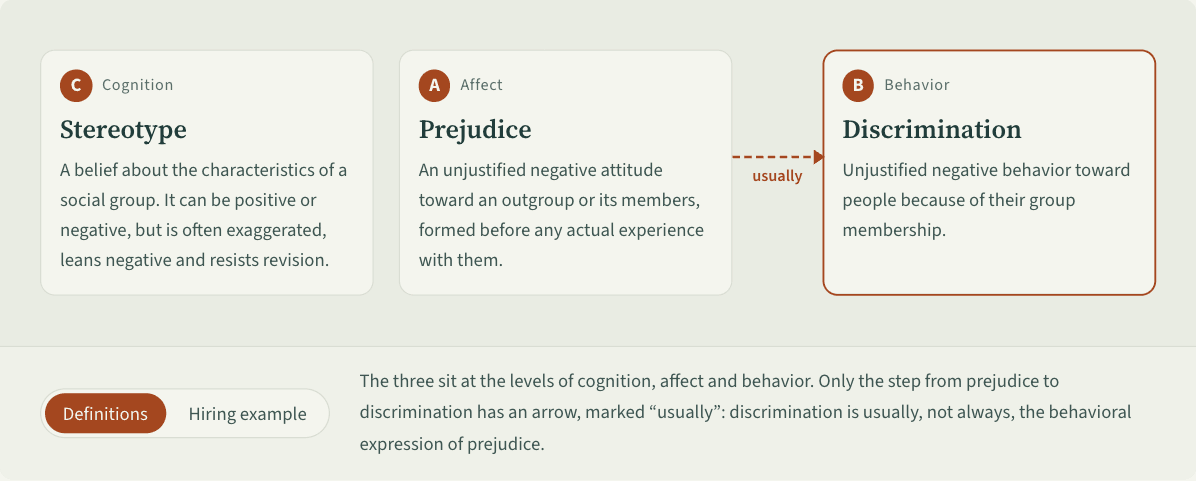
A stereotype is a belief about the characteristics of a social group; prejudice is an unjustified negative attitude toward an outgroup or its members; discrimination is unjustified negative behavior toward people because of their group membership.[1]
C Cognition
Stereotype
A belief about the characteristics of a social group. It can be positive or negative, but is often exaggerated, leans negative and resists revision.
“Recent graduates won’t stay long.”
A Affect
Prejudice
An unjustified negative attitude toward an outgroup or its members, formed before any actual experience with them.
Feels irritated at the sight of a graduate’s résumé.
B Behavior
Discrimination
Unjustified negative behavior toward people because of their group membership.
Rejects all of them without reading further.
Three cards side by side. First: C, cognition, stereotype: a belief about a social group’s characteristics, positive or negative but often exaggerated, leaning negative and resistant to revision. Second: A, affect, prejudice: an unjustified negative attitude toward an outgroup or its members, formed before any actual experience. Third: B, behavior, discrimination: unjustified negative behavior toward people because of their group. A dashed arrow marked “usually” joins the second and third cards. Switching to the hiring example, the cards read: “Recent graduates are unreliable”; feels irritated at the sight of a graduate’s résumé; rejects all of them without reading further.
 Save as image (PNG)
Key points
- Social psychologists map the three onto the ABCs: stereotypes are cognition, prejudice is affect, and discrimination is behavior.[1]
- Stereotypes can be positive or negative, but they are often exaggerated, lean negative and resist revision.[1][2]
- Prejudice is a negative attitude formed in advance of any actual experience with the person or group.[2]
- Discrimination is usually the behavioral expression of prejudice, such as harmful or hostile treatment of a rejected group.[3]
An example
Ms. Wang screens job applicants. She believes recent graduates won’t stay long (stereotype), feels irritated when she sees their résumés (prejudice), and rejects all of them without reading further (discrimination).
Misreadings and limits
A common misreading uses the three words interchangeably. They sit at different levels: belief, feeling and action.[1] The American Psychological Association describes discrimination as usually, not always, the behavioral expression of prejudice, so the two do not map one-to-one.[3]
Sources
- 1 Jhangiani, R., & Tarry, H. (2022). Stereotypes, prejudice, and discrimination. Principles of social psychology (1st international H5P ed.), chapter 11. BCcampus. View source
- 2 American Psychological Association (2023). Inclusive language guide (2nd ed.). American Psychological Association. View source
- 3 American Psychological Association (n.d.). Racism, bias, and discrimination. American Psychological Association (Psychology topics). View source
Last checked against sources: October 26, 2026