Hemispheric lateralization
大脑偏侧化
What is hemispheric lateralization?
Hemispheric lateralization is the division of labor between the brain’s two halves: some functions rely mainly on one side, most clearly language, which is left-dominant in most people.[1] Each hemisphere mainly handles sight and touch from the opposite side and controls the opposite hand.[2]
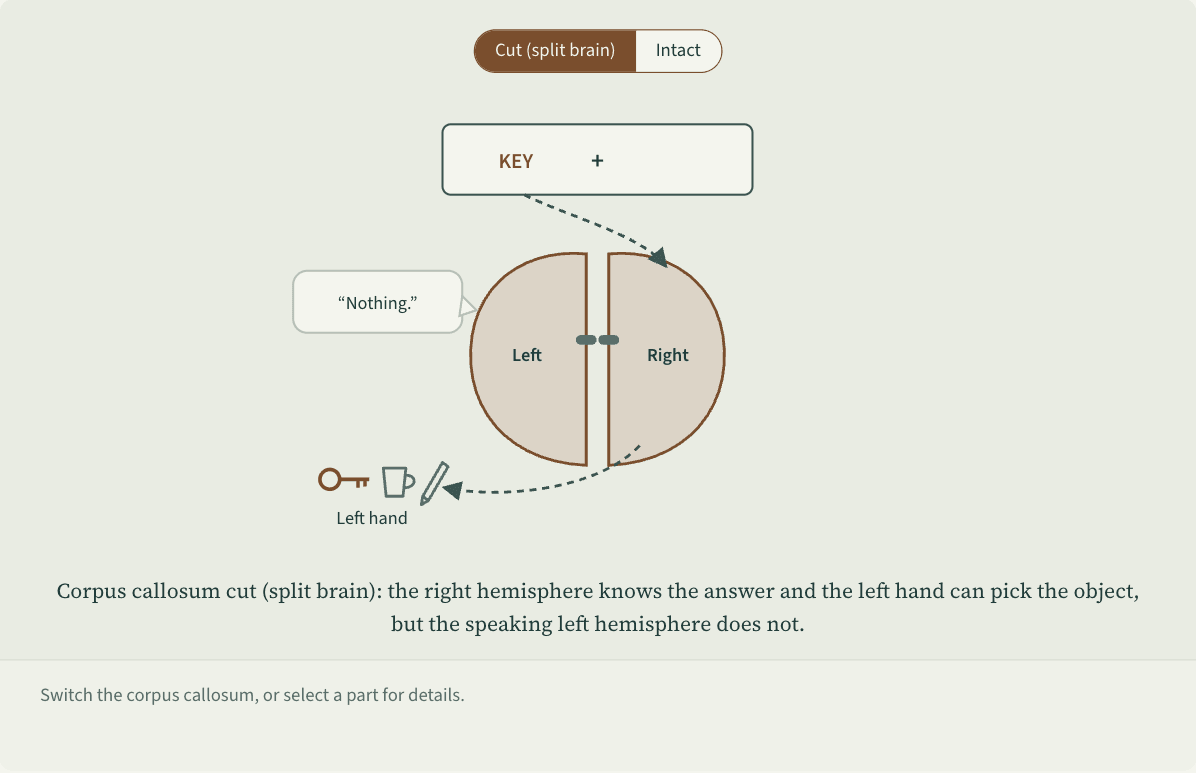
Corpus callosum cut (split brain): the right hemisphere knows the answer and the left hand can pick the object, but the speaking left hemisphere does not.
Corpus callosum intact: the information crosses to the left hemisphere, and the person simply names the word.
A top-down schematic of the brain with a screen above it showing a + in the center and the word KEY to its left. An arrow runs from the left side of the screen to the right hemisphere, showing that the left visual field reaches the right hemisphere. The corpus callosum lies between the hemispheres. With “intact” selected, the information crosses the corpus callosum and a speech bubble by the left hemisphere says “key.” With “cut” selected, the corpus callosum is drawn as a broken dashed line, the left hemisphere’s bubble says “I didn’t see anything,” and an arrow runs from the right hemisphere to the left hand at lower left, which picks the key from a key, a cup and a pencil. Selecting each part explains it: the left visual field goes to the right hemisphere; the right hemisphere recognizes the word, does not speak and controls the left hand; the corpus callosum links the hemispheres and was cut to treat intractable epilepsy; the left hemisphere speaks and, without the information, says it saw nothing; the left hand picks the right object.
 Save as image (PNG)
This figure image is licensed CC BY 4.0: reuse it with credit and a link back to this page. How to reuse
Key points
- In a brain-imaging study of 297 people, language was left-dominant in 88% of right-handers and 78% of left-handers; only 7% of left-handers were clearly right-dominant.[1]
- Split-brain patients, whose corpus callosum was cut to treat intractable epilepsy, say they saw nothing when an object appears in the left visual field, yet their left hand can pick it out.[2]
- Roger Sperry won half of the 1981 Nobel Prize in Physiology or Medicine for discoveries about the functional specialization of the hemispheres, including right-hemisphere strengths in spatial tasks.[3]
- In daily life split-brain patients seem ordinary and say they feel unchanged; whether each hemisphere then has a consciousness of its own is still unresolved.[2]
An example
Jay takes an online quiz that labels him “right-brained: emotional and creative.” In fact he most likely relies mainly on his left hemisphere to speak and read, his right hemisphere has the edge in recognizing familiar faces, and the two work together through the corpus callosum. No quiz can sort a person into one side.[1][2][4]
Misreadings and limits
The idea that left-brained people are logical and right-brained people creative lacks support. The 1981 Nobel Prize honored functional specialization of the hemispheres, not personality types.[3] A resting-state scan study of 1,011 people found lateralization to be a property of local regions, not of a whole brain, and no people with an overall stronger left or right side.[4]
Sources
- 1 Mazoyer, B., Zago, L., Jobard, G., Crivello, F., Joliot, M., Perchey, G., Mellet, E., Petit, L., & Tzourio-Mazoyer, N. (2014). Gaussian mixture modeling of hemispheric lateralization for language in a large sample of healthy individuals balanced for handedness. PLoS ONE, 9(6), e101165. doi:10.1371/journal.pone.0101165
- 2 de Haan, E. H. F., Corballis, P. M., Hillyard, S. A., Marzi, C. A., Seth, A., Lamme, V. A. F., Volz, L., Fabri, M., Schechter, E., Bayne, T., Corballis, M., & Pinto, Y. (2020). Split-brain: What we know now and why this is important for understanding consciousness. Neuropsychology Review, 30(2), 224–233. doi:10.1007/s11065-020-09439-3
- 3 The Nobel Assembly at Karolinska Institutet (1981). The Nobel Prize in Physiology or Medicine 1981: Press release. NobelPrize.org. View source
- 4 Nielsen, J. A., Zielinski, B. A., Ferguson, M. A., Lainhart, J. E., & Anderson, J. S. (2013). An evaluation of the left-brain vs. right-brain hypothesis with resting state functional connectivity magnetic resonance imaging. PLoS ONE, 8(8), e71275. doi:10.1371/journal.pone.0071275
Last checked against sources: October 27, 2026