Frontal alpha asymmetry
额叶 α 波不对称
What is frontal alpha asymmetry?
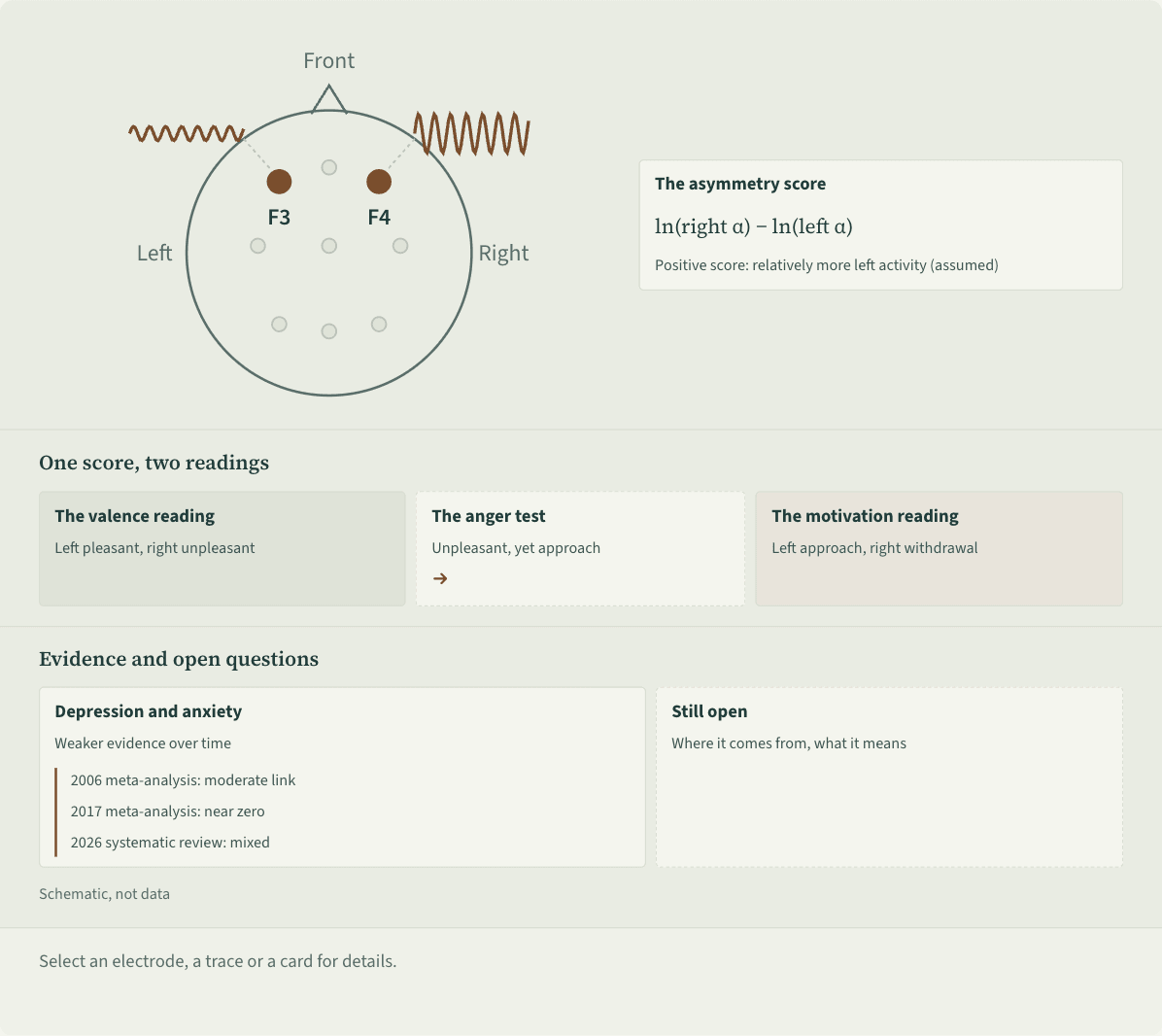
Frontal alpha asymmetry is an EEG measure comparing alpha power over the left and right frontal lobes, usually F4 minus F3.[1] Alpha is treated as an inverse sign of cortical activity, so weaker alpha on one side reads as more activity there.[2] Davidson tied greater left activity to approach motivation and right to withdrawal.[1]
One score, two readings
Evidence and open questions
Schematic, not data
Schematic, top to bottom. At the top is a head seen from above, nose pointing up, with one electrode marked over each side of the forehead: F3 on the left, F4 on the right. Beside each is a stretch of alpha waves, larger on the right than on the left. A formula box reads: log right alpha power minus log left alpha power; a positive score means relatively more left activity. The middle row, labeled two readings, has a valence card (left pleasant, right unpleasant) and a motivation card (left approach, right withdrawal), with anger between them, marked unpleasant but approach-related, pointing to the motivation card. The bottom row, labeled evidence, has one card listing a 2006 meta-analysis finding a moderate link, a 2017 meta-analysis finding one near zero and a 2026 systematic review finding mixed results, and a second card on open questions: where the signal comes from and what it indicates.
 Save as image (PNG)
This figure image is licensed CC BY 4.0: reuse it with credit and a link back to this page. How to reuse
Key points
- A common score subtracts log left alpha power from log right alpha power; higher scores mean relatively more left activity. One to three minutes of artifact-free EEG gives a reliable score.[2]
- Anger feels bad yet pushes people toward confrontation. A 1998 study found relatively more left frontal activity in people high in trait anger, suggesting the asymmetry tracks motivation, not pleasantness.[3]
- A 2006 meta-analysis reported a moderate link between depression and relatively more right-sided activity; a 2017 one limited to diagnosed patients and F3/F4 data (16 studies) found a difference near zero.[1]
- In a 2026 systematic review, 6 of 14 patient–control studies of depression found the expected pattern, 7 no difference and 1 the reverse; pooling 9 of them showed no significant difference.[4]
An example
When a coworker takes credit for her work in a meeting, Ms. Wang is angry enough to stand up and argue. In approach–withdrawal terms, this urge to move in is approach, which studies link with relatively greater left frontal activity; wanting only to slip out of the room would be closer to withdrawal.[3]
Misreadings and limits
It is often summed up as the left front of the brain running happiness and the right running depression and anxiety, or even sold as an EEG test for depression. Resting studies of depression and anxiety are inconsistent,[2] Davidson said the model was never meant to explain depression, and meta-analyses do not support diagnostic use.[1][4]
Sources
- 1 van der Vinne, N., Vollebregt, M. A., van Putten, M. J. A. M., & Arns, M. (2017). Frontal alpha asymmetry as a diagnostic marker in depression: Fact or fiction? A meta-analysis. NeuroImage: Clinical, 16, 79–87. doi:10.1016/j.nicl.2017.07.006
- 2 Smith, E. E., Reznik, S. J., Stewart, J. L., & Allen, J. J. B. (2017). Assessing and conceptualizing frontal EEG asymmetry: An updated primer on recording, processing, analyzing, and interpreting frontal alpha asymmetry. International Journal of Psychophysiology, 111, 98–114. doi:10.1016/j.ijpsycho.2016.11.005
- 3 Harmon-Jones, E., & Allen, J. J. B. (1998). Anger and frontal brain activity: EEG asymmetry consistent with approach motivation despite negative affective valence. Journal of Personality and Social Psychology, 74(5), 1310–1316. doi:10.1037/0022-3514.74.5.1310
- 4 Heitmann, H., Siani, J.-F., Zebhauser, P. T., Henningsen, P., Leucht, S., Priller, J., & Ploner, M. (2026). Resting-state EEG activity in depression: A systematic review and meta-analysis. NeuroImage: Clinical, 50, 103997. doi:10.1016/j.nicl.2026.103997
Last checked against sources: October 28, 2026