Limbic system
边缘系统
What is the limbic system?
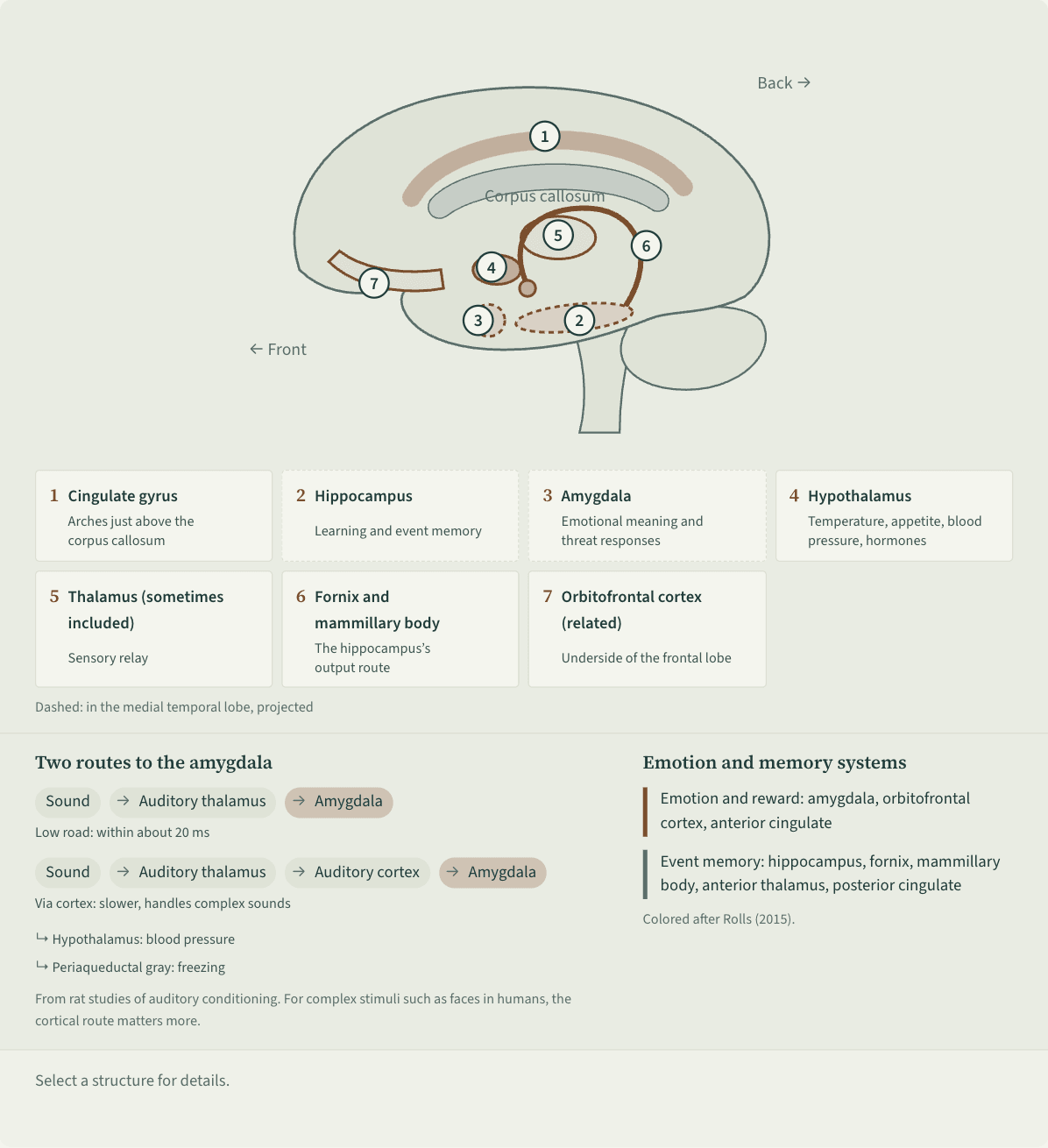
The limbic system is a set of structures on the inner rim of each hemisphere, around the top of the brainstem: usually the hippocampus, amygdala, hypothalamus and cingulate gyrus, sometimes the anterior thalamus.[1][2] Paul MacLean named it in the mid-20th century, seeing it as a unified emotional system.[2][3]
Dashed: in the medial temporal lobe, projected
Two routes to the amygdala
- Sound
- Auditory thalamus
- Amygdala
Low road: within about 20 ms
- Sound
- Auditory thalamus
- Auditory cortex
- Amygdala
Via cortex: slower, handles complex sounds
- Hypothalamus: blood pressure
- Periaqueductal gray: freezing
From rat studies of auditory conditioning. For complex stimuli such as faces in humans, the cortical route matters more.
Emotion and memory systems
Emotion and reward: amygdala, orbitofrontal cortex, anterior cingulate
Event memory: hippocampus, fornix, mammillary body, anterior thalamus, posterior cingulate
Colored after Rolls (2015).
Schematic midline view of the brain, front to the left. The corpus callosum arches across the middle with the cingulate gyrus curving above it; the thalamus sits below the corpus callosum and the hypothalamus below and in front of the thalamus; the fornix curves forward from the hippocampus to the mammillary body. The hippocampus and amygdala are drawn as dashed outlines projected from the medial temporal lobe, the amygdala at the front end of the hippocampus. The orbitofrontal cortex is marked on the underside of the frontal lobe; the brainstem and cerebellum are grey. A second view is a flowchart: sound reaches the amygdala either straight from the auditory thalamus (the low road, within about 20 ms) or through the auditory cortex (slower); the amygdala then changes blood pressure through the hypothalamus and triggers freezing through the periaqueductal gray. A third view colors Rolls’s emotion system (amygdala, orbitofrontal cortex, anterior cingulate) and memory system (hippocampus, fornix, mammillary body, anterior thalamus, posterior cingulate).
 Save as image (PNG)
This figure image is licensed CC BY 4.0: reuse it with credit and a link back to this page. How to reuse
Key points
- The hippocampus is essential for learning and memory. The amygdala helps tie emotional meaning to memories. The hypothalamus regulates temperature, appetite and blood pressure and links nerves to hormones.[1]
- In rats, sound reaches the amygdala straight from the thalamus and also through auditory cortex. This direct “low road” acts within 20 ms; the cortical route is slower but handles complex sounds.[2][3]
- Monkey amygdala neurons also respond to tastes and faces. Rolls argues that complex stimuli such as faces need heavy cortical processing, so the low road is unlikely to carry most primate emotion.[2]
- Rolls argues there is no single limbic system. The amygdala, orbitofrontal cortex and anterior cingulate handle emotion and reward value; the hippocampus, posterior cingulate and anterior thalamus support event memory.[2]
An example
Jay was knocked down by a dog as a child. When a dog barks behind him, his heart jumps and he stops short, then turns to see a small leashed dog. In LeDoux’s rat studies, a simple sound once paired with danger, relayed straight from thalamus to amygdala, was enough to trigger quick defenses; finer discrimination needed cortex.[3]
Misreadings and limits
The limbic system is often called the emotional brain, and the amygdala the fear center. LeDoux notes there are no agreed criteria for what counts as limbic, and the theory does not explain how emotions arise.[3] The amygdala detects threats and triggers defenses, but conscious fear involves other circuits; a woman with damage to both amygdalae could still feel fear.[4]
Sources
- 1 Spielman, R. M., Jenkins, W. J., & Lovett, M. D. (2020). 3.4 The brain and spinal cord. Psychology 2e. OpenStax. View source
- 2 Rolls, E. T. (2015). Limbic systems for emotion and for memory, but no single limbic system. Cortex, 62, 119–157. doi:10.1016/j.cortex.2013.12.005
- 3 LeDoux, J. (2003). The emotional brain, fear, and the amygdala. Cellular and Molecular Neurobiology, 23(4–5), 727–738. doi:10.1023/A:1025048802629
- 4 LeDoux, J. E. (2014). Coming to terms with fear. Proceedings of the National Academy of Sciences, 111(8), 2871–2878. doi:10.1073/pnas.1400335111
Last checked against sources: October 27, 2026