Maladaptive daydreaming
适应不良性白日梦
Maladaptive daydreaming is extensive, immersive fantasy activity that replaces human interaction or interferes with academic, interpersonal or work functioning. Eli Somer introduced the term in 2002.[1]
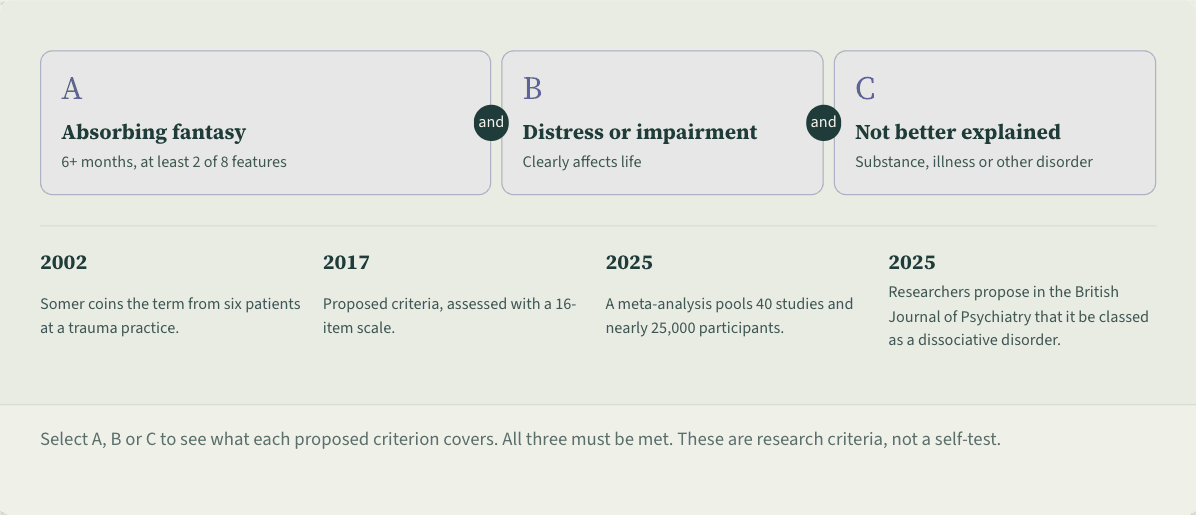
- 2002 Somer coins the term from six patients at a trauma practice.
- 2017 Proposed criteria, assessed with a 16-item scale.
- 2025 A meta-analysis pools 40 studies and nearly 25,000 participants.
- 2025 Researchers propose in the British Journal of Psychiatry that it be classed as a dissociative disorder.
Three boxes joined by “and”: A absorbing fantasy (6+ months, at least 2 of 8 features), B distress or impairment, C not better explained. Below, a timeline: 2002 term coined, 2017 proposed criteria, 2025 meta-analysis, 2025 proposal to class it as a dissociative disorder.
 Save as image (PNG)
Key points
- Somer’s first report described six patients from a trauma practice; he saw adverse circumstances as contributing to the habit.[1]
- Criteria proposed in 2017 require at least 6 months of vivid, absorbing fantasy with two or more listed features, such as music or pacing triggers or failed control, plus distress or impairment.[2]
- The 16-item Maladaptive Daydreaming Scale (MDS-16), with a cutoff of 50, separated cases from controls with 96.8% sensitivity and 100% specificity in one study.[2]
- A meta-analysis of 40 studies linked it with depression, anxiety, dissociation, OCD and Attention-deficit/hyperactivity disorder (ADHD) symptoms.[4]
An example
After work, Jay often puts on headphones and paces his room for hours, absorbed in a long-running story he has invented. He skips dinner and drifts off at work the next day. He has tried to cut back but keeps slipping into it.
Misreadings and limits
Maladaptive daydreaming is not formally recognized in diagnostic manuals; its criteria and scales are research tools, and in 2025 researchers proposed classing it as a dissociative disorder.[2][3] A rich fantasy life alone is not a problem: the proposed criteria require clear distress or impairment.[2]
Sources
- 1 Somer, E. (2002). Maladaptive daydreaming: A qualitative inquiry. Journal of Contemporary Psychotherapy, 32(2–3), 197–212. doi:10.1023/A:1020597026919
- 2 Somer, E., Soffer-Dudek, N., Ross, C. A., & Halpern, N. (2017). Maladaptive daydreaming: Proposed diagnostic criteria and their assessment with a structured clinical interview. Psychology of Consciousness: Theory, Research, and Practice, 4(2), 176–189. doi:10.1037/cns0000114
- 3 Soffer-Dudek, N., Somer, E., Spiegel, D., et al. (2025). Maladaptive daydreaming should be included as a dissociative disorder in psychiatric manuals: Position paper. The British Journal of Psychiatry, 226, 238–242. doi:10.1192/bjp.2024.279
- 4 Somer, E., Herscu, O., Samara, M., & Abu-Rayya, H. M. (2025). Maladaptive daydreaming and psychopathology: A meta-analysis. International Journal of Psychology, 60(2), e70027. View source
Last checked against sources: October 26, 2026