Attention-deficit/hyperactivity disorder (ADHD)
注意缺陷多动障碍(ADHD)
A neurodevelopmental disorder marked by ongoing inattention and/or hyperactivity and impulsivity that are frequent, show up across settings and interfere with daily life.[1][2]
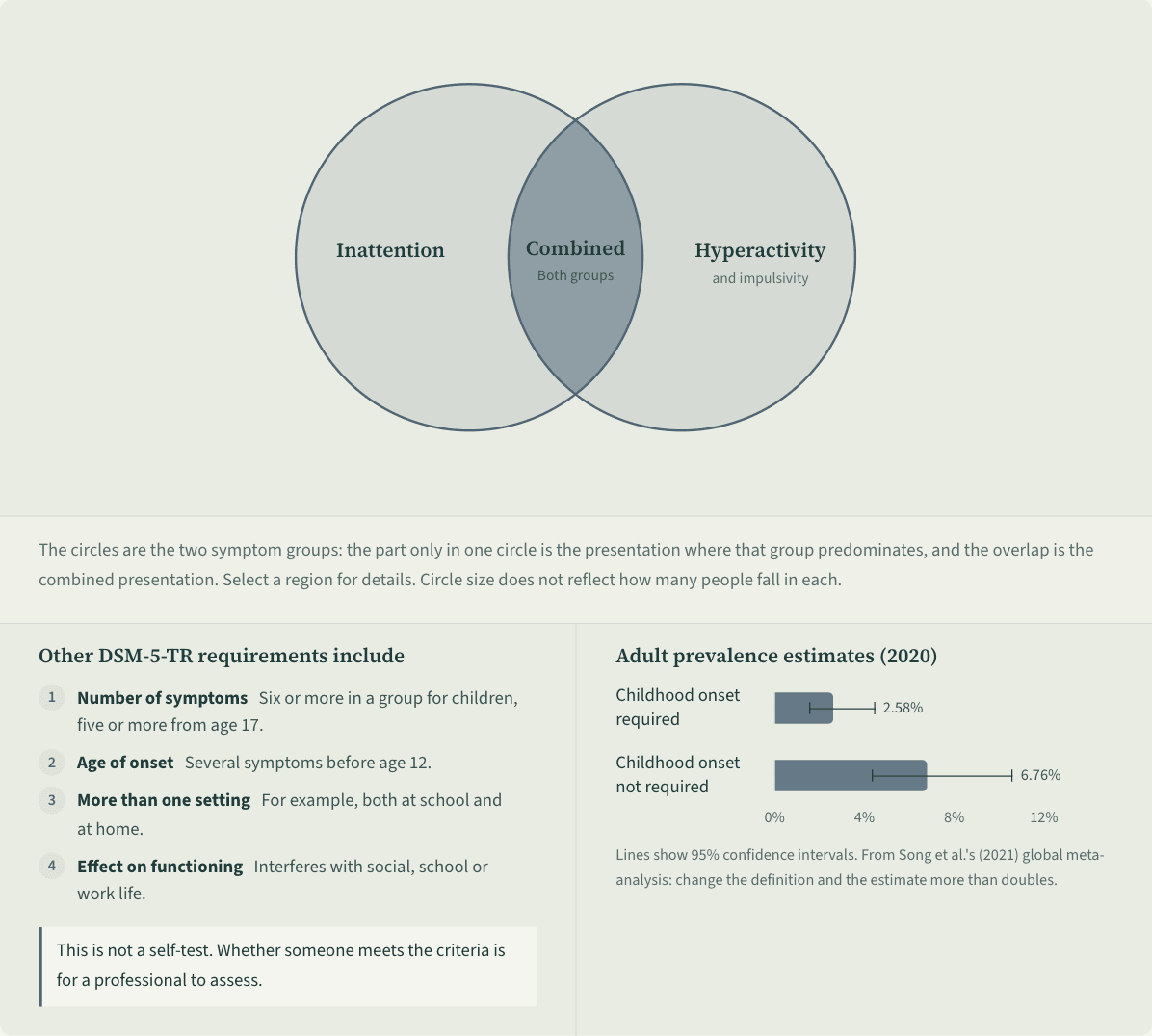
Other DSM-5-TR requirements include
- Number of symptoms Six or more in a group for children, five or more from age 17.
- Age of onset Several symptoms before age 12.
- More than one setting For example, both at school and at home.
- Effect on functioning Interferes with social, school or work life.
This is not a self-test. Whether someone meets the criteria is for a professional to assess.
Adult prevalence estimates (2020)
Lines show 95% confidence intervals. From Song et al.'s (2021) global meta-analysis: change the definition and the estimate more than doubles.
Top: two overlapping circles. The left circle is inattention; the part only in it is the predominantly inattentive presentation. The right circle is hyperactivity-impulsivity; the part only in it is the predominantly hyperactive-impulsive presentation. The overlap is the combined presentation. Bottom left, DSM-5-TR’s other requirements: six or more symptoms in a group for children, five or more from age 17; several symptoms before age 12; present in more than one setting, such as school and home; interfering with social, school or work functioning. Bottom right, two bars for 2020 estimates of adult prevalence: 2.58% when childhood onset is required (95% CI 1.51–4.45%) and 6.76% when it is not (4.31–10.61%).
 Save as image (PNG)
Key points
- DSM-5-TR sorts symptoms into inattention and hyperactivity-impulsivity. Children need six or more symptoms in a group, people 17 and older five or more, and several must appear before age 12.[1]
- Depending on which symptoms dominate, there are three presentations: predominantly inattentive, predominantly hyperactive-impulsive, and combined.[3]
- Symptoms start in childhood and usually continue into the teen years and adulthood.[2] A 2021 global meta-analysis put adult ADHD with childhood onset at about 2.6%.[4]
- Standard treatments are medication and psychosocial interventions such as Cognitive behavioral therapy, parent training and school-based support.[2]
An example
After watching a short video’s ADHD checklist, Yu feels every item fits: she zones out and loses her keys. Everyone does these things now and then. A clinical assessment looks at whether they are frequent, appear across settings and have affected life since childhood, and a professional carries it out.
Misreadings and limits
Occasional distraction or restlessness is not ADHD. NIMH notes that many people show these behaviors some of the time; in ADHD they are frequent, appear across settings and interfere with daily life.[2] Without the childhood-onset requirement, the adult estimate rises to 6.8%, so figures depend heavily on definitions.[4]
Sources
- 1 Centers for Disease Control and Prevention (2026). Clinical care of ADHD in children. Centers for Disease Control and Prevention (DSM-5-TR criteria in shortened form; last reviewed October 21, 2026). View source
- 2 National Institute of Mental Health (2026). Attention-deficit/hyperactivity disorder (ADHD). National Institute of Mental Health (last reviewed August 2026). View source
- 3 Centers for Disease Control and Prevention (2026). Symptoms of ADHD. Centers for Disease Control and Prevention (last reviewed July 30, 2026). View source
- 4 Song, P., Zha, M., Yang, Q., Zhang, Y., Li, X., & Rudan, I. (2021). The prevalence of adult attention-deficit hyperactivity disorder: A global systematic review and meta-analysis. Journal of Global Health, 11, 04009. doi:10.7189/jogh.11.04009
Last checked against sources: October 26, 2026