Mind-wandering
心智游移
Mind-wandering is a shift of attention away from the current task toward unrelated, self-generated thoughts and feelings. It is common and usually unintended; in everyday speech it is called zoning out or daydreaming.[1][3]
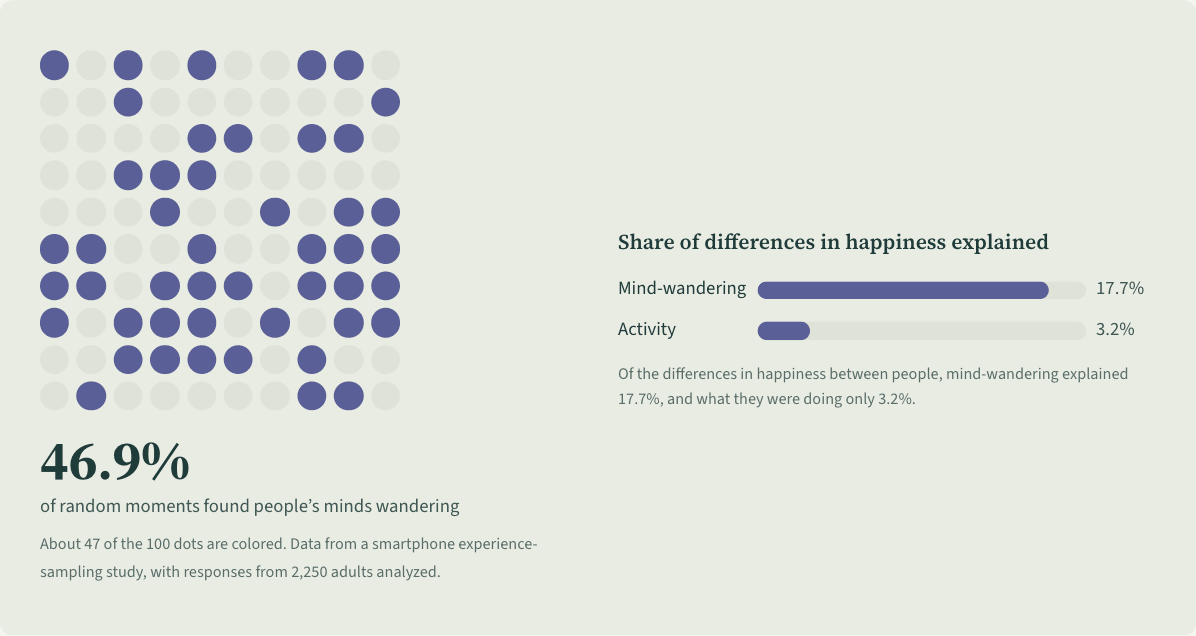
46.9% of random moments found people’s minds wandering
About 47 of the 100 dots are colored. Data from a smartphone experience-sampling study, with responses from 2,250 adults analyzed.
A 10-by-10 grid of dots with 47 colored and the figure 46.9%. Beside it, two bars: mind-wandering explained 17.7% of the differences in happiness between people, activity only 3.2%.
 Save as image (PNG)
Key points
- A smartphone experience-sampling study of 2,250 adults found their minds wandering in 46.9% of samples.[2]
- In the same study people were less happy while mind-wandering, and time-lag analyses suggested it was generally a cause of unhappiness, not merely a result.[2]
- In one study of people injured in road crashes, being deeply absorbed in mind-wandering was the strongest single predictor of being responsible for the crash.[1]
- During mind-wandering, the default mode network, centered on the posterior cingulate and medial prefrontal cortex, becomes more active.[1]
An example
Lin finishes three pages of a report, flips back to the first and realizes she remembers none of it. Her thoughts had drifted to her weekend trip.
Misreadings and limits
“A wandering mind is an unhappy mind” is often stretched into “mind-wandering is bad.” A major review notes that it impairs reading comprehension and sustained attention but may also help with planning, creative ideas and relief from boredom.[1] Frequent, absorbing fantasy that disrupts life is a separate topic: Maladaptive daydreaming.
Sources
- 1 Smallwood, J., & Schooler, J. W. (2015). The science of mind wandering: Empirically navigating the stream of consciousness. Annual Review of Psychology, 66, 487–518. doi:10.1146/annurev-psych-010814-015331
- 2 Killingsworth, M. A., & Gilbert, D. T. (2010). A wandering mind is an unhappy mind. Science, 330(6006), 932. doi:10.1126/science.1192439
- 3 宋晓兰, 王晓, & 唐孝威 (2011). 心智游移:现象、机制及意义. 心理科学进展, 19(4), 499–509. View source
Last checked against sources: October 26, 2026