Sleepwalking
睡行症
Sleepwalking is a parasomnia in which a person partly arouses from N3, the deepest stage of non-REM sleep, and sits up, walks or does complex things without full awareness, usually with no memory of it afterward.[1][2]
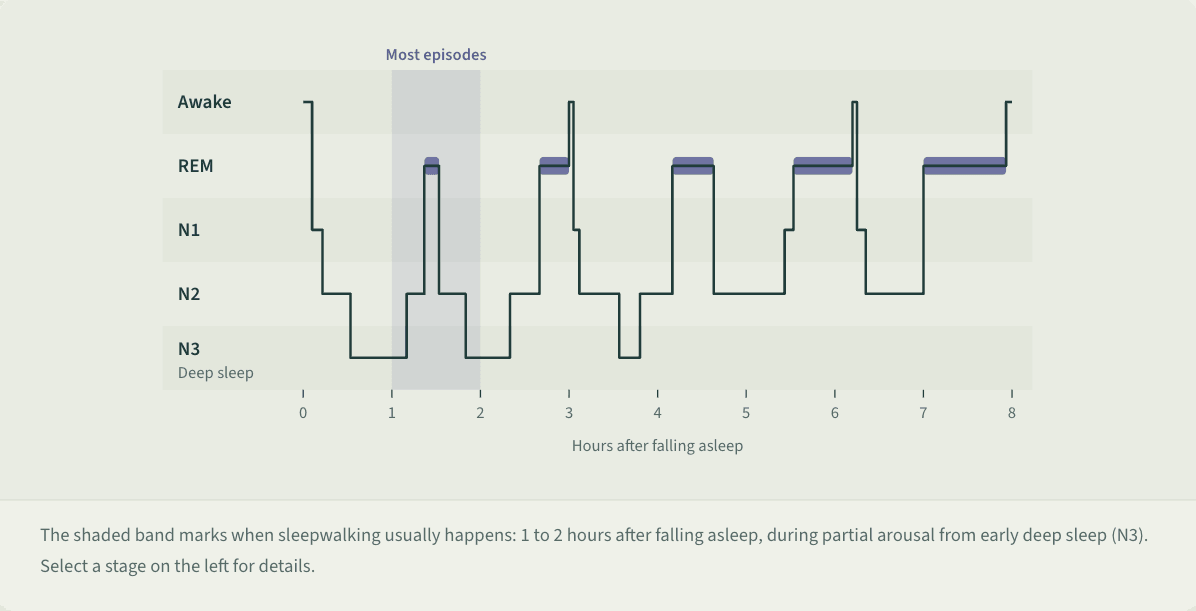
The same sleep chart as for sleep stages, with the band from 1 to 2 hours after sleep onset shaded over the N3 deep-sleep stretches of the first cycles and labeled most episodes.
 Save as image (PNG)
Key points
- Episodes usually happen early in the night, 1 to 2 hours after falling asleep, and typically last several minutes.[1]
- It is more common in children, and most outgrow it by their teens; it affects up to 4% of adults.[1][2]
- Triggers include too little sleep, stress, fever and disrupted schedules. It is more common in people whose parents sleepwalked.[1]
- The main risk is injury. In a study of 100 adult sleepwalkers, 17% had an episode in which they or a bed partner were hurt badly enough to need medical care.[2]
An example
Jay’s parents find him in the living room at midnight, eyes open but barely responding. Instead of shaking him awake, they quietly lead him back to bed. The next morning he has no memory of it.
Misreadings and limits
The idea that waking a sleepwalker damages the brain or heart, or can kill them, is a myth. The real risk is that a startled, confused person may fall or lash out, so the usual advice is to guide them gently back to bed rather than shake them awake.[3]
Sources
- 1 Mayo Clinic Staff (2024). Sleepwalking: Symptoms and causes. Mayo Clinic. View source
- 2 American Academy of Sleep Medicine (2013). Adult sleepwalking serious condition that impacts quality of life. Sleep Education (sleepeducation.org), American Academy of Sleep Medicine. View source
- 3 Sukel, K. (2019). Is it dangerous to wake a sleepwalker?. BrainFacts.org, Society for Neuroscience. View source
Last checked against sources: October 26, 2026