Five stages of grief
哀伤五阶段
The five stages of grief come from Elisabeth Kübler-Ross’s 1969 book On Death and Dying, which described dying patients moving through denial, anger, bargaining, depression and acceptance. The model was later applied widely to bereaved people.[1]
The five reactions Kübler-Ross described in dying patients
- Denial
- Anger
- Bargaining
- Depression
- Acceptance
No numbers and no arrows: research does not support a fixed order.
What bereaved people actually reported
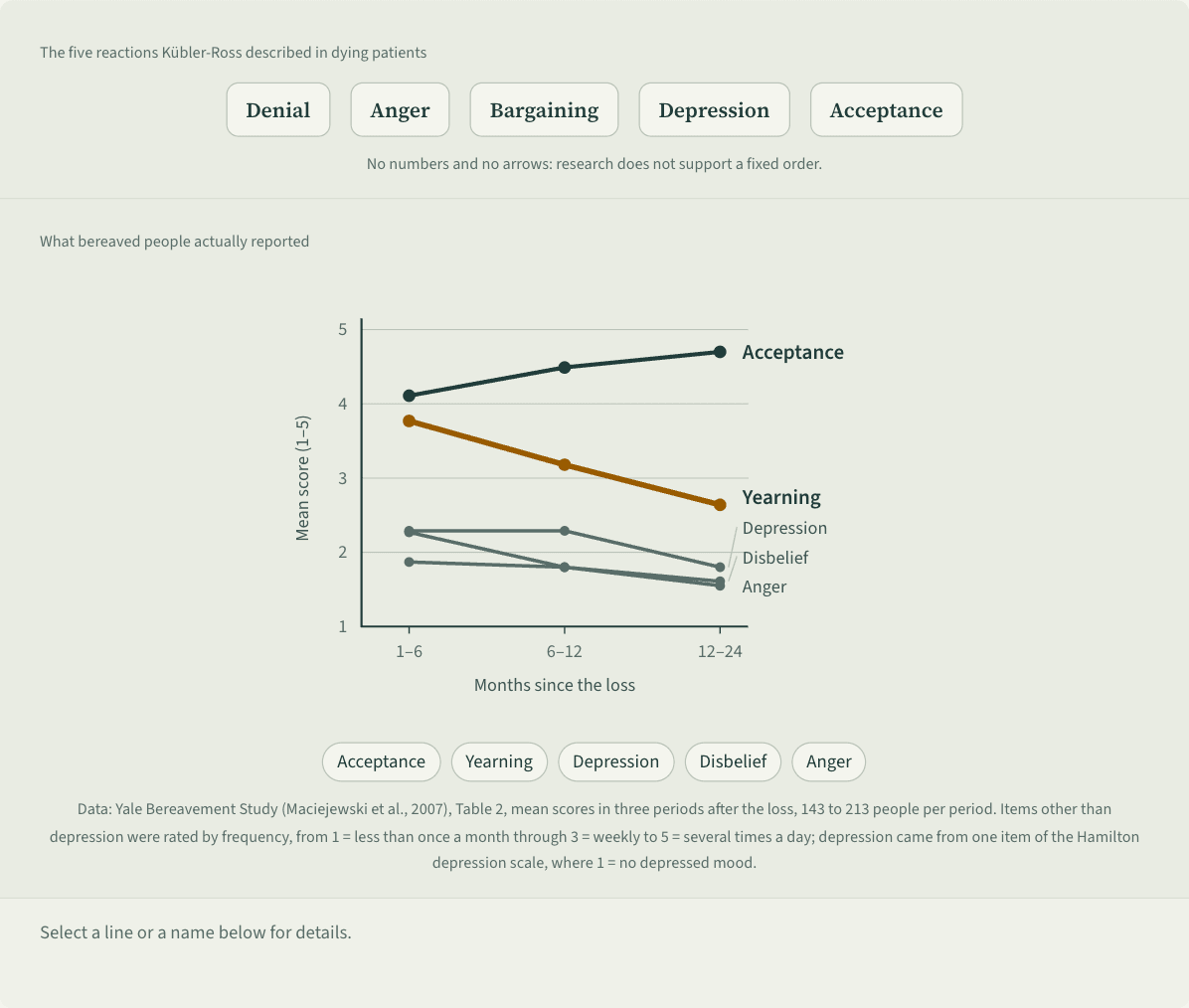
Data: Yale Bereavement Study (Maciejewski et al., 2007), Table 2, mean scores in three periods after the loss, 143 to 213 people per period. Items other than depression were rated by frequency, from 1 = less than once a month through 3 = weekly to 5 = several times a day; depression came from one item of the Hamilton depression scale, where 1 = no depressed mood.
At the top, five boxes in no particular order read denial, anger, bargaining, depression and acceptance, with no numbers or arrows. Below, a line chart of mean scores from 1 to 5 in three periods after the loss (1–6, 6–12 and 12–24 months): acceptance is highest and keeps rising, at 4.11, 4.49 and 4.70; yearning, drawn in the accent color, falls from 3.77 to 3.18 and 2.64 and is always the highest negative experience; depression is 2.29, 2.29 and 1.80; disbelief 2.27, 1.80 and 1.61; anger 1.87, 1.80 and 1.55. A note gives the source as Table 2 of a bereavement study, with 143 to 213 people per period.
 Save as image (PNG)
Key points
- The model was built from case studies of dying patients, not from systematic research on bereaved people.[1]
- A study of 233 people interviewed 1 to 24 months after a loss found acceptance was the most endorsed item and yearning, absent from the model, the dominant negative experience.[2]
- Reviewers find little support for a fixed sequence, and expecting bereaved people to pass through stages can harm them by making them feel they are not coping properly.[1]
- Researchers recommend moving to other frameworks, such as the dual process model, task models, grief trajectories and meaning-making.[1]
An example
Six months after his father’s death, Jay still has sudden waves of longing, yet on other days he works and sees friends as usual. A friend says he “hasn’t reached acceptance yet,” but his grief does not seem to follow any order.
Misreadings and limits
The most common misreading treats the five stages as a sequence everyone must complete. Kübler-Ross observed dying patients, research does not support a fixed order, and using the stages as a yardstick can leave bereaved people worried that they are grieving wrongly.[1]
Sources
- 1 Stroebe, M., Schut, H., & Boerner, K. (2017). Cautioning health-care professionals: Bereaved persons are misguided through the stages of grief. OMEGA – Journal of Death and Dying, 74(4), 455–473. doi:10.1177/0030222817691870
- 2 Maciejewski, P. K., Zhang, B., Block, S. D., & Prigerson, H. G. (2007). An empirical examination of the stage theory of grief. JAMA, 297(7), 716–723. doi:10.1001/jama.297.7.716
Last checked against sources: October 26, 2026