Wise mind
智慧心
Wise mind is a concept from the mindfulness skills of dialectical behavior therapy (DBT). It refers to the wisdom within each person, which sees the value of both reason and emotion and takes the middle path.[1]
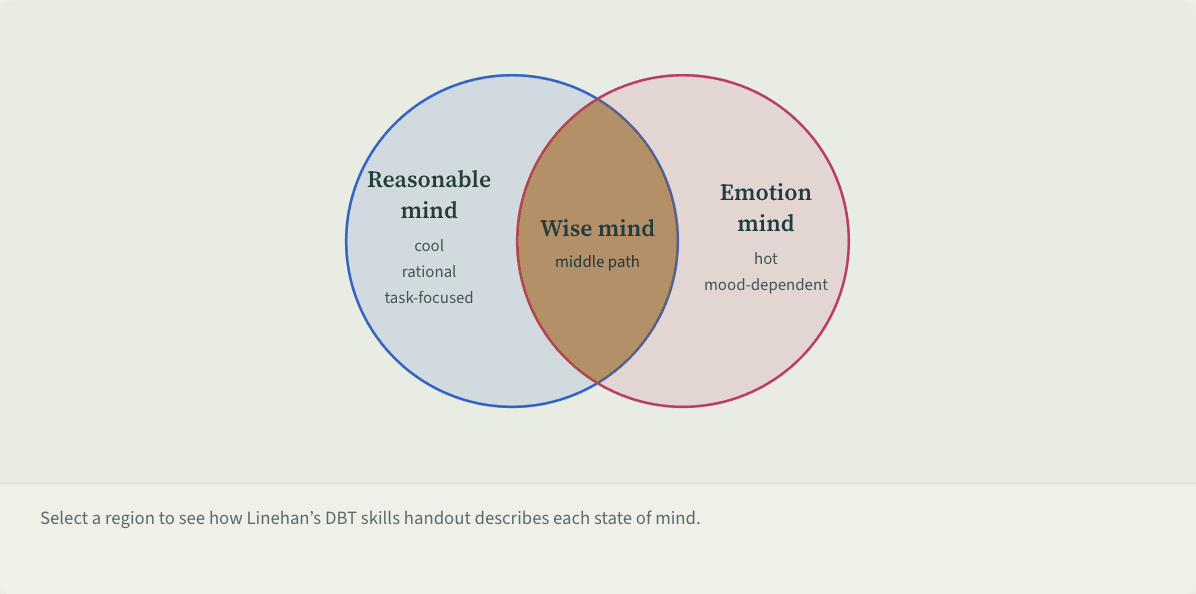
Two overlapping circles. The left circle is reasonable mind, labeled cool, rational and task-focused; the right circle is emotion mind, labeled hot and mood-dependent; the overlap is wise mind, labeled the middle path.
 Save as image (PNG)
Key points
- Reasonable mind is cool, rational and task-focused. It is ruled by facts, reason, logic and pragmatics, and sets values and feelings aside.[1]
- Emotion mind is hot and mood-dependent. It is ruled by moods, feelings and urges to do or say things, and sets facts, reason and logic aside.[1]
- Wise mind integrates the two, weighing facts and feelings as well as values and goals.[3]
- DBT skills come in four modules: mindfulness, interpersonal effectiveness, emotion regulation and distress tolerance. Wise mind is taught in the mindfulness module.[1][2]
An example
Ms. Wang is offered a better-paid job in another city. Looking only at the salary, she wants to accept at once; thinking of leaving her family, she wants to refuse right away. She pauses to ask what she really values and proposes a three-month remote trial first.
Misreadings and limits
Wise mind is often taken to mean letting reason override emotion. DBT describes it as seeing the value of both; relying on reasonable mind alone also ignores feelings and values.[1][3]
Sources
- 1 Linehan, M. M. (2015). DBT skills training handouts and worksheets (2nd ed.). Mindfulness Handout 3: Wise mind: States of mind. Guilford Press. View source
- 2 Linehan Institute (n.d.). DBT skills training manual (2nd ed.) [book page]. The Linehan Institute. View source
- 3 Hellberg, S., Kirby, J., & Hopkins, T. (2023). Surviving and thriving in clinical science training: Wise mind. Psychological Clinical Science Accreditation System (PCSAS) newsletter. View source
Last checked against sources: October 26, 2026