Yerkes–Dodson law
耶克斯-多德森定律
The Yerkes–Dodson law comes from a 1908 mouse study by Robert Yerkes and John Dodson, in which the shock strength that produced the fastest learning depended on how hard the discrimination task was.[1][3] It was later recast as an inverted-U law of arousal and performance.[2]
A
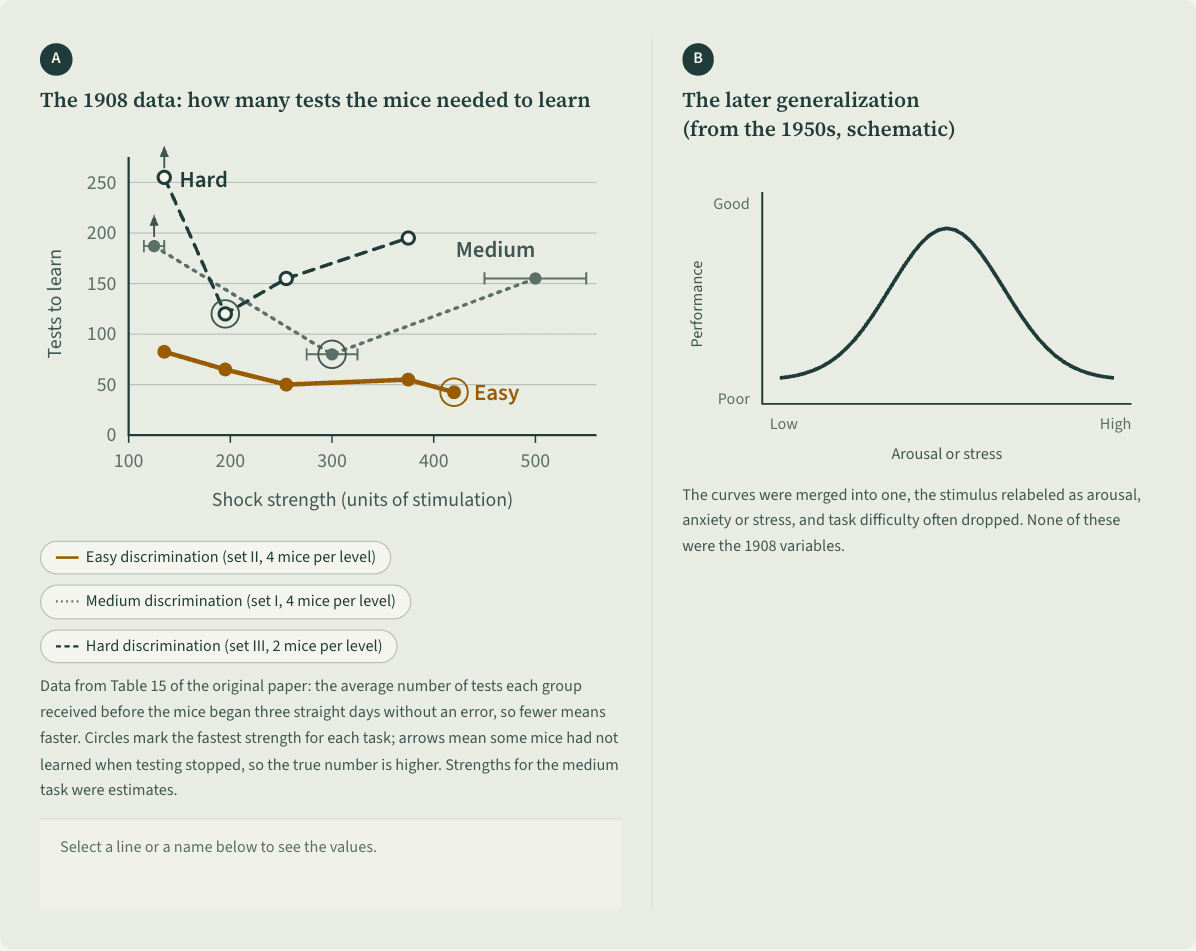
The 1908 data: how many tests the mice needed to learn
Data from Table 15 of the original paper: the average number of tests each group received before the mice began three straight days without an error, so fewer means faster. Circles mark the fastest strength for each task; arrows mean some mice had not learned when testing stopped, so the true number is higher. Strengths for the medium task were estimates.
B
The later generalization (from the 1950s, schematic)
The curves were merged into one, the stimulus relabeled as arousal, anxiety or stress, and task difficulty often dropped. None of these were the 1908 variables.
Two charts. Chart A shows the original 1908 data, with shock strength from 100 to 500 units of stimulation across and the number of tests the mice needed to learn up the side, where fewer means faster. The easy-task line mostly falls, from 82.5 tests at 135 units to a low of 42.5 at 420. The medium task, whose strengths were estimated, needed 187 or more, 80 and 155 tests at about 125, 300 and 500 units, so the middle strength was fastest. The hard task needed 255, 120, 155 and 195 tests at 135, 195, 255 and 375 units, fastest at 195. Each strength used 2 to 4 mice. Chart B is a schematic inverted U of performance against arousal or stress, noted as a generalization from the 1950s onward whose variables were not those of the 1908 study.
 Save as image (PNG)
Key points
- Mice learned to avoid a shocked black passage and pick a white one, while the researchers varied shock strength and, through lighting, how hard the passages were to tell apart.[3]
- When the task was easy, learning was fastest at the strongest of five shock levels. When it was hard, a weaker shock worked best and stronger shocks slowed learning.[3]
- The data were thin: each condition used only two to four mice, and the U shape appeared only for harder tasks.[3]
- After a 1950s revival built on Hebb’s concept of arousal, the curves were merged into one and the stimulus relabeled as arousal, anxiety or stress, still credited to Yerkes and Dodson.[2][3]
An example
Ms. Wang is preparing an important presentation. With no pressure at all she keeps putting it off; with the deadline close and some tension she works best; the night before, she is so anxious she cannot remember her notes. People often cite experiences like this to illustrate the inverted U.
Misreadings and limits
The inverted U is often presented as Yerkes and Dodson’s universal law of human stress and performance. Their study measured how fast mice learned under shock, and later restatements rarely acknowledged how far they had moved from it.[2][3]
Sources
- 1 Yerkes, R. M., & Dodson, J. D. (1908). The relation of strength of stimulus to rapidity of habit-formation. Journal of Comparative Neurology and Psychology, 18, 459–482. View source
- 2 Teigen, K. H. (1994). Yerkes-Dodson: A law for all seasons. Theory & Psychology, 4(4), 525–547. doi:10.1177/0959354394044004
- 3 Teigen, K. H. (2017). En artikkel for alle årstider. Tidsskrift for Norsk psykologforening (published 2 May 2017). View source
Last checked against sources: October 26, 2026