Fight-or-flight response
战斗-逃跑反应
The fight-or-flight response is the set of stress behaviors and physiological changes that humans and animals show when their survival is threatened, readying them to fight or escape.[3] Walter Cannon was the first to describe it.[1]
The defense cascade: fight or flight is one step
Two pathways in the body
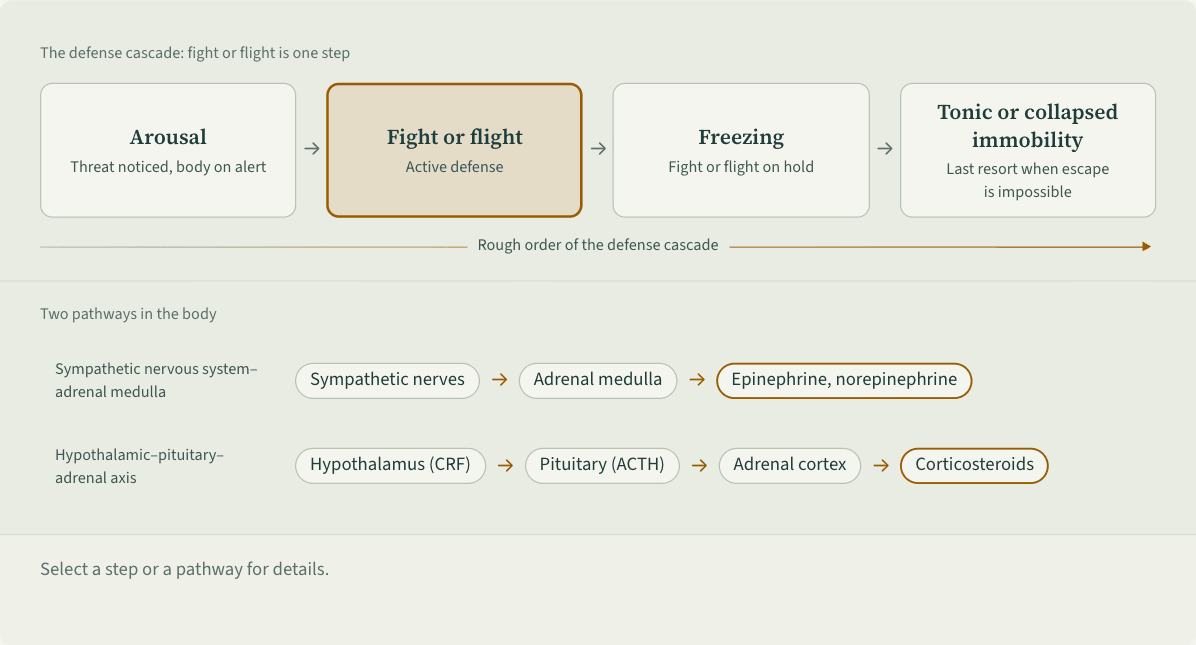
Four boxes run left to right: arousal; fight or flight (highlighted); freezing, fight or flight on hold; and tonic or collapsed immobility, the last resort when escape is impossible. An arrow beneath shows the order of the cascade, ending with threats that cannot be escaped. Below, two pathways: sympathetic nerves to the adrenal medulla, releasing epinephrine and norepinephrine; and hypothalamus (CRF) to pituitary (ACTH) to adrenal cortex, releasing corticosteroids.
 Save as image (PNG)
Key points
- The sympathetic nervous system stimulates the adrenal medulla to release epinephrine (adrenaline) and norepinephrine, while the hypothalamic–pituitary–adrenal axis triggers corticosteroid release from the adrenal cortex.[1]
- It is one part of a wider defense cascade: arousal, then fight or flight; freezing is fight-or-flight put on hold; tonic or collapsed immobility is a last resort against inescapable threat.[2]
- Taylor and colleagues proposed that females under stress may also “tend and befriend,” protecting offspring and building social ties, possibly with oxytocin involved; they called parts of this conjectural.[1]
An example
Walking down a dark lane at night, Jay hears quick footsteps behind him. His heart pounds, his breathing speeds up, his muscles tense, and he walks faster before he has really thought about it. When he sees it is a neighbor out jogging, it takes him a while to calm down.
Misreadings and limits
A common misreading is that people under threat can only fight or flee, and that freezing or going limp signals weakness. Researchers describe freezing and immobility as innate, automatically activated defenses, not deliberate choices.[2]
Sources
- 1 Taylor, S. E., Klein, L. C., Lewis, B. P., Gruenewald, T. L., Gurung, R. A. R., & Updegraff, J. A. (2000). Biobehavioral responses to stress in females: Tend-and-befriend, not fight-or-flight. Psychological Review, 107(3), 411–429. doi:10.1037/0033-295X.107.3.411
- 2 Kozlowska, K., Walker, P., McLean, L., & Carrive, P. (2015). Fear and the defense cascade: Clinical implications and management. Harvard Review of Psychiatry, 23(4), 263–287. View source
- 3 曹鹏, & 王倩 (2016). 综述:引发“战斗-逃跑”反应的神经环路机制. 生物化学与生物物理进展, 43(4), 326–329. View source
Last checked against sources: October 26, 2026