Window of tolerance
情绪容纳之窗
The window of tolerance is the range of arousal within which a person can process emotions and keep thinking and acting effectively. Its width varies with temperament, upbringing and experience.[1] The idea comes from Daniel Siegel’s 1999 book The Developing Mind.[1][2]
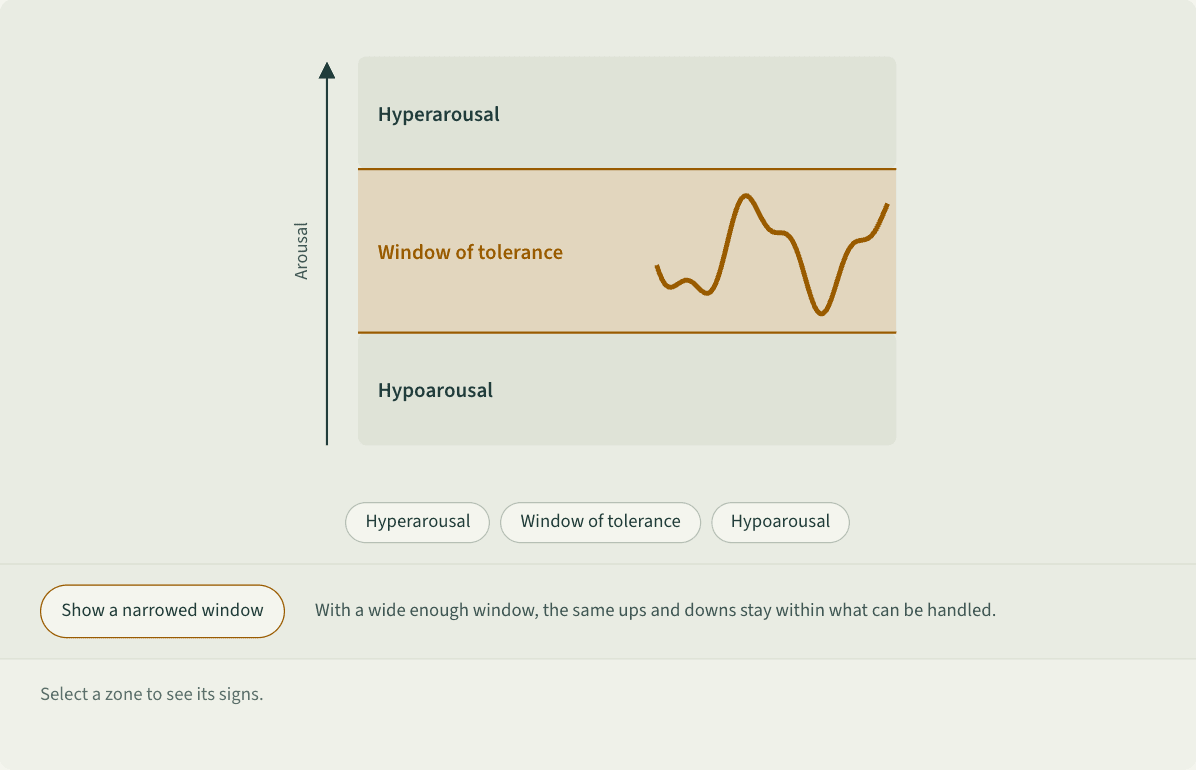
Arousal runs up the vertical axis, split from top to bottom into three bands: hyperarousal, the window of tolerance and hypoarousal. A wavy line shows arousal changing over time. With a wide window the line stays inside it; when the narrowed window is shown, the peaks and troughs of the same line spill into the bands above and below. Each zone can be selected to see its signs.
 Save as image (PNG)
Key points
- Above the window is hyperarousal: intense anger, agitation, confusion, loss of control or an urge to flee or fight, with a racing heart and fast breathing.[1][2]
- Below it is hypoarousal: numbness, drowsiness, trouble thinking or focusing, low motivation, and a body that feels limp or stiff.[1][2]
- Trauma can narrow the window, so reminders of the trauma readily push a person into extreme states; some researchers read self-harm and substance use as attempts to regulate this.[2][3]
- The window can be widened by noticing triggers, observing emotions without judging them, relaxing the body and talking with trusted people; trauma therapists also work at its edges to expand it.[1][2]
An example
During an argument with his partner, Jay’s voice keeps rising, his heart races and all he wants is to storm out. Recognizing he has moved above his window, he asks for a 20-minute break. After a walk he can calmly say what he actually cares about.
Misreadings and limits
The window is often read as a zone of calm with no emotional ups and downs. Inside it a person can still feel emotions rise and fall while staying focused, thinking clearly and relating calmly to others, and its width is not fixed: it changes with experience and can be widened through practice.[1]
Sources
- 1 Social Welfare Department, Clinical Psychology Services (Hong Kong) (n.d.). Window of tolerance [leaflet; English and Simplified Chinese versions]. Social Welfare Department, Hong Kong SAR Government. View source
- 2 Buckley, T. (n.d.). Trauma and the body: An introduction to Sensorimotor Psychotherapy [slides; © Sensorimotor Psychotherapy Institute 2012]. British Association for Counselling and Psychotherapy (bacp.co.uk). View source
- 3 Corrigan, F. M., Fisher, J. J., & Nutt, D. J. (2011). Autonomic dysregulation and the window of tolerance model of the effects of complex emotional trauma. Journal of Psychopharmacology, 25(1), 17–25. View source
Last checked against sources: October 26, 2026