Classical conditioning
经典条件反射
Classical conditioning is a form of associative learning: a neutral stimulus that repeatedly comes just before a stimulus that naturally triggers a response begins to trigger a similar response on its own. Ivan Pavlov studied the process systematically in experiments on salivation in dogs.[1][2]
Before conditioning
During conditioning
After conditioning
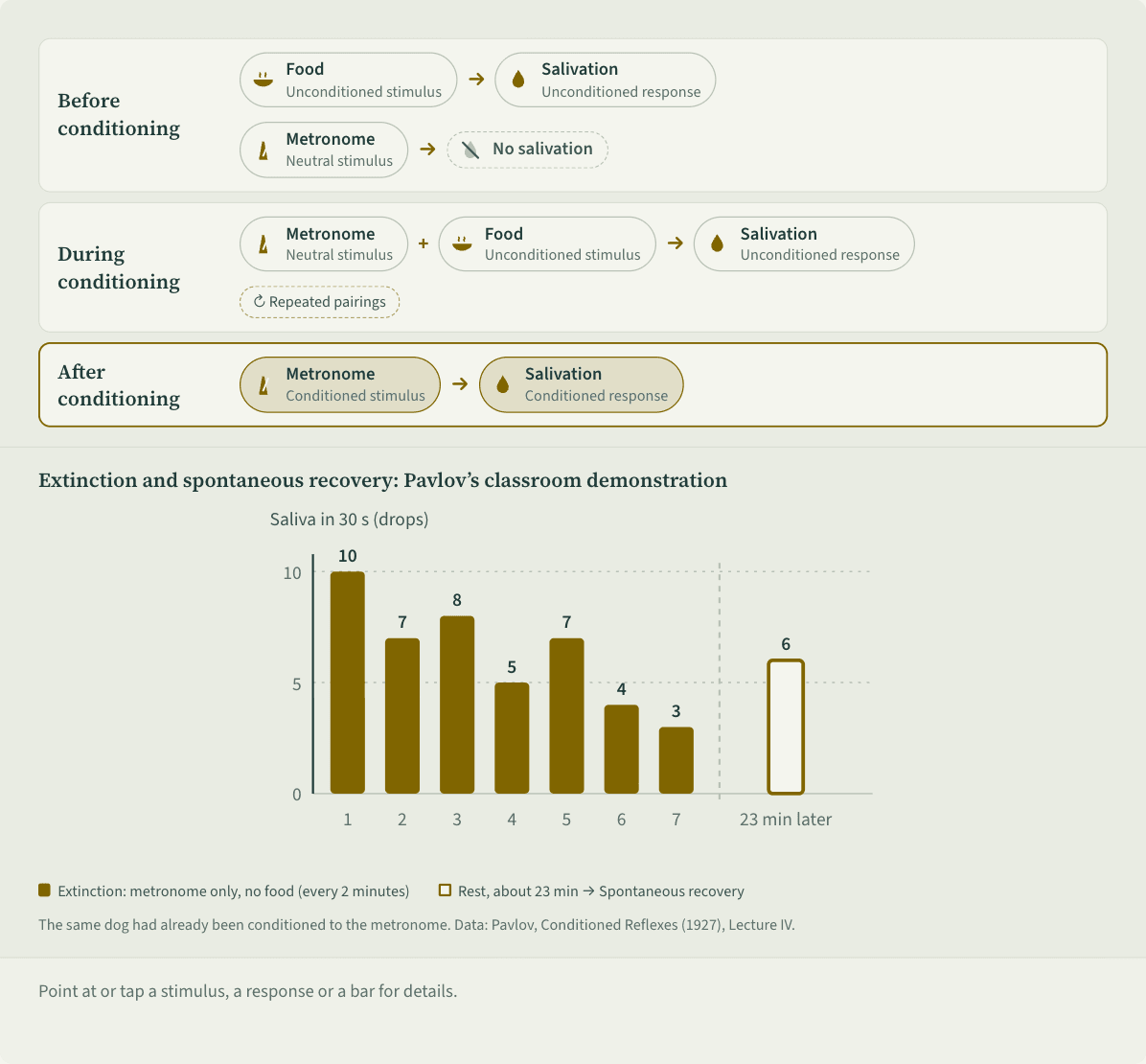
Extinction and spontaneous recovery: Pavlov’s classroom demonstration
- Extinction: metronome only, no food (every 2 minutes)
- Rest, about 23 min → Spontaneous recovery
The same dog had already been conditioned to the metronome. Data: Pavlov, Conditioned Reflexes (1927), Lecture IV.
The top half shows three stages. Before conditioning: food (unconditioned stimulus) causes salivation (unconditioned response); a metronome sound (neutral stimulus) causes none. During conditioning: the metronome sounds and food follows at once, causing salivation; this pairing is repeated. After conditioning: the metronome alone (conditioned stimulus) causes salivation (conditioned response). The bottom half is a bar chart of drops of saliva in 30 seconds. With the metronome sounded every 2 minutes and no food, the seven trials gave 10, 7, 8, 5, 7, 4 and 3 drops, and the delay before salivation grew from 3 to 13 seconds: extinction. After a rest of about 23 minutes, one more trial gave 6 drops after 5 seconds: spontaneous recovery. Data from Lecture IV of Pavlov’s Conditioned Reflexes (1927).
 Save as image (PNG)
Key points
- Food is the unconditioned stimulus; salivation to it, the unconditioned response. A metronome sound starts neutral and, after pairing, becomes a conditioned stimulus whose salivation is the conditioned response.[1][2]
- The neutral stimulus must start before the unconditioned stimulus and overlap it. In Pavlov’s lab, a bell sounded after feeding produced no conditioned reflex, even after 374 pairings.[1]
- If the conditioned stimulus keeps coming without food, the response fades: extinction. After a rest of minutes to hours, it can come back on its own: spontaneous recovery.[1][2]
- Stimuli similar to the conditioned stimulus also trigger the response, more strongly the more similar they are: generalization. If only one is followed by food, the animal learns to tell them apart.[1][2]
An example
Whenever Jay had a filling, the whine of the drill came with an ache. After a few visits, the sound alone sets his heart racing at the clinic, and a neighbor’s power drill at home makes him tense up too. The drill sound has become a conditioned stimulus; reacting to similar sounds is generalization.
Misreadings and limits
Two common misreadings. Pairing alone is not enough: what matters is whether the conditioned stimulus predicts the unconditioned one.[3] And extinction does not erase the original learning: the response can return after a change of setting, the passage of time, or a fresh encounter with the unconditioned stimulus.[4]
Sources
- 1 Pavlov, I. P. (1927). Conditioned reflexes: An investigation of the physiological activity of the cerebral cortex (G. V. Anrep, Trans.). Oxford University Press (Lectures II, IV and VII as reproduced in Classics in the History of Psychology). View source
- 2 Spielman, R. M., Jenkins, W. J., & Lovett, M. D. (2020). 6.2 Classical conditioning. Psychology 2e. OpenStax. View source
- 3 Rescorla, R. A. (1988). Pavlovian conditioning: It's not what you think it is. American Psychologist, 43(3), 151–160. doi:10.1037/0003-066X.43.3.151
- 4 Todd, T. P., Vurbic, D., & Bouton, M. E. (2014). Behavioral and neurobiological mechanisms of extinction in Pavlovian and instrumental learning. Neurobiology of Learning and Memory, 108, 52–64. doi:10.1016/j.nlm.2013.08.012
Last checked against sources: October 26, 2026