Learned helplessness
习得性无助
Learned helplessness is a passive state in which, after uncontrollable negative events, a person or animal stops trying to cope even when the situation becomes controllable. The idea comes from 1967 experiments with dogs and electric shock.[1][2]
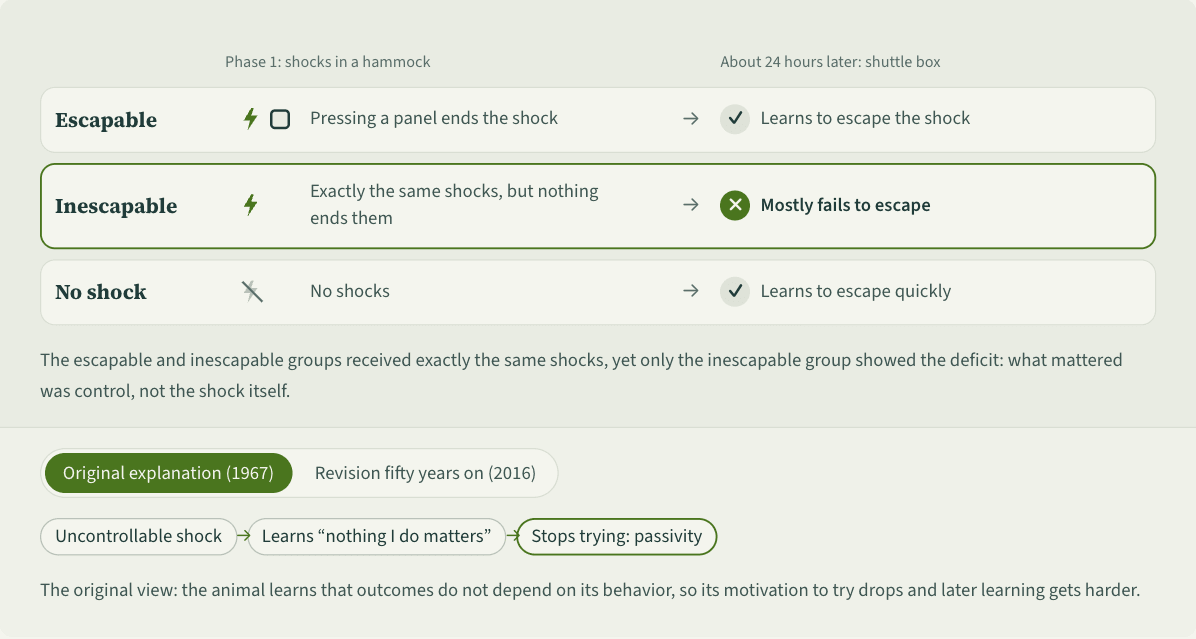
Escapable
Phase 1: shocks in a hammock Pressing a panel ends the shock
About 24 hours later: shuttle box Learns to escape the shock
Inescapable
Phase 1: shocks in a hammock Exactly the same shocks, but nothing ends them
About 24 hours later: shuttle box Mostly fails to escape
No shock
Phase 1: shocks in a hammock No shocks
About 24 hours later: shuttle box Learns to escape quickly
The escapable and inescapable groups received exactly the same shocks, yet only the inescapable group showed the deficit: what mattered was control, not the shock itself.
- Uncontrollable shock
- Learns “nothing I do matters”
- Stops trying: passivity
- Prolonged aversive event
- Passivity: the default, not learned
- Detecting control (medial prefrontal cortex)
- Inhibits the default passivity
The original view: the animal learns that outcomes do not depend on its behavior, so its motivation to try drops and later learning gets harder. The founders later concluded the theory “got it backward”: passivity is the default response to prolonged aversive events (linked to the dorsal raphe nucleus), and what is learned is control.
Three rows, one per group. Escapable: in phase 1, shocks in a hammock that a panel press ends; about 24 hours later, it learns to escape the shock in a shuttle box. Inescapable: exactly the same shocks but nothing ends them; it mostly fails to escape later, and this row is highlighted. No shock: no shocks; it learns to escape quickly. Conclusion: what mattered was control, not the shock itself. Below, a toggle compares explanations. Original: uncontrollable shock leads to learning that nothing matters, then passivity. 2016 revision: under prolonged aversive events passivity is the default, not learned; detecting control (medial prefrontal cortex) inhibits that default.
 Save as image (PNG)
Key points
- Dogs first given inescapable shock mostly failed to learn to escape shock in a shuttle box the next day, while dogs with no prior shock learned quickly.[1]
- The key comparison: dogs that received the same shocks but could switch them off by pressing a panel showed no problem, so the cause was lack of control, not shock itself.[2]
- The original explanation was that the animals learned “nothing I do matters,” which lowered their motivation to try and made later learning harder.[2]
- Researchers later applied it to human depression, adding how people explain the causes of bad events; see Explanatory style.[4]
An example
Ms. Wang asked her supervisor several times to adjust her workload and never got a response. When a more approachable supervisor took over, she didn’t ask again, thinking, “There’s no point.”
Misreadings and limits
Fifty years on, the theory’s founders concluded it “got it backward.” Neuroscience suggests passivity is the default response to prolonged aversive events; what animals learn is that they have control, which suppresses that default.[3]
Sources
- 1 Overmier, J. B., & Seligman, M. E. P. (1967). Effects of inescapable shock upon subsequent escape and avoidance responding. Journal of Comparative and Physiological Psychology, 63(1), 28–33. View source
- 2 Maier, S. F., & Seligman, M. E. P. (1976). Learned helplessness: Theory and evidence. Journal of Experimental Psychology: General, 105(1), 3–46. View source
- 3 Maier, S. F., & Seligman, M. E. P. (2016). Learned helplessness at fifty: Insights from neuroscience. Psychological Review, 123(4), 349–367. doi:10.1037/rev0000033
- 4 Peterson, C., & Seligman, M. E. P. (1984). Causal explanations as a risk factor for depression: Theory and evidence. Psychological Review, 91(3), 347–374. View source
Last checked against sources: October 26, 2026