Operant conditioning
操作性条件反射
Operant conditioning is learning from the consequences of behavior: what follows an action changes how likely that action is to happen again. Edward Thorndike stated the law of effect, and B. F. Skinner systematically studied reinforcement and punishment.[1][2][3]
Stimulus added “positive”
Stimulus removed “negative”
Behavior increases reinforcement
Behavior decreases punishment
Intermittent schedules: when reinforcement comes
Reinforcing every response (continuous reinforcement) teaches fastest; behavior reinforced only some of the time (intermittent reinforcement) is harder to extinguish.
By number of responses
By time
Schematic: cumulative responses
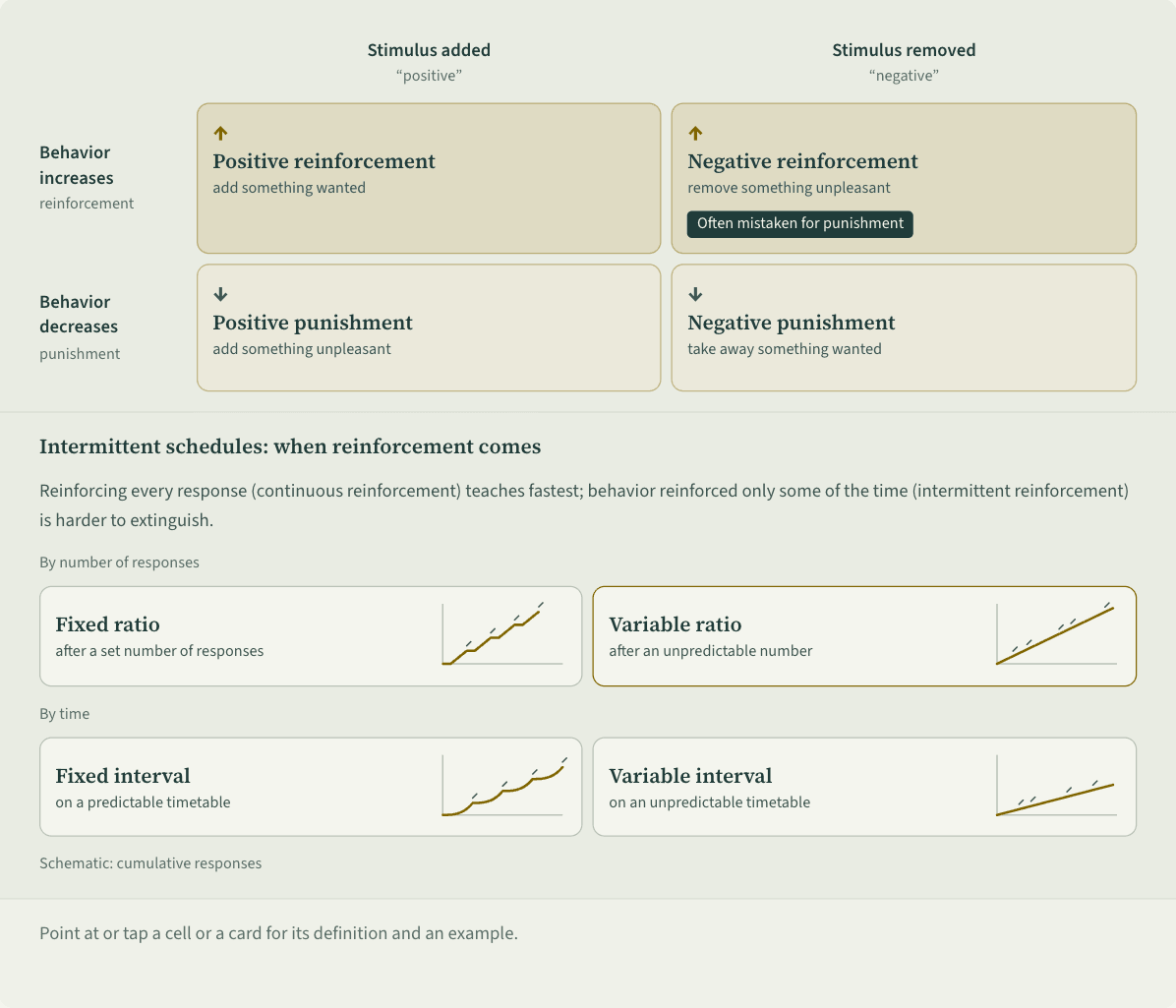
The top half is a 2×2 table. Columns: stimulus added (positive), stimulus removed (negative). Rows: behavior increases (reinforcement), behavior decreases (punishment). Positive reinforcement: something wanted is added and the behavior increases, such as a toy for cleaning a room. Negative reinforcement: something unpleasant is removed and the behavior increases, such as a seat-belt alarm stopping once you buckle up; this cell is marked “often mistaken for punishment”. Positive punishment: something unpleasant is added and the behavior decreases, such as being scolded for texting in class. Negative punishment: something wanted is taken away and the behavior decreases, such as losing a favorite toy or a time-out. The bottom half shows four intermittent schedules: fixed ratio (reinforcement after a set number of responses; high rate with pauses after reinforcement; piecework pay); variable ratio (an unpredictable number; high, steady rate; most resistant to extinction; slot machines); fixed interval (reinforcement on a predictable timetable; moderate rate with clear pauses after reinforcement); variable interval (an unpredictable timetable; moderate, steady rate). Each card has a schematic cumulative-response curve.
 Save as image (PNG)
Key points
- Thorndike shut hungry cats in puzzle boxes with food outside, and their escape times fell gradually. He proposed the law of effect: responses followed by satisfaction become more likely to recur.[1]
- Reinforcement increases a behavior and punishment decreases it. “Positive” means a stimulus is added and “negative” that one is removed, not good or bad; crossing the two gives four cases.[2][3]
- Reinforcing only some responses is intermittent reinforcement. It makes behavior harder to extinguish than reinforcing every response, most of all on a variable-ratio schedule such as a slot machine.[2][3]
- Skinner noted that approval and affection often come intermittently.[2] Among 75 women who had left abusive partners, more extreme intermittent abuse went with stronger attachment, still present six months later.[4]
An example
At the checkout, Lin’s son cries until she buys him candy, and he goes quiet at once. His crying was positively reinforced by the candy; her buying was negatively reinforced, because it ended the crying. Both behaviors are now more likely to happen again.
Misreadings and limits
The most common misreading is treating negative reinforcement as punishment. Negative reinforcement removes something unpleasant, as when a seat-belt alarm stops once you buckle up, and the behavior increases; punishment makes a behavior less likely.[2][3] The relationship study in the key points is correlational and concerns abuse, so it does not show that every on-off relationship works this way.[4]
Sources
- 1 Thorndike, E. L. (1911). Animal intelligence: Experimental studies. Macmillan (Chapters II and V as reproduced in Classics in the History of Psychology). View source
- 2 Skinner, B. F. (1953). Science and human behavior. Macmillan (Chapters V, VI and XII). View source
- 3 Spielman, R. M., Jenkins, W. J., & Lovett, M. D. (2020). 6.3 Operant conditioning. Psychology 2e. OpenStax. View source
- 4 Dutton, D. G., & Painter, S. (1993). Emotional attachments in abusive relationships: A test of traumatic bonding theory. Violence and Victims, 8(2), 105–120. doi:10.1891/0886-6708.8.2.105
Last checked against sources: October 26, 2026