Maslow’s hierarchy of needs
马斯洛需要层次理论
Abraham Maslow proposed in 1943 that five kinds of basic needs are arranged in a hierarchy of priority: physiological, safety, love, esteem, and self-actualization.[1]
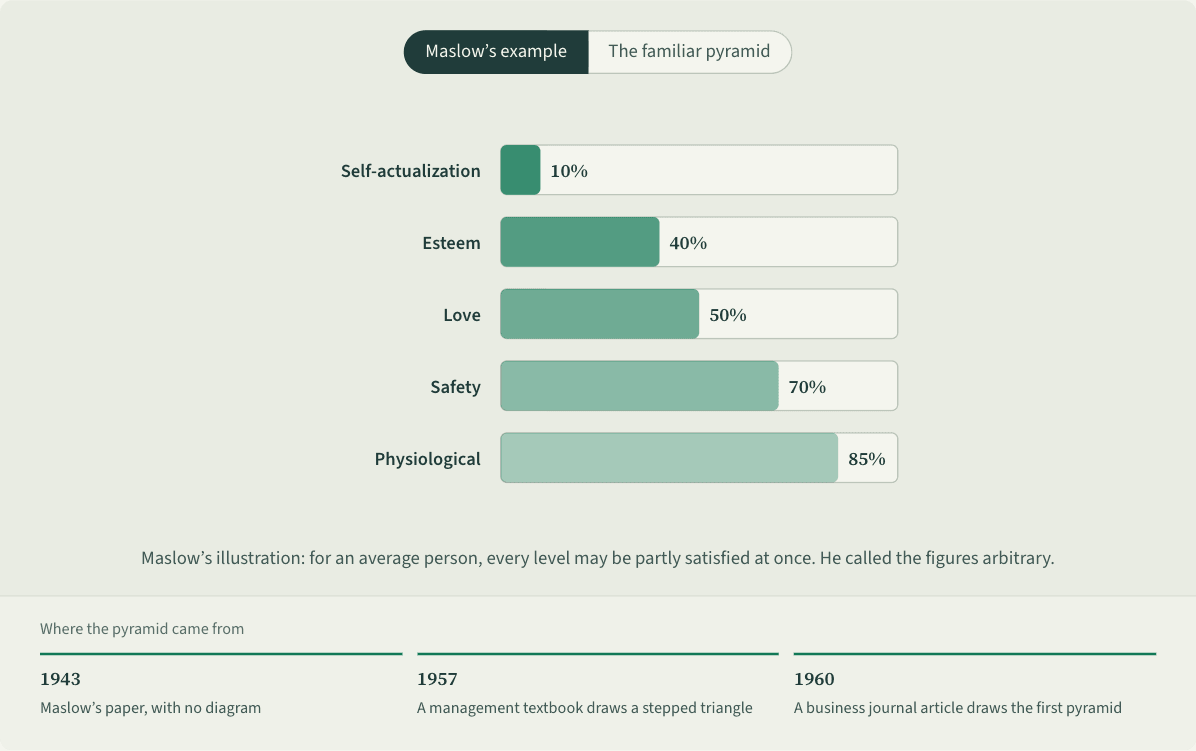
Maslow’s illustration: for an average person, every level may be partly satisfied at once. He called the figures arbitrary. Maslow never drew the pyramid. It suggests each level must be complete before the next, which is not what he described.
Where the pyramid came from
- 1943 Maslow’s paper, with no diagram
- 1957 A management textbook draws a stepped triangle
- 1960 A business journal article draws the first pyramid
Five horizontal bars, from bottom to top physiological, safety, love, esteem and self-actualization, filled to 85%, 70%, 50%, 40% and 10%, noted as Maslow’s example with figures he called arbitrary. A toggle switches to a five-tier pyramid, noted as not drawn by Maslow and at odds with his description. A timeline below: 1943, Maslow’s paper, with no diagram; 1957, a management textbook draws a stepped triangle; 1960, a business journal article draws the first pyramid.
 Save as image (PNG)
Key points
- Maslow held that needs emerge before lower ones are fully met: an average person’s levels might be 85%, 70%, 50%, 40% and 10% satisfied, figures he called arbitrary.[1]
- He also said the hierarchy is not rigid, allows exceptions, and that most behavior serves several needs at once.[1]
- Maslow never drew the pyramid. A stepped triangle first appeared in a 1957 management textbook, and the pyramid in a 1960 business journal article.[2]
- A study using data from 123 countries found that meeting social and respect needs was linked to well-being even when basic needs were not fully met.[3]
An example
Jay has just changed jobs and his rent is a strain, but he still goes to band practice every weekend. Playing with friends gives him a sense of belonging and achievement that did not wait until his finances were fully settled.
Misreadings and limits
A common misreading treats the theory as a pyramid whose levels must be completed one at a time. Maslow himself said the hierarchy is not rigid, and cross-national data show that the order in which needs are met matters little for well-being.[1][3]
Sources
- 1 Maslow, A. H. (1943). A theory of human motivation. Psychological Review, 50(4), 370–396. View source
- 2 Bridgman, T., Cummings, S., & Ballard, J. (2019). Who built Maslow's pyramid? A history of the creation of management studies' most famous symbol and its implications for management education. Academy of Management Learning & Education, 18(1), 81–98. doi:10.5465/amle.2017.0351
- 3 Tay, L., & Diener, E. (2011). Needs and subjective well-being around the world. Journal of Personality and Social Psychology, 101(2), 354–365. doi:10.1037/a0023779
Last checked against sources: October 26, 2026