Intrinsic and extrinsic motivation
内部动机与外部动机
Intrinsic motivation means doing something out of interest, enjoyment, or curiosity; extrinsic motivation means doing it for an outcome outside the activity, such as pay. Self-determination theory holds that extrinsic motivation varies in how autonomous it is.[1][3]
Both relate to three basic psychological needs: Autonomy Competence Relatedness
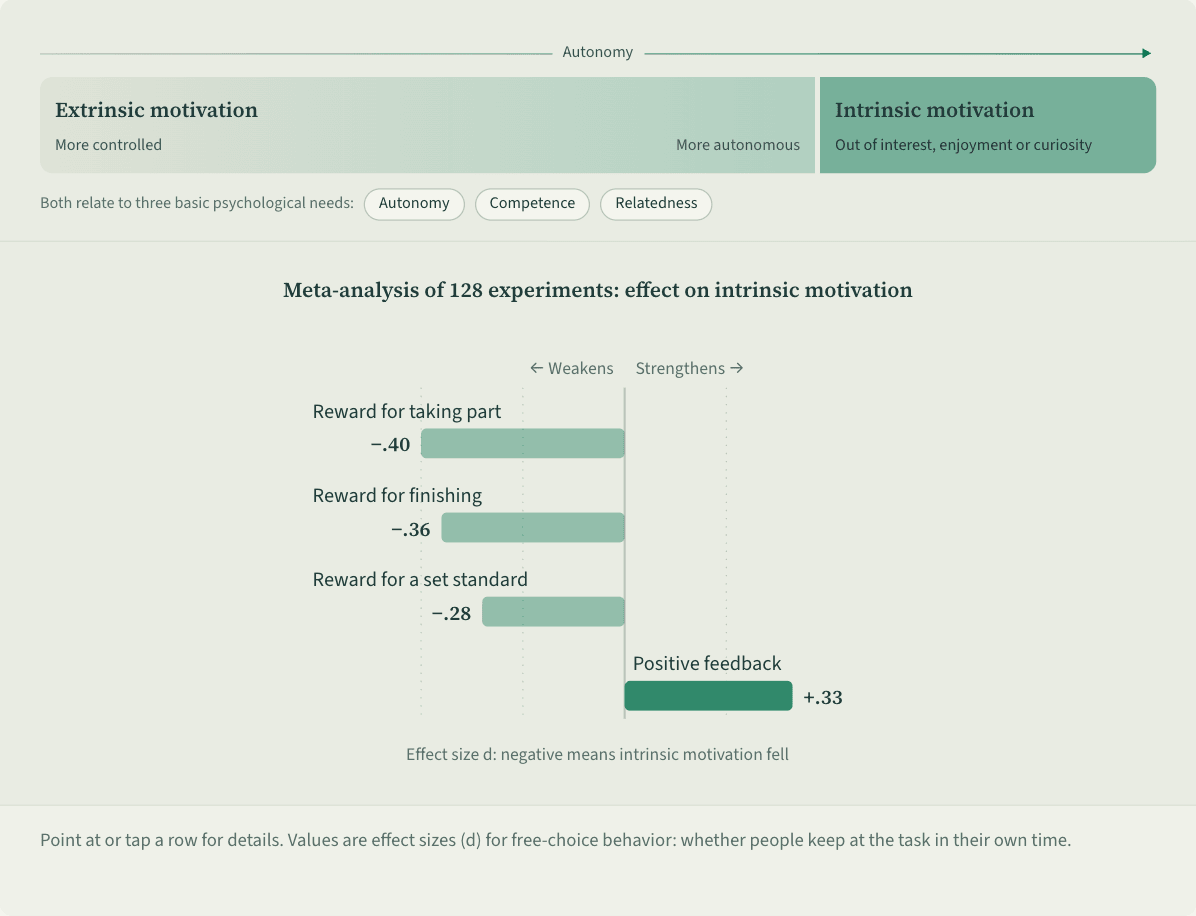
Meta-analysis of 128 experiments: effect on intrinsic motivation
At the top, a band: the left part is extrinsic motivation, shading from “more controlled” to “more autonomous”; the right part is intrinsic motivation, “out of interest, enjoyment or curiosity.” Below it, the three basic psychological needs: autonomy, competence, relatedness. At the bottom, a bar chart titled “Meta-analysis of 128 experiments: effect on intrinsic motivation”: reward for taking part −0.40, reward for finishing −0.36 and reward for a set standard −0.28 all extend left, meaning intrinsic motivation fell; positive feedback +0.33 extends right, meaning it rose.
 Save as image (PNG)
Key points
- Self-determination theory links both kinds of motivation to three basic psychological needs: autonomy, competence, and relatedness.[1]
- Extrinsic motivation is not always pressured: people can come to value a task that is not interesting in itself and still do it with a sense of autonomy.[3]
- In Deci’s 1971 experiment, people paid to solve puzzles later spent less free time on them, a larger drop than among unpaid participants, though the effect was only marginally significant.[3]
- A meta-analysis of 128 studies found that expected, task-contingent rewards undermine intrinsic motivation, while positive feedback strengthens it.[2]
An example
Lin loves drawing and often spends whole weekend afternoons on it. After she starts taking paid commissions priced per piece, she notices she rarely feels like drawing when there is no order. She sets aside time each week to draw just for herself.
Misreadings and limits
A common misreading is that outside rewards are always harmful. The meta-analysis traced the undermining effect mainly to expected, task-contingent rewards, while positive feedback had the opposite effect. Extrinsic motivation can also be autonomous.[1][2]
Sources
- 1 Ryan, R. M., & Deci, E. L. (2000). Intrinsic and extrinsic motivations: Classic definitions and new directions. Contemporary Educational Psychology, 25(1), 54–67. doi:10.1006/ceps.1999.1020
- 2 Deci, E. L., Koestner, R., & Ryan, R. M. (1999). A meta-analytic review of experiments examining the effects of extrinsic rewards on intrinsic motivation. Psychological Bulletin, 125(6), 627–668. doi:10.1037/0033-2909.125.6.627
- 3 Ryan, R. M., Ryan, W. S., & Di Domenico, S. I. (2019). Beyond reinforcement: Deci (1971) on the effects of rewards on self-determination and intrinsic motivation. Center for Self-Determination Theory (selfdeterminationtheory.org), chapter PDF. View source
Last checked against sources: October 26, 2026