Rorschach inkblot test
罗夏墨迹测验
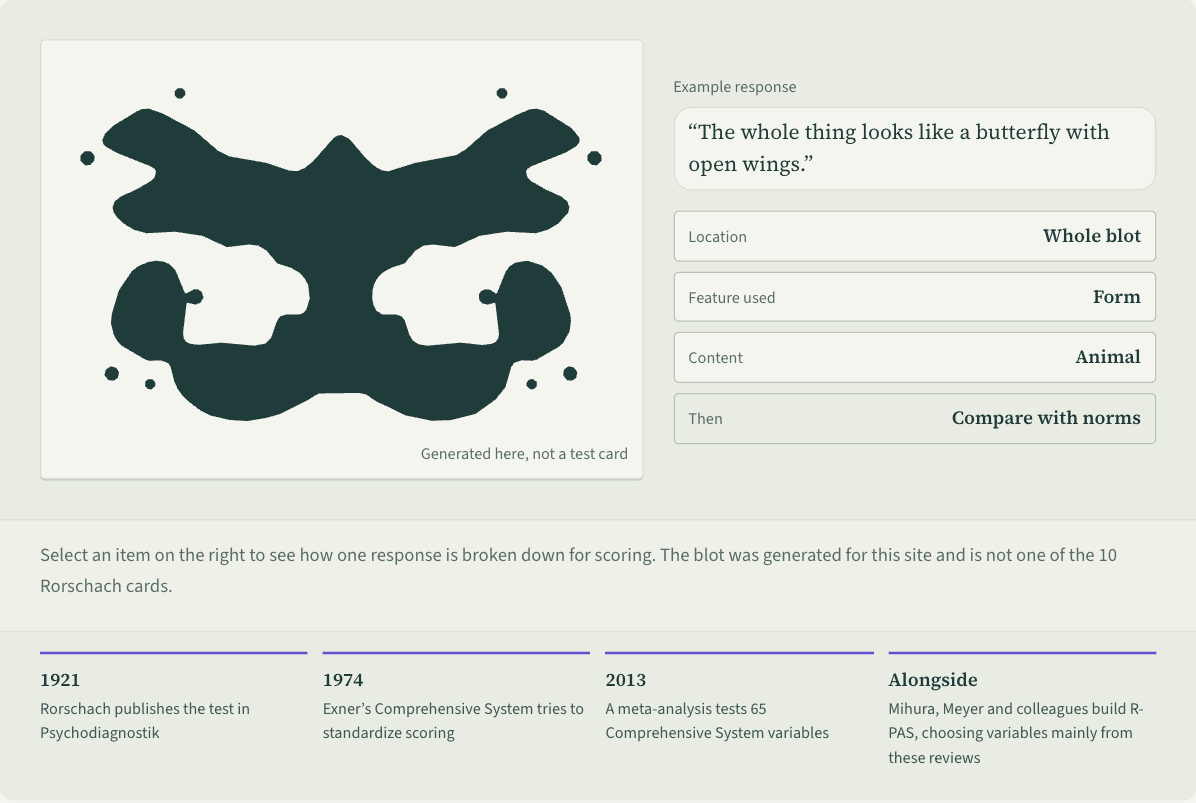
The Rorschach is a projective test in which people say what each of 10 inkblots looks like. The examiner scores where in the blot the response is located, which features (such as form or color) it draws on, and its content, and compares the scores with norms.[1]
Example response
“The whole thing looks like a butterfly with open wings.”
- 1921 Rorschach publishes the test in Psychodiagnostik
- 1974 Exner’s Comprehensive System tries to standardize scoring
- 2013 A meta-analysis tests 65 Comprehensive System variables
- Alongside Mihura, Meyer and colleagues build R-PAS, choosing variables mainly from these reviews
Left: a symmetrical black ink blot resembling spread wings, marked in the corner “Generated here, not a test card.” Right: the example response “The whole thing looks like a butterfly with open wings,” broken down as location: whole blot; feature used: form; content: animal; then compare with norms. Selecting an item highlights the matching aspect of the blot. A timeline at the bottom: 1921, Rorschach publishes the test; 1974, Exner’s Comprehensive System tries to standardize scoring; 2013, a meta-analysis tests 65 variables; alongside it, Mihura, Meyer and colleagues build R-PAS, choosing its variables mainly from those reviews.
 Save as image (PNG)
Key points
- The Swiss psychiatrist Hermann Rorschach introduced the test in 1921 with his book Psychodiagnostik.[1]
- Some of the 10 blots are black or gray and some carry color. From 1974, John Exner’s Comprehensive System tried to standardize scoring.[1]
- A 2013 meta-analysis tested the validity of 65 Comprehensive System variables.[2] R-PAS, a newer scoring system two of its authors helped develop, drew mainly on these reviews when choosing its variables.[4]
- Scores tied to thought disorder and cognitive functioning have strong support; evidence for judging emotional and other noncognitive traits remains weak.[3]
An example
In a psychology class, the teacher shows an inkblot. Lin sees a bat, and Jay sees two people dancing. The teacher uses this to show that people can see different things in the same image, and notes that a classroom demonstration cannot support any conclusions.
Misreadings and limits
A common misreading treats it as a fun personality quiz or an all-purpose diagnostic tool. It is generally considered unreliable; critics find noncognitive scores poorly supported, and Comprehensive System norms tended to make healthy people look disturbed.[1][3]
Sources
- 1 Encyclopaedia Britannica (n.d.). Rorschach test. Encyclopaedia Britannica. View source
- 2 Mihura, J. L., Meyer, G. J., Dumitrascu, N., & Bombel, G. (2013). The validity of individual Rorschach variables: Systematic reviews and meta-analyses of the Comprehensive System. Psychological Bulletin, 139(3), 548–605. doi:10.1037/a0029406
- 3 Wood, J. M., Garb, H. N., Nezworski, M. T., Lilienfeld, S. O., & Duke, M. C. (2015). A second look at the validity of widely used Rorschach indices: Comment on Mihura, Meyer, Dumitrascu, and Bombel (2013). Psychological Bulletin, 141(1), 236–249. doi:10.1037/a0036005
- 4 Viglione, D. J., Blume-Marcovici, A. C., Miller, H. L., Giromini, L., & Meyer, G. (2012). An inter-rater reliability study for the Rorschach Performance Assessment System. Journal of Personality Assessment, 94(6), 607–612. doi:10.1080/00223891.2012.684118
Last checked against sources: October 26, 2026