Broaden-and-build theory
拓展-建构理论
A theory proposed by psychologist Barbara Fredrickson: positive emotions such as joy, interest and contentment temporarily widen the range of thoughts and actions that come to mind, and over time this builds lasting personal resources.[1][2]
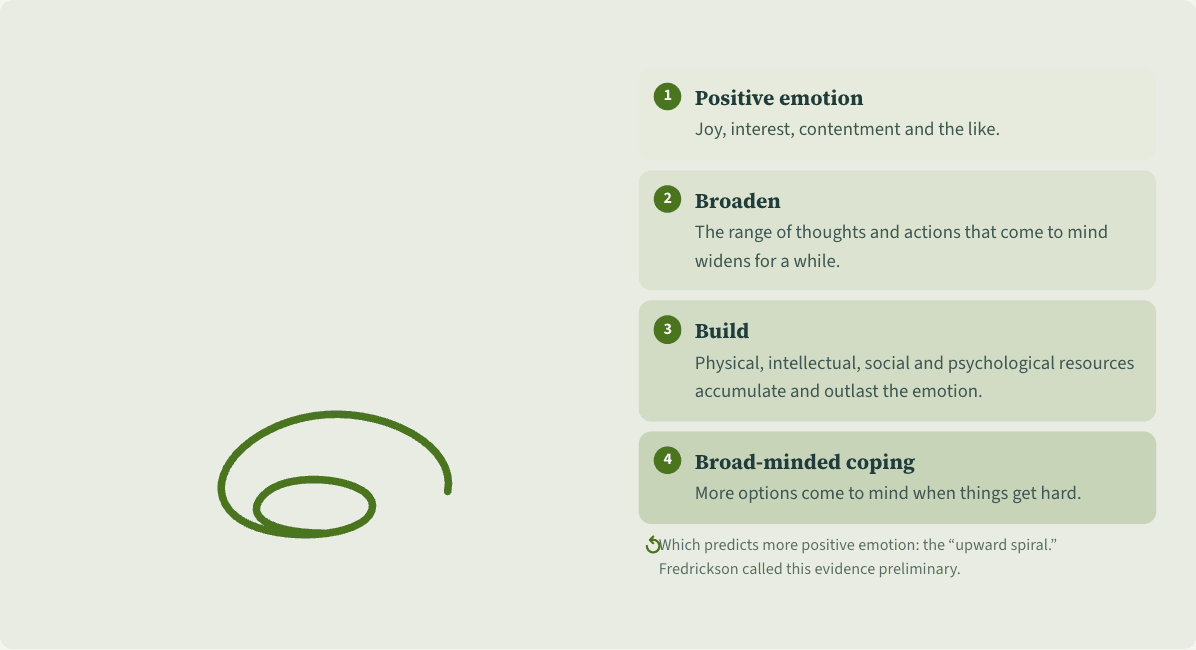
- Positive emotion Joy, interest, contentment and the like.
- Broaden The range of thoughts and actions that come to mind widens for a while.
- Build Physical, intellectual, social and psychological resources accumulate and outlast the emotion.
- Broad-minded coping More options come to mind when things get hard.
On the left, a 3D spiral that widens as it rises, with a small ball climbing it and leaving beads that grow along the way. On the right, a four-step loop: positive emotion, broaden, build, broad-minded coping, then “which predicts more positive emotion.”
 Save as image (PNG)
Key points
- Many negative emotions come with specific urges, such as fear prompting escape and anger prompting attack. Positive emotions instead widen the set of thoughts and actions that come to mind.[1]
- Each positive emotion has its own broad urge: joy sparks play, interest sparks exploration, and contentment invites savoring recent events and fitting them into one’s sense of self.[1]
- Broadened action builds physical, intellectual, social and psychological resources that outlast the emotion itself and can be drawn on later.[2]
- The theory also describes an “upward spiral”: positive emotion fosters broad-minded coping, which in turn predicts more positive emotion. Fredrickson called this evidence preliminary.[2]
An example
After several days of anxious exam prep, Lin could only stare at the questions she got wrong. A relaxed weekend game with friends lifted her mood. Back at her desk, she thought of a new way to organize her notes and invited a classmate to study with her.
Misreadings and limits
The popular claim that people flourish once positive emotions outnumber negative ones by about 3 to 1 (precisely 2.9013) has no sound basis. The mathematical model behind that number was shown to be invalid and was formally withdrawn in 2013. The withdrawal concerned that model, not broaden-and-build theory itself.[3][4]
Sources
- 1 Fredrickson, B. L. (1998). What good are positive emotions?. Review of General Psychology, 2(3), 300–319. doi:10.1037/1089-2680.2.3.300
- 2 Fredrickson, B. L. (2001). The role of positive emotions in positive psychology: The broaden-and-build theory of positive emotions. American Psychologist, 56(3), 218–226. doi:10.1037/0003-066X.56.3.218
- 3 Brown, N. J. L., Sokal, A. D., & Friedman, H. L. (2013). The complex dynamics of wishful thinking: The critical positivity ratio. American Psychologist, 68(9), 801–813. doi:10.1037/a0032850
- 4 Winerman, L. (2013). American Psychologist retracts model that suggests there is a positive to negative emotions tipping point. Monitor on Psychology, 44(11), American Psychological Association. View source
Last checked against sources: October 26, 2026