Active-constructive responding
主动建设性回应
Active-constructive responding means meeting someone’s good news with genuine enthusiasm, asking about the details and talking through what it means for them. It comes from psychologist Shelly Gable and colleagues’ research on sharing positive events, called capitalization.[1][2]
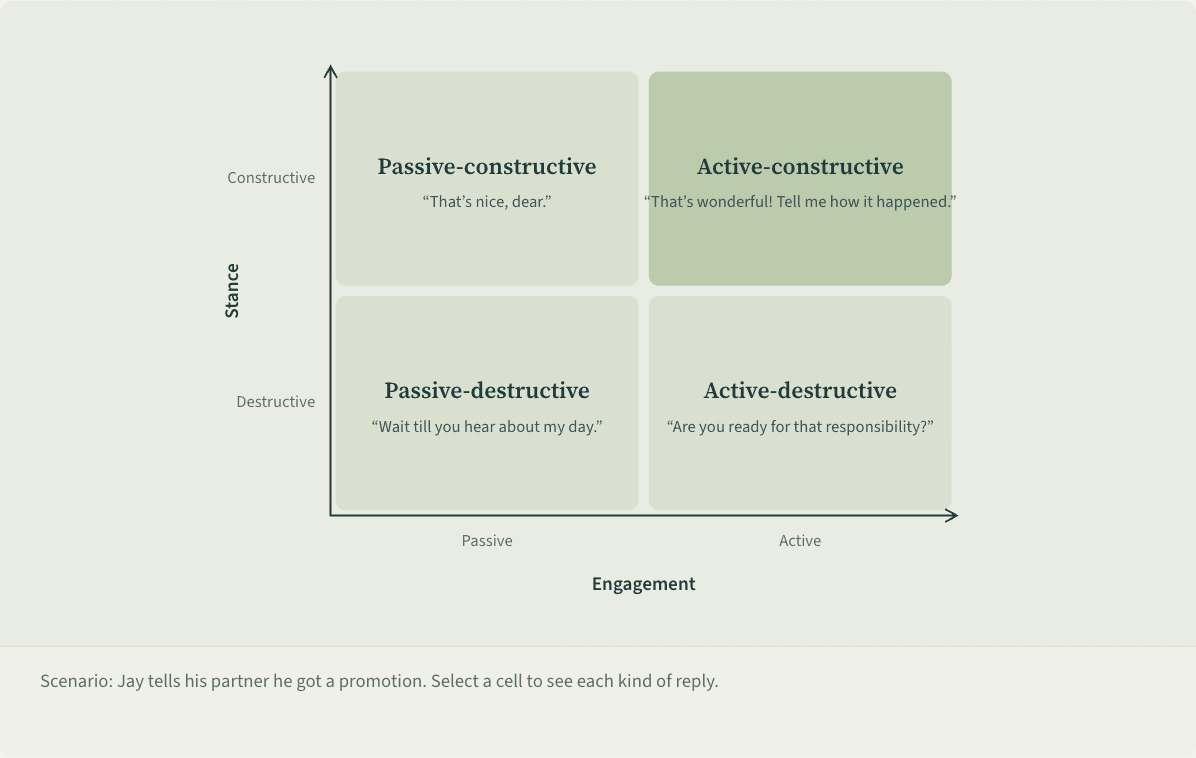
A two-by-two grid. The horizontal axis runs from passive to active, the vertical from destructive to constructive. Top right active-constructive (highlighted), top left passive-constructive, bottom right active-destructive, bottom left passive-destructive, each with an example reply.
 Save as image (PNG)
Key points
- Researchers sort responses to good news along two dimensions, active vs passive and constructive vs destructive, giving four response types.[1]
- Among dating and married couples, only active-constructive responses went with higher relationship quality. The other three, including a flat “That’s nice,” went with poorer relationships.[1]
- In experiments, people whose good news met an enthusiastic response later rated the event more positively and trusted the listener more.[3]
- What counts is the sharer’s experience: whether they feel understood, validated and cared for, not only which words the listener uses.[2]
An example
Ms. Wang tells two coworkers that her proposal was approved. One says “Nice” and goes back to his phone. The other puts down her work and asks, “That’s great! What did the manager say? Which part will you lead?” The second reply is active-constructive.
Misreadings and limits
It is not a script for over-the-top praise. The original couple studies were correlational and measured how sharers perceived their partner’s replies, so they could not establish cause and effect.[1] The theory stresses that the benefit depends on the sharer actually feeling understood and cared for.[2]
Sources
- 1 Gable, S. L., Reis, H. T., Impett, E. A., & Asher, E. R. (2004). What do you do when things go right? The intrapersonal and interpersonal benefits of sharing positive events. Journal of Personality and Social Psychology, 87(2), 228–245. doi:10.1037/0022-3514.87.2.228
- 2 Gable, S. L., & Reis, H. T. (2010). Good news! Capitalizing on positive events in an interpersonal context. Advances in Experimental Social Psychology, 42, 195–257. doi:10.1016/S0065-2601(10)42004-3
- 3 Reis, H. T., Smith, S. M., Carmichael, C. L., Caprariello, P. A., Tsai, F.-F., Rodrigues, A., & Maniaci, M. R. (2010). Are you happy for me? How sharing positive events with others provides personal and interpersonal benefits. Journal of Personality and Social Psychology, 99(2), 311–329. doi:10.1037/a0018344
Last checked against sources: October 26, 2026