VIA classification of character strengths
VIA 品格优势
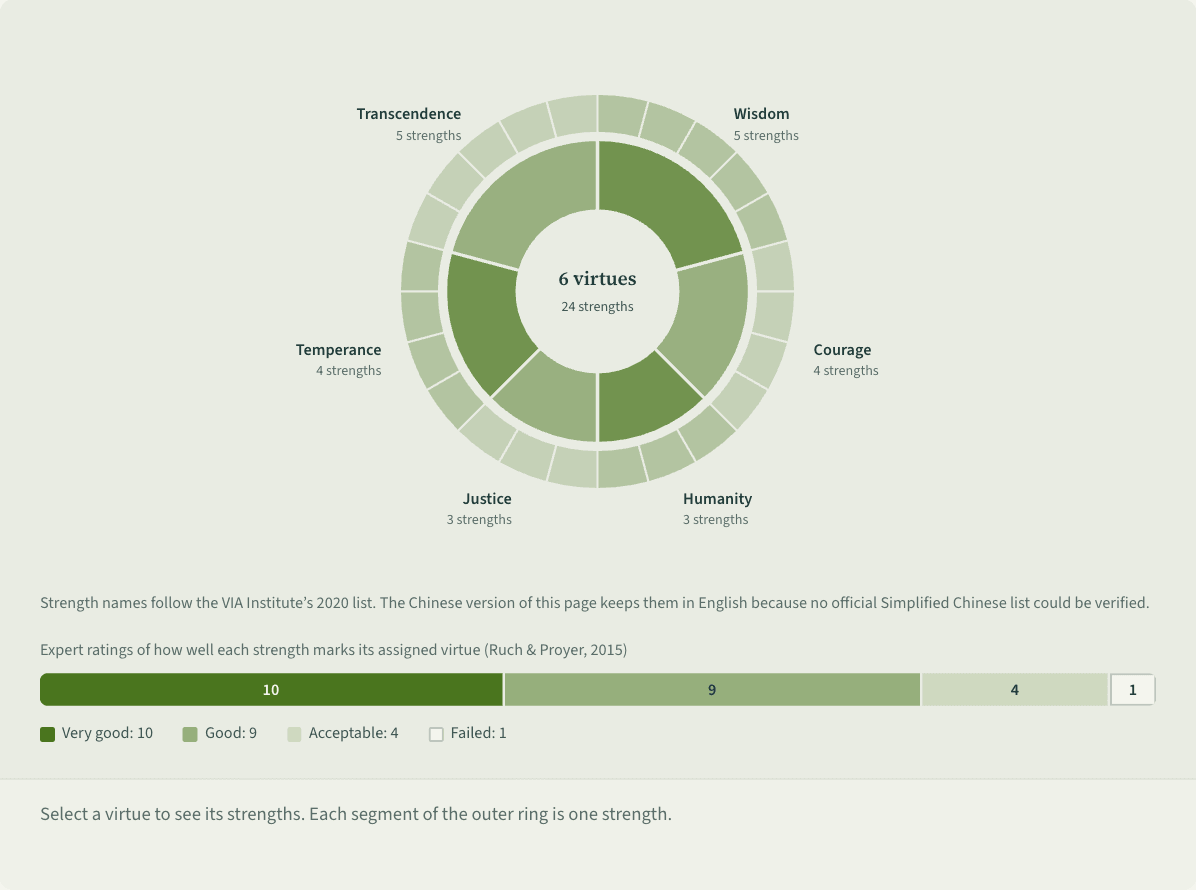
The VIA classification, published by Christopher Peterson and Martin Seligman in 2004, sorts 24 character strengths under six virtues: wisdom, courage, humanity, justice, temperance and transcendence.[1][2]
Strength names follow the VIA Institute’s 2020 list. The Chinese version of this page keeps them in English because no official Simplified Chinese list could be verified.
Expert ratings of how well each strength marks its assigned virtue (Ruch & Proyer, 2015)
Very good: 10 Good: 9 Acceptable: 4 Failed: 1
A two-ring donut. The inner ring has six virtue segments: Wisdom (5 strengths: Creativity, Curiosity, Judgment, Love of Learning, Perspective), Courage (4: Bravery, Perseverance, Honesty, Zest), Humanity (3: Love, Kindness, Social Intelligence), Justice (3: Teamwork, Fairness, Leadership), Temperance (4: Forgiveness, Humility, Prudence, Self-Regulation) and Transcendence (5: Appreciation of Beauty & Excellence, Gratitude, Hope, Humor, Spirituality). The outer ring has 24 segments, one per strength. A note says the strength names follow the VIA Institute’s English list. A bar at the bottom shows expert ratings of how well the strengths mark their virtues: 10 very good, 9 good, 4 acceptable, 1 failed.
 Save as image (PNG)
Key points
- It is meant to be descriptive, not prescriptive: a common language for talking about good character. Each strength was reviewed against 10 criteria.[1]
- The VIA Institute holds that everyone has all 24 strengths in different degrees, giving each person a unique strengths profile.[3]
- The accompanying VIA Survey is free online and takes about 10–15 minutes.[3]
- The six-virtue grouping was made on theoretical grounds. An expert-rating study found that many strengths fit two or three virtues and that the assignment needs adjustment.[4]
An example
Lin takes the VIA Survey and finds curiosity, love of learning and humor near the top. She had never counted these as skills. When training new hires, she starts using them on purpose, asking questions instead of lecturing and using jokes to ease tension.
Misreadings and limits
A common misreading treats VIA results as a talent test or reads lower-ranked strengths as weaknesses. The results show a relative profile, and everyone has all 24.[3] The six-virtue grouping itself is still debated, so it should not be treated as a fixed typology.[4]
Sources
- 1 Peterson, C., & Seligman, M. E. P. (2004). Character strengths and virtues: A handbook and classification. Oxford University Press; American Psychological Association. View source
- 2 VIA Institute on Character (2020). The VIA classification of 24 character strengths. VIA Institute on Character. View source
- 3 VIA Institute on Character (n.d.). Character strengths. VIA Institute on Character. View source
- 4 Ruch, W., & Proyer, R. T. (2015). Mapping strengths into virtues: The relation of the 24 VIA-strengths to six ubiquitous virtues. Frontiers in Psychology, 6, Article 460. doi:10.3389/fpsyg.2015.00460
Last checked against sources: October 26, 2026