Adult attachment styles
成人依恋类型
Adult attachment research applies Attachment theory to close adult relationships, starting with Hazan and Shaver’s 1987 work on romantic love. Today it is usually measured on two dimensions: attachment anxiety and attachment avoidance.[1]
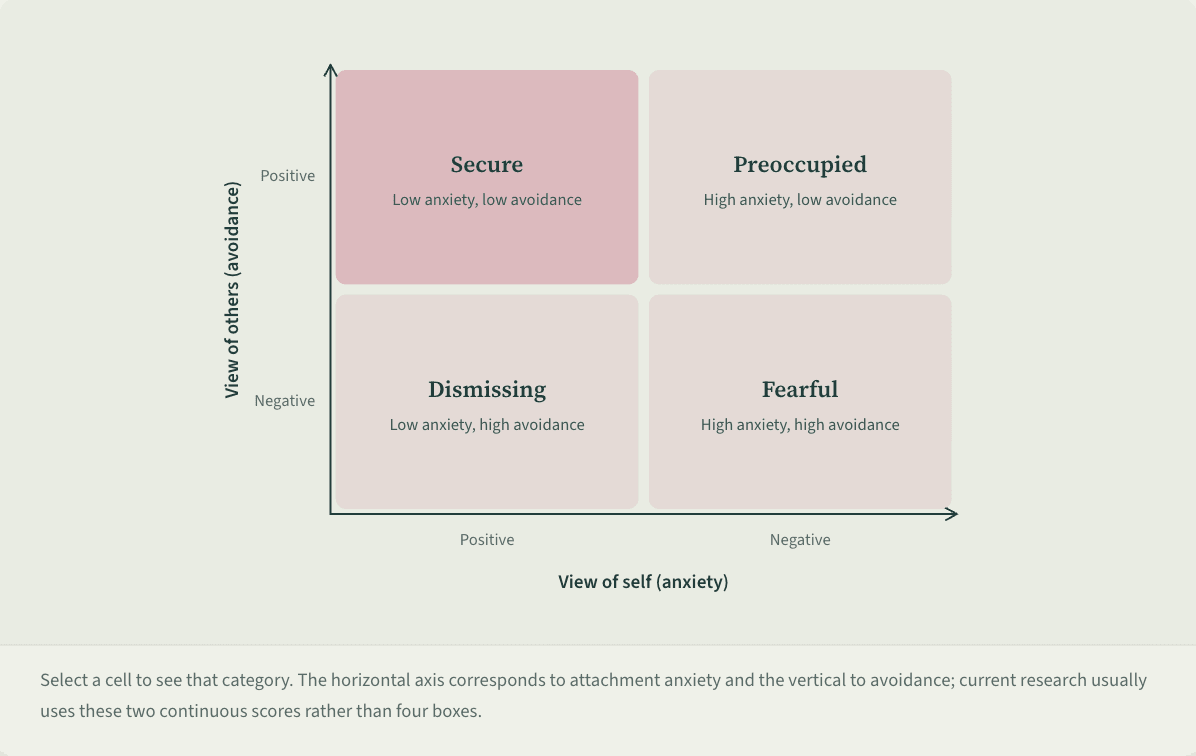
A two-by-two grid. The horizontal axis runs from positive to negative view of self, the vertical from positive (top) to negative (bottom) view of others. Top left secure, top right preoccupied, bottom left dismissing, bottom right fearful.
 Save as image (PNG)
Key points
- Bartholomew and colleagues (1991) sorted adults into four categories, secure, preoccupied, dismissing and fearful, by whether their views of self and of others are positive.[1][2]
- The 36-item ECR by Brennan and colleagues (1998) measures anxiety and avoidance: anxiety tracks a negative view of self, avoidance a negative view of others.[1]
- In an observational study of 80 couples, secure and preoccupied partners showed more trust, attentiveness and pleasant expression in conversation than dismissing or fearful partners.[2]
- The Adult Attachment Interview (AAI) comes from a separate tradition: it asks adults about childhood attachment, codes how coherently they tell it, and relates to their infants’ patterns.[3]
An example
Lin texts her partner and, after two hours without a reply, keeps checking her phone, worried he has stopped caring. Jay, after every argument, wants to be alone and avoids talking about feelings. Lin’s reaction resembles the questionnaire’s anxiety items; Jay’s resembles its avoidance items.
Misreadings and limits
Online quizzes often assign one type as a lifelong label. Researchers prefer continuous scores, and longitudinal studies find adult attachment only moderately stable, shifting with factors such as life stress.[1][4]
Sources
- 1 Guzmán-González, M., Rivera-Ottenberger, D., Brassard, A., Spencer, R., & Lafontaine, M.-F. (2020). Measuring adult romantic attachment: Psychometric properties of the brief Spanish version of the Experiences in Close Relationships. Psicologia: Reflexão e Crítica, 33, Article 9. doi:10.1186/s41155-020-00145-w
- 2 Guerrero, L. K. (1996). Attachment-style differences in intimacy and involvement: A test of the four-category model. Communication Monographs, 63(4), 269–292. doi:10.1080/03637759609376395
- 3 Bretherton, I. (1992). The origins of attachment theory: John Bowlby and Mary Ainsworth. Developmental Psychology, 28(5), 759–775. View source
- 4 王岩, & 王大华 (2012). 成人依恋的稳定性. 心理发展与教育, 28(4), 442–448. View source
Last checked against sources: October 26, 2026