Demand–withdraw pattern
要求-退缩模式
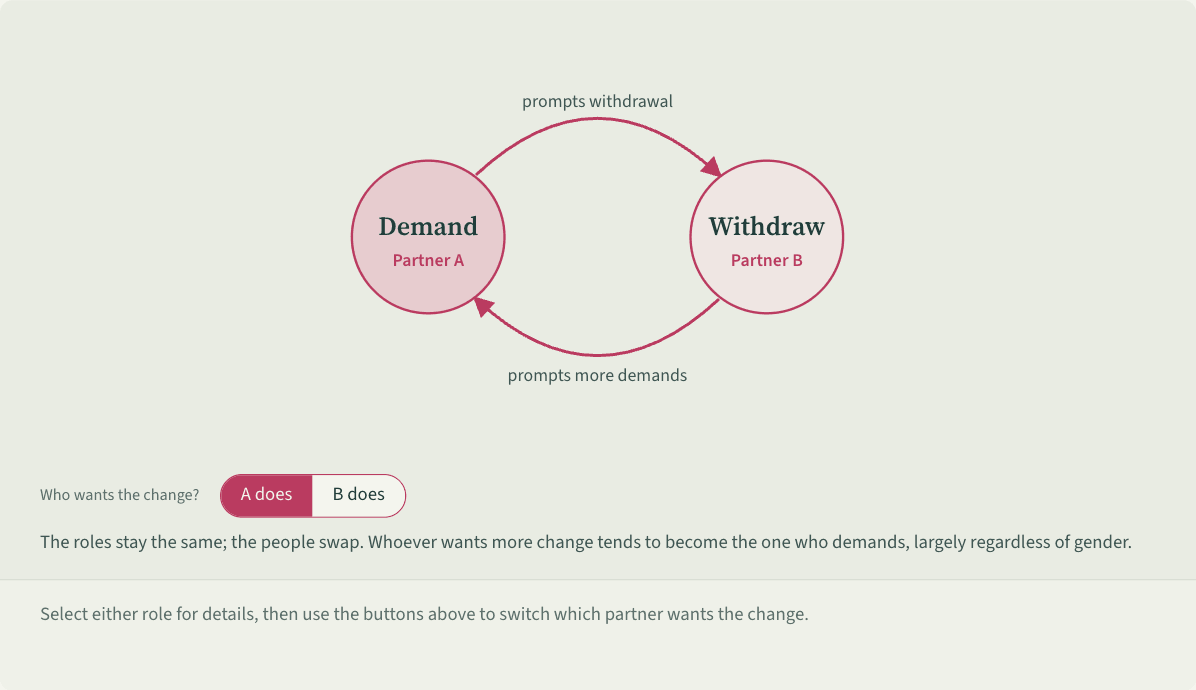
The demand–withdraw pattern is a sequence in couple conflict: one partner raises problems, criticizes or presses for change, while the other avoids the discussion, becomes defensive or withdraws.[1]
Two circles joined into a loop by one arrow above and one below. The left circle reads “Demand” and the right “Withdraw.” The upper arrow runs from demand to withdraw, labeled “prompts withdrawal”; the lower arrow runs back, labeled “prompts more demands.” Each circle shows whether Partner A or Partner B holds that role. Buttons below switch which partner wants change; the partners swap roles while the loop stays the same.
 Save as image (PNG)
Key points
- A meta-analysis of 74 studies with more than 14,000 participants called it the most common conflict pattern in established romantic relationships.[3]
- It is linked to lower relationship satisfaction and intimacy, and to anxiety, aggression and some physical symptoms.[3]
- Who demands often depends on whose issue is discussed. On the wife’s issue, wives demanded more and husbands withdrew more; on the husband’s issue, the two behaved similarly.[2]
An example
Jay wants Lin to work fewer weekends and spend more time with family. Each time he raises it, she says, “Later.” He grows more insistent and brings up old complaints; she puts on headphones and stops responding. The more ignored he feels, the more he pushes, and the further she pulls away.
Misreadings and limits
A common misreading treats it as a gender trait: nagging women, withdrawn men. Research finds that whoever wants more change tends to be the one who demands, largely regardless of gender, and the pattern is just as strongly linked to relationship distress whichever partner takes which role.[1][3]
Sources
- 1 Holley, S. R., Sturm, V. E., & Levenson, R. W. (2010). Exploring the basis for gender differences in the demand-withdraw pattern. Journal of Homosexuality, 57(5), 666–684. doi:10.1080/00918361003712145
- 2 Heavey, C. L., Layne, C., & Christensen, A. (1993). Gender and conflict structure in marital interaction: A replication and extension. Journal of Consulting and Clinical Psychology, 61(1). doi:10.1037/0022-006X.61.1.16
- 3 Schrodt, P., Witt, P. L., & Shimkowski, J. R. (2014). A meta-analytical review of the demand/withdraw pattern of interaction and its associations with individual, relational, and communicative outcomes. Communication Monographs, 81(1). doi:10.1080/03637751.2013.813632
Last checked against sources: October 26, 2026