Drama triangle
戏剧三角
The drama triangle is a model from transactional analysis (TA), introduced by Stephen Karpman in a 1968 article, that describes three roles people take on and switch between in conflict.[1][2]
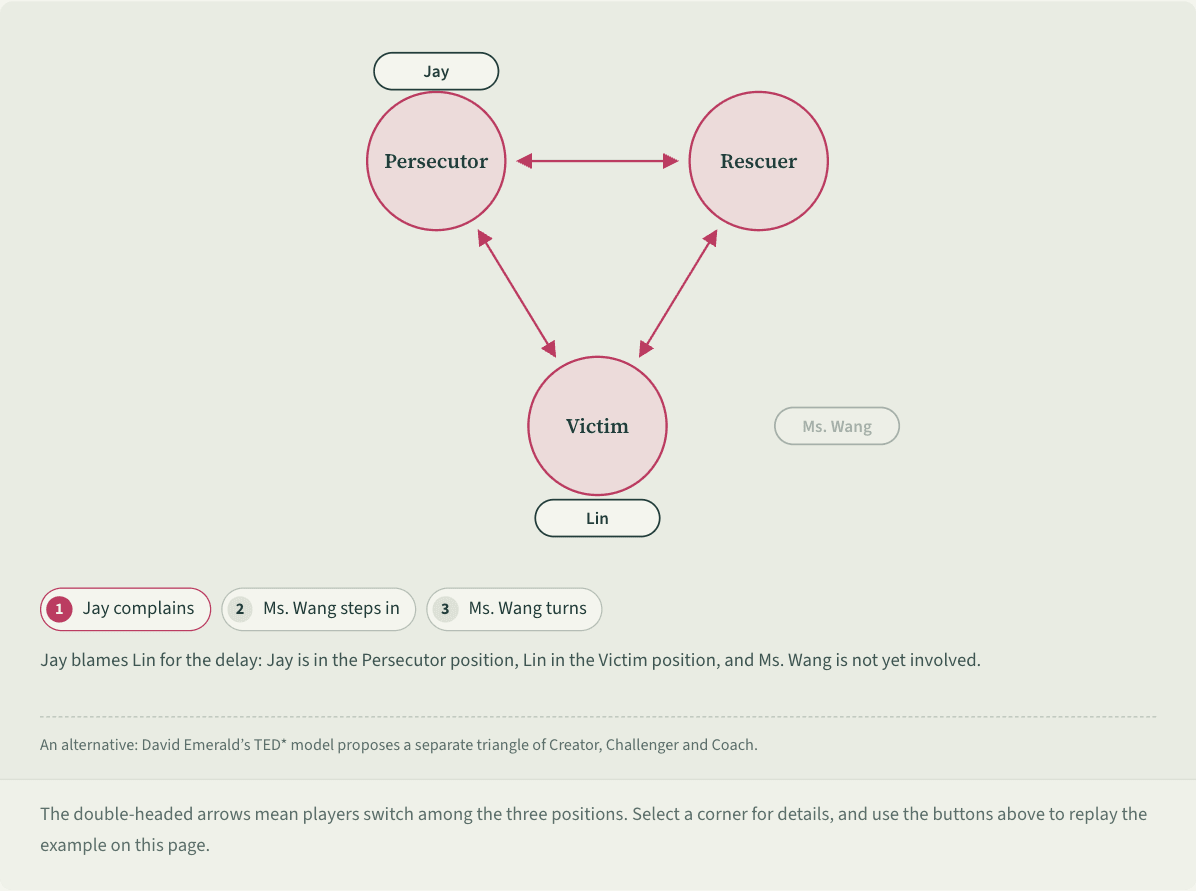
A triangle whose corners are Persecutor, Rescuer and Victim, with double-headed arrows on all three sides. Three name tags (Jay, Lin, Ms. Wang) move with the buttons. Step 1: Jay at Persecutor, Lin at Victim, Ms. Wang outside the triangle. Step 2: Ms. Wang enters at Rescuer. Step 3: Ms. Wang moves to Persecutor, Jay leaves the triangle, and Lin stays at Victim. A note below mentions David Emerald’s TED* model, an alternative triangle of Creator, Challenger and Coach.
 Save as image (PNG)
Key points
- The three roles are Persecutor, Rescuer and Victim. Karpman treats them as positions in an interaction, and players often switch among them.[2]
- Switching corners is not the same as leaving the triangle: someone who moves from Victim to Persecutor is still inside the drama.[2]
- The model grew out of TA script analysis and borrows the character roles of fairy tales and family stories.[1][2]
- David Emerald’s The Empowerment Dynamic (TED*) proposes an alternative triangle of Creator, Challenger and Coach.[3]
An example
Jay complains that his colleague Lin is holding up the project. Lin goes to their manager, Ms. Wang, upset, and Ms. Wang takes over Lin’s work. A week later, worn out, Ms. Wang criticizes Lin for always leaning on others: she has moved from Rescuer to Persecutor.
Misreadings and limits
The triangle is a descriptive tool for looking at interactions, not a label for people. Karpman says it began as a playful diagram that spread by word of mouth, and his papers rest on case examples and analogy rather than research data.[2]
Sources
- 1 Karpman, S. B. (1968). Fairy tales and script drama analysis. Transactional Analysis Bulletin, 7(26), 39–43. View source
- 2 Karpman, S. B. (2019). Script drama analysis II. International Journal of Transactional Analysis Research & Practice, 10(1), 21–39. doi:10.29044/v10i1p21
- 3 Emerald, D. (2015). The power of TED* (*The empowerment dynamic) (3rd ed.). Polaris Publishing. View source
Last checked against sources: October 26, 2026