Inner child
内在小孩
The inner child is a self-help concept from the late 1980s for the part of a person that holds childhood vitality and hurt. Whitfield’s 1987 book launched the movement, and Bradshaw’s 1990 book made it widely popular.[1][3]
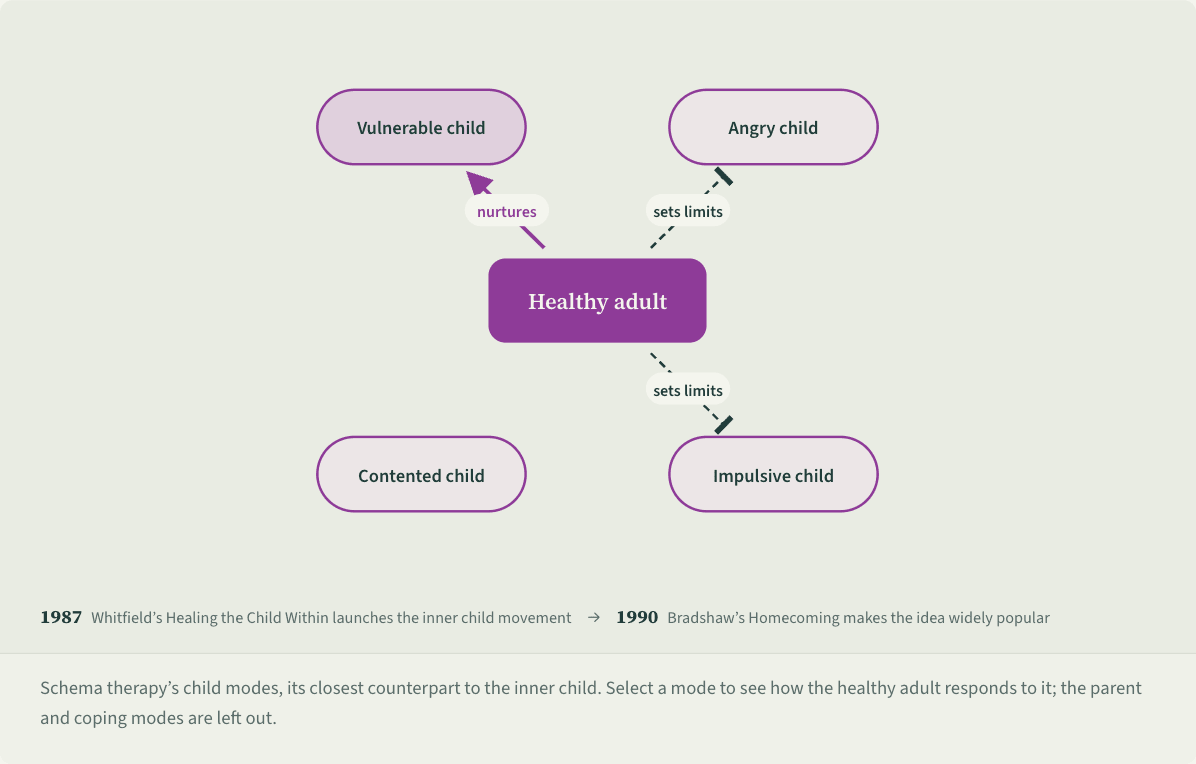
1987 Whitfield’s Healing the Child Within launches the inner child movement 1990 Bradshaw’s Homecoming makes the idea widely popular
A filled box in the middle reads “Healthy adult,” with a rounded box in each corner: Vulnerable child, Angry child, Impulsive child, Contented child. A solid arrow labeled “nurtures” runs from the healthy adult to the vulnerable child; dashed lines ending in a bar, labeled “sets limits,” run to the angry and impulsive child; there is no link to the contented child. A strip below notes that Whitfield’s 1987 book launched the inner child movement and Bradshaw’s 1990 book made it widely popular.
 Save as image (PNG)
Key points
- Whitfield described the child within as the part of us that is truly alive and creative, buried by trauma and loss, and argued that recovering it eases adult fear and unhappiness.[1]
- Bradshaw wrote of a “wounded inner child” and proposed revisiting each developmental stage to supply the parenting you missed, using letters, meditations and other exercises.[2]
- Bradshaw’s work drew largely on the Jungian archetype of the “wonder child”; in therapy, clients are guided through childhood traumatic events to rework the emotions tied to them.[3]
- Schema therapy has a related idea, child modes: vulnerable, angry, impulsive and contented child. The “healthy adult” mode nurtures the vulnerable child and sets limits on the angry and impulsive ones.[4]
An example
After his manager criticizes him in front of the team, Jay feels low all evening and remembers his father scolding him over a bad exam as a boy. In his journal he writes a few comforting lines to “that kid back then,” and gradually settles down.
Misreadings and limits
Popular accounts often picture the inner child as innocent and needing only comfort. Schema therapy distinguishes several child modes, and for the angry and impulsive ones the healthy adult’s job is to set limits, not only to soothe.[4]
Sources
- 1 Whitfield, C. L. (1987). Healing the child within: Discovery and recovery for adult children of dysfunctional families. Health Communications. View source
- 2 Bradshaw, J. (1990). Homecoming: Reclaiming and championing your inner child. Bantam. View source
- 3 Nance, N. (2015). Inner child therapy. In The SAGE encyclopedia of theory in counseling and psychotherapy (pp. 538–539). SAGE Publications. doi:10.4135/9781483346502.n186
- 4 Young, J. E., & First, M. (2003). Schema mode listing. Schema Therapy Institute. View source
Last checked against sources: October 26, 2026