Codependency
共依存
Codependency first described partners and families of people with drinking problems, who organized their lives around the drinker and unintentionally kept the drinking going. It later came to mean a broader pattern built on caretaking and excessive responsibility for others.[2][3]
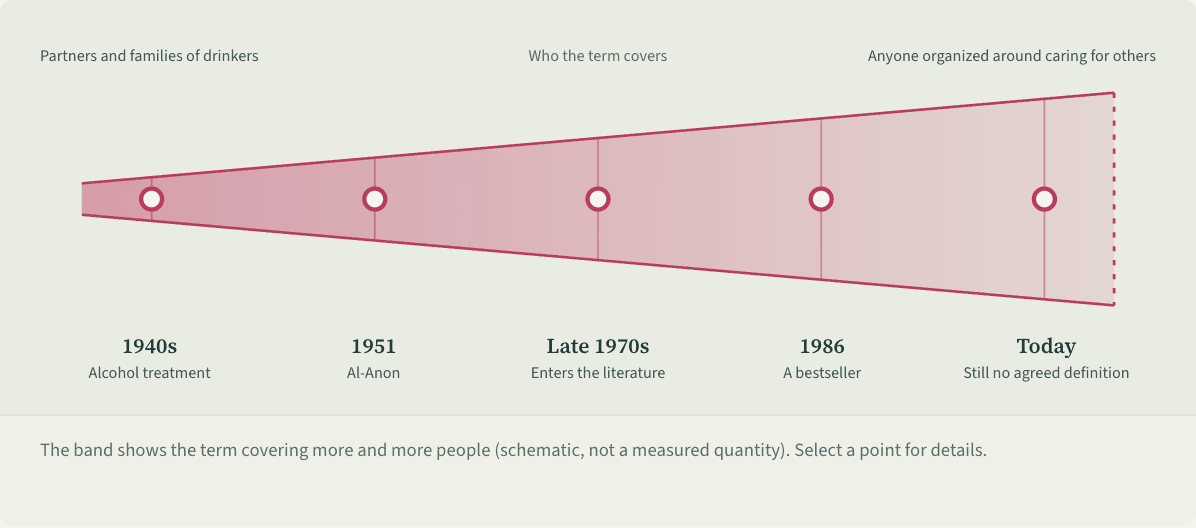
A band that widens from left to right. The left end is labeled “Partners and families of drinkers,” the right end “Anyone organized around caring for others.” Five points along it: 1940s, descriptions of alcoholics’ wives in US treatment; 1951, Al-Anon is founded and names “enabling”; late 1970s, the word enters the mental health literature; 1986, Beattie’s bestselling self-help book; today, no agreed definition and not in the DSM-5.
 Save as image (PNG)
Key points
- The idea grew out of US substance-misuse treatment, where early descriptions focused on alcoholics’ wives; the term entered the mental health literature in the late 1970s.[2][3]
- Melody Beattie’s 1986 best-selling self-help book describes the codependent as obsessed with controlling another’s behavior, and drew many people to support groups.[1][2][3]
- There is no agreed definition or set of diagnostic criteria, and it is not listed in the DSM-5.[2]
- In one interview study, eight self-identified codependents described an unclear sense of self and ongoing imbalance across emotional, relational and work life, which they traced to parental abandonment and control in childhood.[2]
An example
Ms. Wang’s husband often misses work after drinking. She calls in sick for him, pays off his credit card and hides it from relatives. Her energy goes into keeping him in line, and her own hobbies and friendships slowly fall away.
Misreadings and limits
Critics argue the concept is so broad it fits almost anyone who cares for others, and that it may pathologize a feminine identity built on caretaking; others worry the label can trap people in a sick role.[2][3]
Sources
- 1 Beattie, M. (1986). Codependent no more: How to stop controlling others and start caring for yourself. Hazelden. View source
- 2 Bacon, I., McKay, E., Reynolds, F., & McIntyre, A. (2018). The lived experience of codependency: An interpretative phenomenological analysis. International Journal of Mental Health and Addiction. doi:10.1007/s11469-018-9983-8
- 3 Haaken, J. (1990). A critical analysis of the co-dependence construct. Psychiatry, 53(4), 396–406. doi:10.1080/00332747.1990.11024522
Last checked against sources: October 26, 2026